Slovakia confirms mandatory B2B and B2G eFaktúra from 1 January 2027
- Jurisdiction
- Slovakia
- Tax
- VAT
- Change type
- E-invoicing
- Status
- Enacted
- Impact
- Plan ahead
- Announced
- 7 July 2026
- Effective
- 1 January 2027
- Instrument
- SK-LAW-385-2025
- Authority
- Finančná správa Slovenskej republiky
- Systems
- Invoicing, ERP, Tax engine
- Verified
- Fetched from official source · high confidence
Slovak VAT payers and taxable persons issuing domestic B2B or B2G invoices. B2C invoicing is out of scope.
Slovak businesses should select a certified delivery-service provider from the Financial Administration list and be able to issue and receive EN 16931 XML invoices via Peppol before 1 January 2027.
InvoicingERPTax engine
Zákon č. 385/2025 Z. z., amending the Slovak VAT Act (č. 222/2004 Z. z.), makes domestic B2B and B2G electronic invoicing (eFaktúra) mandatory from 1 January 2027, with a transitional period running from 1 January 2026 to 31 December 2026; B2C invoicing is out of scope. Invoices must be structured XML conforming to EN 16931 (UBL or CII) and routed through accredited Peppol-connected certified delivery-service providers. The Financial Administration published FAQ 9/DPH/2025/IM on 7 July 2026 and an updated list of certified delivery-service providers on 22 July 2026. Cross-border EU B2B e-invoicing is planned for 2030 under ViDA.
What changed in detail
Zákon č. 385/2025 Z. z., amending the Slovak VAT Act (č. 222/2004 Z. z.), makes domestic B2B and B2G electronic invoicing — eFaktúra — mandatory from 1 January 2027, with a transitional period running from 1 January 2026 to 31 December 2026. B2C invoicing is out of scope.
Invoices must be structured XML conforming to EN 16931 in either the UBL or the CII syntax, and are routed through accredited Peppol-connected certified delivery-service providers rather than to a state platform directly. From 1 January 2027 a VAT payer must issue the invoice as an electronic document capable of automated processing and conforming to EN 16931 and its syntaxes — so EDI formats such as EDIFACT require conversion into a conforming format. Invoices must be retained for ten years from the end of the calendar year to which they relate.
The Financial Administration published FAQ 9/DPH/2025/IM on 7 July 2026 and an updated list of certified delivery-service providers on 22 July 2026. Cross-border EU B2B e-invoicing is planned for 2030 under ViDA.
What it means
Slovakia has chosen the “digital postman” model: you do not connect to the state, you connect to an accredited provider that does. Provider selection is therefore the long-lead item, and the certified list only stabilised in July 2026 — which means anyone who chose a provider earlier should re-check it against the current list.
The EDI point is the quiet trap. Existing EDIFACT flows do not stop working, but they stop being sufficient on their own: the conforming EN 16931 document is what discharges the obligation, so conversion has to sit inside the invoicing path rather than alongside it.
Proof
1 5 Existuje prechodné obdobie na zavedenie elektronickej fakturácie? Odpoveď Prechodné obdobie pre zavedenie tuzemskej elektronickej fakturácie je od 1. januára 2026 do 31. decembra 2026 . V tomto období môžu subjekty dobrovoľne vyhotovovať elektronické faktúry a doručovať ich prostredníctvom D igitálneho poštára, ak má aj ich odberateľ D igitálneho poštára. Príklad č.Current and upcoming deadlines: the transitional period in Slovakia will run from 1 January 2026 to 1 January 2027. The obligation to invoice B2B and B2G transactions in Slovakia will apply from 1 January 2027. Cross-border electronic invoicing is planned from 2030.
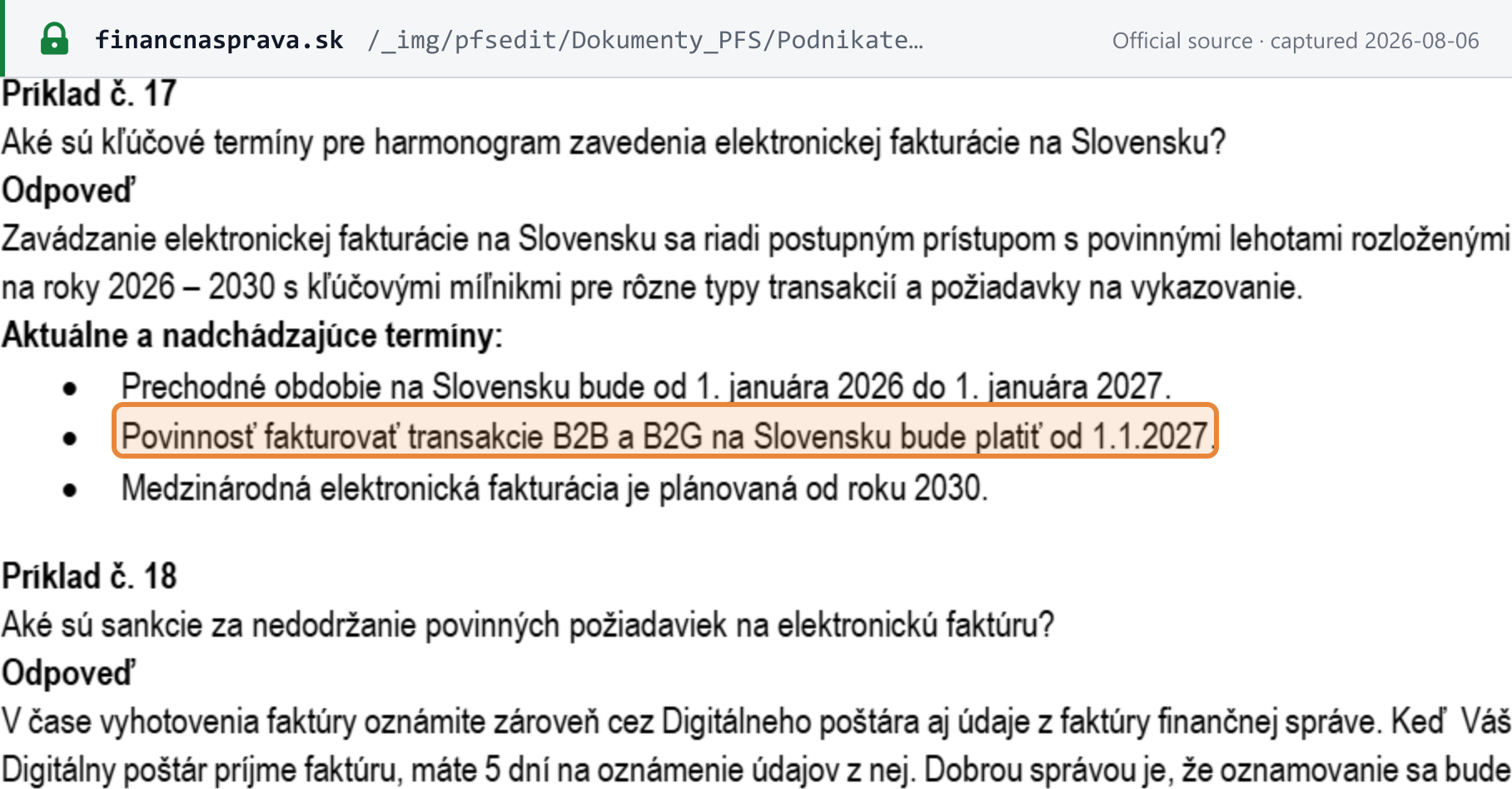 Source snapshot of the official page. Open full size ↗