DRAFT: South Africa proposes letting a Budget VAT-rate announcement take effect for 12 months before Parliament confirms it
This change is proposed and is not law. The rules below describe what would change if it is adopted.
This page records one dated change. For the rules in South Africa as they stand today, see the South Africa guide →
- Jurisdiction
- South Africa
- Tax
- VAT
- Change type
- Rate change
- Status
- Proposed
- Impact
- Watch
- Announced
- 30 July 2026
- Instrument
- ZA-DTLAB-2026
- Authority
- South African Revenue Service (SARS)
- Systems
- Tax engine
- Verified
- Fetched from official source · high confidence
All VAT vendors and the systems that apply South African VAT rates. If enacted as drafted, a rate change the Minister announces in the national Budget would become effective from a date the Minister determines, ahead of Parliament passing the confirming Act.
No action — monitoring only. This is a draft bill published for comment. If enacted, a VAT rate change announced in the Budget would take effect from the date the Minister determines and hold for 12 months pending confirming legislation.
Tax engine
SARS and National Treasury published the Draft Taxation Laws Amendment Bill, 2026 for public comment on 30 July 2026. It would substitute section 7(4) of the Value-Added Tax Act, 1991, so that where the Minister announces in the national annual budget that the VAT rate is to be altered, that alteration is effective from a date determined by the Minister in the announcement and continues to apply for 12 months from that date, subject to Parliament passing legislation giving effect to the announcement within that period.
What changed in detail
This is a draft bill published for public comment — not law. SARS and National Treasury published the Draft Taxation Laws Amendment Bill, 2026 for comment on 30 July 2026. As drafted, it would substitute section 7(4) of the Value-Added Tax Act, 1991: where the Minister announces in the national annual Budget that the VAT rate is to be altered, that alteration would be effective from a date the Minister determines in the announcement itself, and would continue to apply for 12 months from that date — subject to Parliament passing legislation giving effect to the announcement within that 12-month period. No effective date has been set, and the mechanism has not been enacted.
What it means
This is the same mechanism South Africa’s 2025 VAT-rate-increase litigation turned on: whether a Ministerial Budget announcement can make a rate change legally effective before Parliament has actually passed a confirming Act, and what happens if Parliament doesn’t. That episode showed the gap is not hypothetical — the announced increase had to be reversed after legal challenge. This draft would write an explicit statutory mechanism, with a 12-month backstop, into section 7(4) rather than leaving the question to be litigated again. It is not yet law, and businesses should not build rate-change readiness around a Budget speech alone until this bill, or something like it, is enacted.
Proof
that alteration will be effective from a date determined by the Minister in that announcement, and continues to apply for a period of 12 months from that date subject to Parliament passing legislation giving effect to that announcement within that period of 12 months.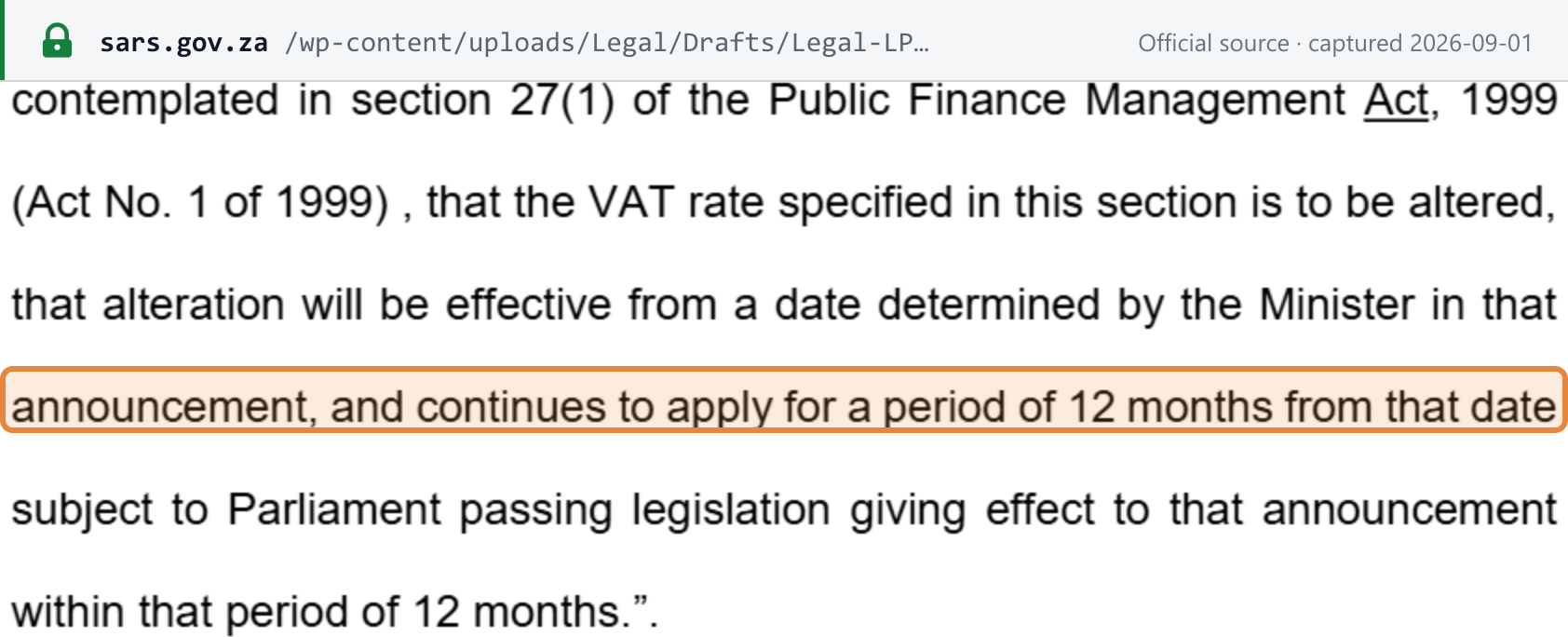 Source snapshot of the official page. Open full size ↗
Archived from the official distribution · www.sars.gov.za