South Africa raises its VAT registration threshold to R2.3 million, residents and foreign digital suppliers alike
This page records one dated change. For the rules in South Africa as they stand today, see the South Africa guide →
- Jurisdiction
- South Africa
- Tax
- VAT
- Change type
- Threshold
- Status
- In force
- Impact
- Action required
- Announced
- 25 February 2026
- Effective
- 1 April 2026
- Authority
- South African Revenue Service (SARS)
- Systems
- Tax engine, E-commerce, Reporting
- Verified
- Fetched from official source · high confidence
Every enterprise supplying into South Africa: resident vendors testing the general R2.3 million trigger, and non-resident suppliers of electronic services testing the same figure under section 23(1A).
Re-test South African VAT registration against R2.3 million over 12 months — this applies to resident vendors and non-resident electronic-services suppliers alike. Vendors registered solely because they exceeded R1 million may now qualify to deregister.
Tax engineE-commerceReporting
South Africa raised its VAT registration thresholds with effect from 1 April 2026. Clause 20 of the 2026 Draft Rates and Monetary Amounts and Amendment of Revenue Laws Bill substitutes R2.3 million for R1 million in both section 23(1)(a) of the Value Added Tax Act 89 of 1991 — the general compulsory registration threshold — and section 23(1A), the threshold for non-resident suppliers of electronic services, and substitutes R120,000 for R50,000 as the voluntary registration threshold in section 23(3)(b). SARS applies all three figures from 1 April 2026 and has updated its Register for VAT page and the VAT101 form accordingly, and its dedicated guide for foreign suppliers (VAT-REG-02-G02) states that the section 23(1A) threshold "was increased to R2,3 million" effective 1 April 2026. The measure was announced in the Budget on 25 February 2026; the Rates Bill remains a draft published for public comment (comments closed 26 June 2026) and has not been introduced in Parliament.
What changed in detail
Clause 20 of the 2026 Draft Rates and Monetary Amounts and Amendment of Revenue Laws Bill substitutes R2.3 million for R1 million in both section 23(1)(a) of the Value-Added Tax Act 89 of 1991 — the general compulsory registration threshold — and section 23(1A), the threshold for non-resident suppliers of electronic services. It also substitutes R120,000 for R50,000 as the voluntary registration threshold in section 23(3)(b).
SARS applies all three figures from 1 April 2026. Its Register for VAT page and the VAT101 form have been updated, and its dedicated guide for foreign suppliers (VAT-REG-02-G02) states that the section 23(1A) threshold “was increased to R2,3 million” with effect from that date.
The measure was announced in the Budget on 25 February 2026. The Rates Bill itself remains a draft published for public comment — comments closed 26 June 2026 — and had not been introduced in Parliament at the date of this record.
What it means
This is broader than it first looks, and it is not only a digital-services measure. The general R1 million trigger had stood for years, so more than doubling it takes a large band of resident vendors out of compulsory registration alongside modest foreign digital suppliers. Anyone registered solely because they crossed R1 million should test whether they can now deregister.
Be precise about the legal basis, though. SARS is administering figures that sit in a document still watermarked DRAFT and not yet tabled. That is normal South African budget practice, and the administrative position is what a vendor is assessed against — but it is not the same as enacted law, and it is worth citing the SARS page rather than the Bill when explaining why you did not register.
Proof
Non-resident suppliers of certain electronic services are also liable for compulsory VAT registration at the end of the month in which the total value of taxable supplies exceeds R2.3 million.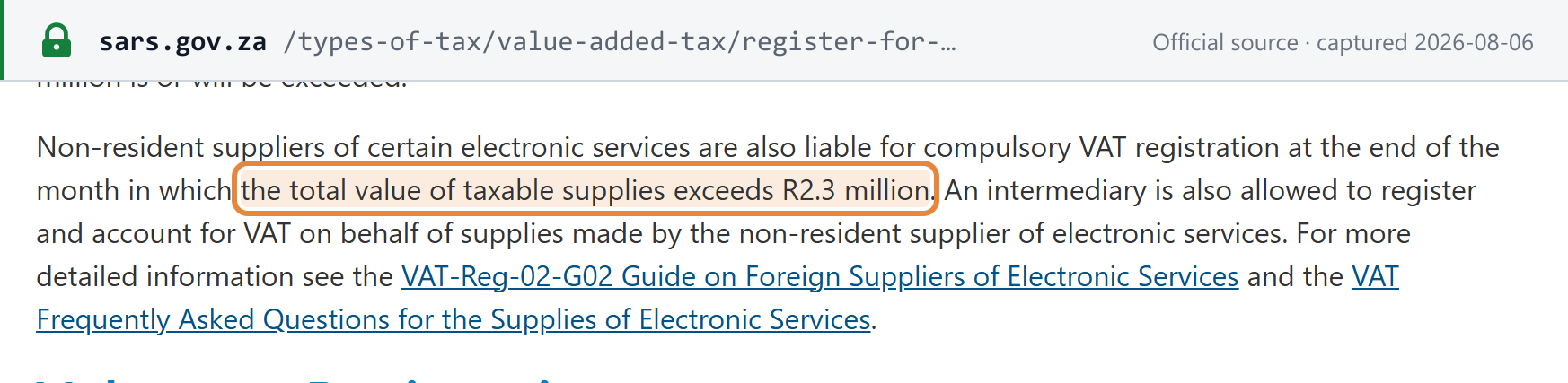 Source snapshot of the official page. Open full size ↗
at the end of any month where the total value of taxable supplies made by that person in the period of 12 months ending at the end of that month in the course of carrying on all enterprises has exceeded [R1 million] R2,3 million;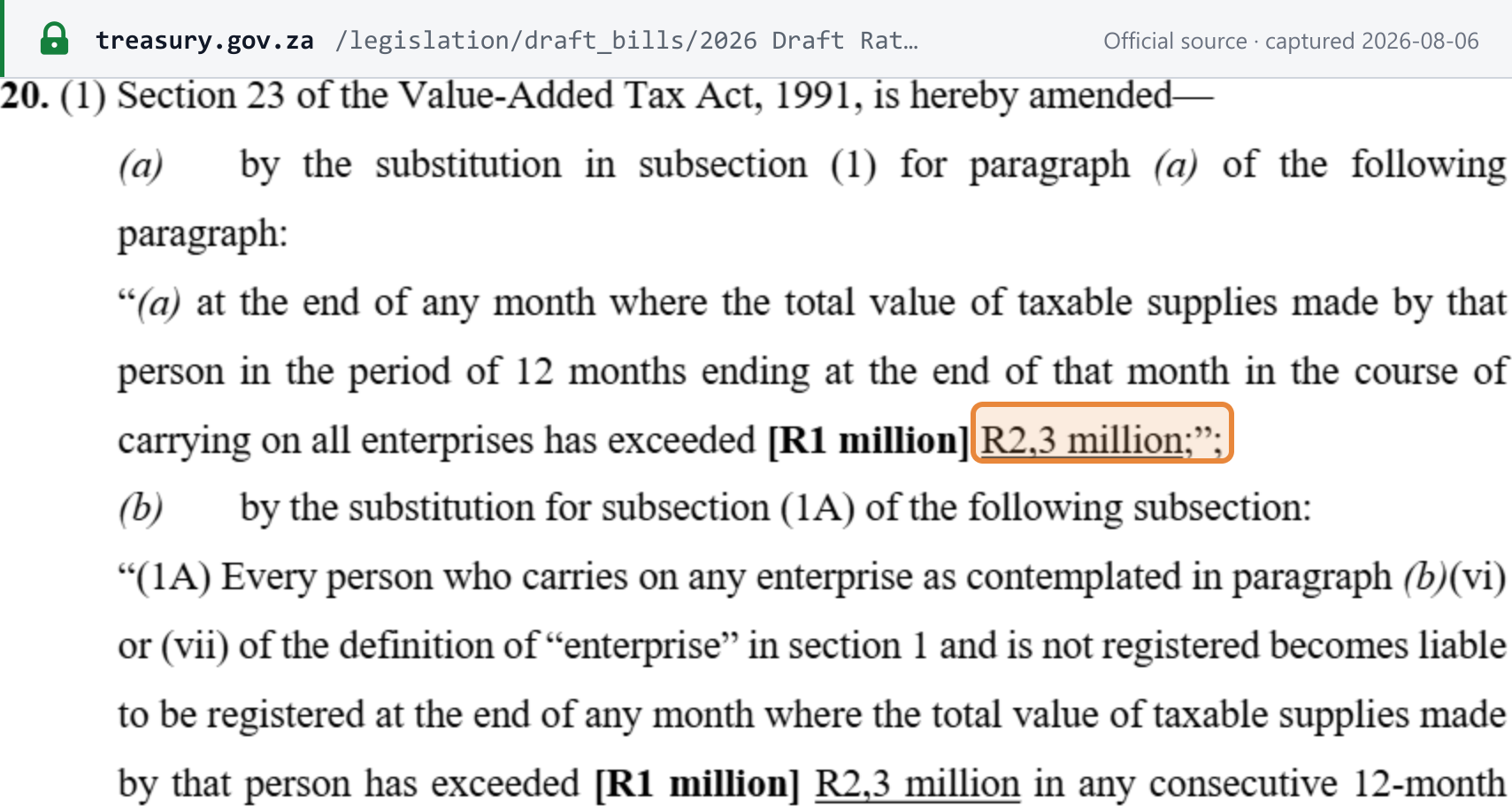 Source snapshot of the official page. Open full size ↗