South Korea's tax invoice field renaming would apply from 1 July 2027, detailed proposal confirms
This change is proposed and is not law. The rules below describe what would change if it is adopted.
- Jurisdiction
- South Korea
- Tax
- VAT
- Change type
- Invoice rules
- Status
- Proposed
- Impact
- Plan ahead
- Announced
- 3 August 2026
- Effective
- 1 July 2027
- Authority
- Ministry of Finance and Economy (Republic of Korea) / 재정경제부
- Systems
- Invoicing, ERP
- Verified
- Fetched from official source · high confidence
Korean VAT-registered businesses issuing tax invoices and statements — if enacted, invoice templates and field mappings keyed to '작성연월일' (date of preparation) or '공급연월일' (date of supply) would need updating for documents issued on or after 1 July 2027.
Plan Korean tax-invoice field mapping for the renamed date fields applying to invoices issued on or after 1 July 2027.
InvoicingERP
South Korea's 2026 Tax Reform Proposal (issued by the Ministry of Finance and Economy, Jaejeong-gyeongjebu, 3 August 2026 -- not the Ministry of Economy and Finance as recorded in the W33 write-up) proposes renaming tax-invoice and statement entry fields under VAT Act Article 32, VAT Decree Article 67 and Income Tax Decree Articles 211/212-4: the mandatory field '작성연월일' (date of preparation) is renamed '공급연월일' (date of supply), and the existing optional '공급연월일' field is renamed '발급일' (issue date). The detailed proposal document states this change applies to tax invoices and statements issued on or after 1 July 2027.
What changed in detail
This is a proposal, not enacted law. South Korea’s Ministry of Finance and Economy (재정경제부) published the 2026 Tax Reform Proposal on 3 August 2026, including a plan to rename two mandatory tax-invoice and statement fields under VAT Act Article 32, VAT Decree Article 67, and Income Tax Decree Articles 211 and 212-4: the current mandatory field “작성연월일” (date of preparation) would become “공급연월일” (date of supply), and the existing optional “공급연월일” field would become “발급일” (issue date). The detailed proposal document — a separate, more granular document from the outline version published the same day — states that this applies to tax invoices and statements issued on or after 1 July 2027.
An earlier record of this proposal carried no application date, because that date appears only in the detailed proposal, not the outline. It also attributed the proposal to the wrong ministry name; the issuing body is the Ministry of Finance and Economy (재정경제부), not the Ministry of Economy and Finance.
What it means
Nothing to configure yet — this has not cleared the National Assembly. If enacted as proposed, the swap is easy to implement wrong precisely because it relabels dates that already exist rather than adding a new field: a system that keys off current field names by label, rather than by field position, would point the renamed labels at the wrong date once the change lands. Track this toward 1 July 2027 rather than the broader 2026 reform-package timeline.
Proof
<적용시기> ’27.7.1. 이후세금계산서·계산서를발급하는분부터적용<Application timing> Applies to tax invoices and statements issued on or after 1 July 2027.
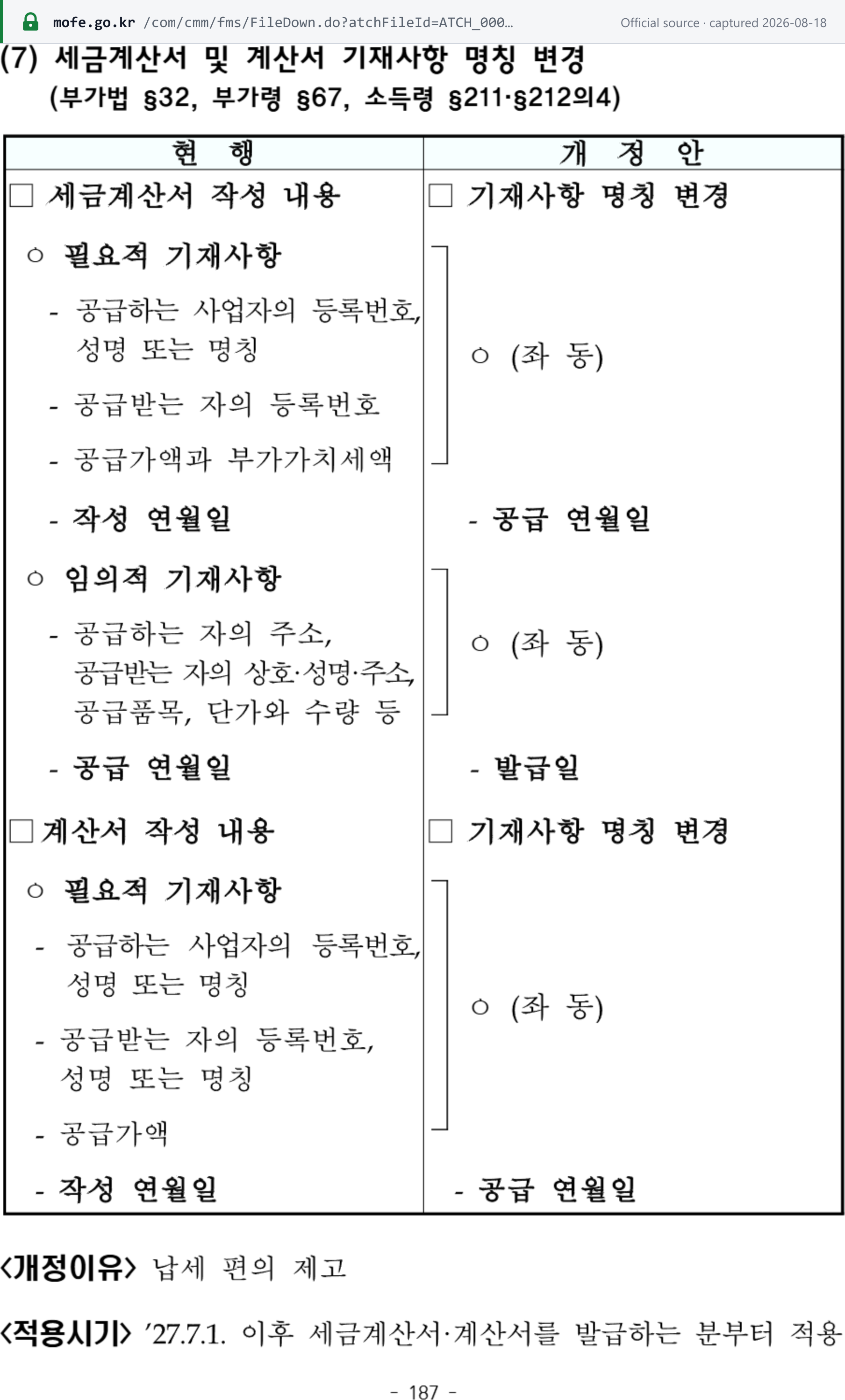 Source snapshot of the official page. Open full size ↗
Archived from the official distribution · 2026년 세제개편안 상세본 (2026 Tax Reform Proposal, Detailed Version) · Ministry of Finance and Economy, 3 August 2026 · printed p.187 (PDF p.200 of 250) · www.mofe.go.kr