Sri Lanka sets the non-resident digital-services VAT trigger at LKR 60 million
This page records one dated change. For the rules in Sri Lanka as they stand today, see the Sri Lanka guide →
- Jurisdiction
- Sri Lanka
- Tax
- VAT
- Change type
- Digital services
- Status
- In force
- Impact
- Action required
- Effective
- 1 July 2026
- Authority
- Inland Revenue Department, Sri Lanka
- Systems
- Tax engine, E-commerce, Invoicing
- Verified
- Fetched from official source · high confidence
Non-resident suppliers of digital services to Sri Lankan consumers, and platforms assessing whether they cross the registration trigger.
Correct the tax-changes record to LKR 60 million (12-month) / LKR 15 million (quarterly) for non-resident digital-service-provider VAT registration in Sri Lanka, effective 1 July 2026.
Tax engineE-commerceInvoicing
CORRECTION to the W18 report: the enacted Value Added Tax (Amendment) Act, No. 14 of 2026 (certified 30 June 2026) sets the non-resident digital-services VAT registration trigger at LKR 60 million in a trailing 12-month period OR LKR 15 million in any calendar quarter (new section 25L, Chapter IIIC, effective 1 July 2026) -- not the bill's LKR 36 million / LKR 9 million figures that W18 reported as enacted. The bill text (Bill No. 65, same section 25L as originally drafted) used 'thirty six million rupees' and 'nine million rupees'; the enacted Act replaced both figures with 'sixty million rupees' and 'fifteen million rupees' respectively before passage.
What changed in detail
A non-resident supplier of digital services to Sri Lankan consumers must register for VAT once its supplies exceed LKR 60 million in a trailing 12-month period, or LKR 15 million in any calendar quarter. The trigger sits in new section 25L, Chapter IIIC of the Value Added Tax (Amendment) Act, No. 14 of 2026, certified 30 June 2026, and applies from 1 July 2026.
The bill as drafted set the trigger at LKR 36 million and LKR 9 million. Both figures were replaced before passage — the enacted section reads “sixty million rupees” and “fifteen million rupees”.
What it means
The enacted trigger is materially higher than the drafted one, so the population of non-resident suppliers that has to register is smaller than the bill implied. A supplier sitting between LKR 36 million and LKR 60 million was in scope under the bill and is out of scope under the Act.
The quarterly test is the one to automate. An annual trailing test is easy to monitor once a year and easy to breach unnoticed inside a quarter, and the quarterly figure is a quarter of the annual one — so a supplier with an uneven year can cross the quarterly trigger without ever approaching the annual one.
Proof
Notwithstanding anything to the contrary in section 10, a non-resident person who supplies services through an electronic platform to a person in Sri Lanka (hereinafter referred to as the “digital services”) shall be required to be registered under this Act, if – ( a ) on or after July 1, 2026, the total value of the supply of such services, within the twelve months period then ending has exceeded sixty million rupees or an equivalent to that in any other currency;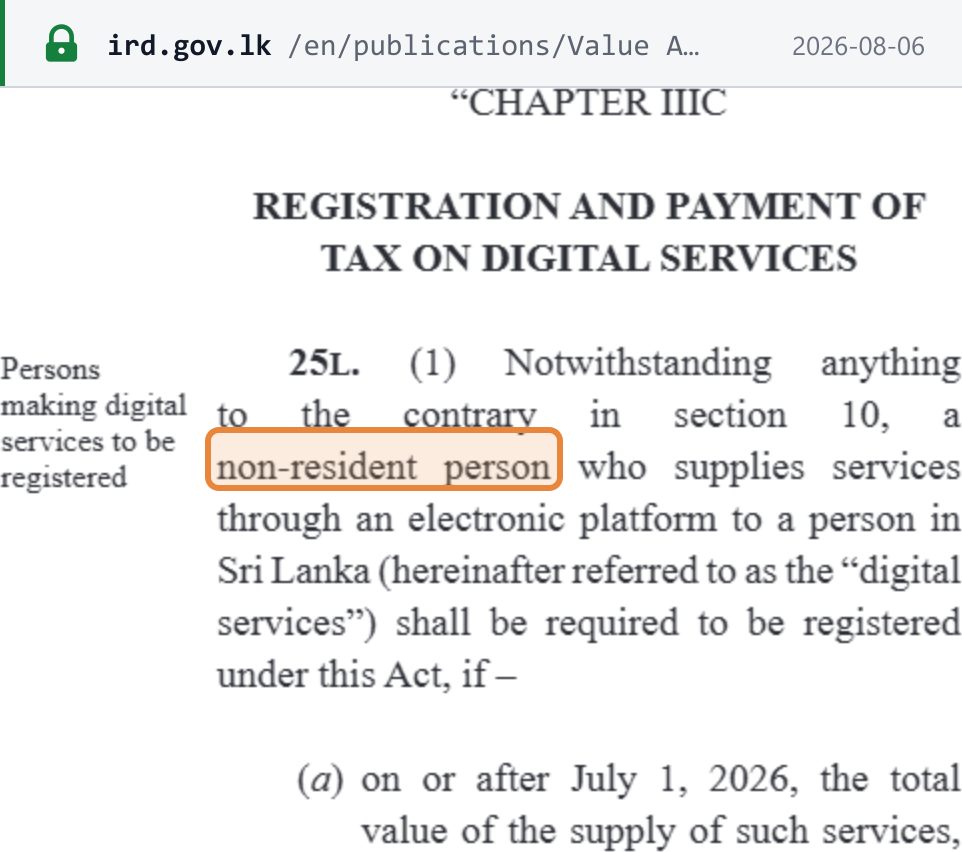 Source snapshot of the official page. Open full size ↗
Sources
What this replaces
- Sri Lanka taxes non-resident digital services at 18% effective 1 July 2026