Sri Lanka makes a new VAT tax invoice format binding from 1 July 2026
This page records one dated change. For the rules in Sri Lanka as they stand today, see the Sri Lanka guide →
- Jurisdiction
- Sri Lanka
- Tax
- VAT
- Change type
- Compliance
- Status
- In force
- Impact
- Action required
- Announced
- 20 May 2026
- Effective
- 1 July 2026
- Authority
- Inland Revenue Department, Sri Lanka
- Systems
- ERP, Invoicing, Tax engine, Reporting
- Verified
- Fetched from official source · high confidence
Every VAT-registered person in Sri Lanka issuing a tax invoice for a taxable supply — domestic and cross-border alike.
Update invoicing templates/ERP systems to the mandatory Tax Invoice format (header, TIN fields, YYMMM_QQQQ_XXXXX serial numbering, dual dates, VAT value breakdown) by 1 July 2026, or apply for RAMIS Web API integration approval before that date to use the relaxed serial-number rule (integration due by 31 December 2026); non-compliant invoices risk rejection for input VAT credit.
ERPInvoicingTax engineReporting
Sri Lanka's Inland Revenue Department implemented a revised, legally binding VAT Tax Invoice format and specification (issued under the VAT Act No. 14 of 2002 via Gazette Extraordinary No. 2481/22 of 27 March 2026), mandating a 'TAX INVOICE' header, prescribed TIN/party details, a structured serial number (YYMMM_QQQQ_XXXXX, max 40 characters), separate invoice/supply dates, and a three-line VAT value breakdown, effective from 1 July 2026, superseding the prior format under Gazette No. 2463/05. Businesses integrating ERP systems with RAMIS via Web API (approved before 1 July 2026, completed by 31 December 2026) may omit the date/branch prefix from the serial number.
What changed in detail
Circular SEC/2026/E/03, issued by the Inland Revenue Department on 20 May 2026 under the Value Added Tax Act No. 14 of 2002 and Gazette Extraordinary No. 2481/22 of 27 March 2026, makes a revised tax invoice format binding on all VAT-registered persons from 1 July 2026. The format published under Gazette No. 2463/05 was withdrawn from the same date.
Every tax invoice must now display the words “TAX INVOICE” prominently, carry the supplier’s nine-digit TIN, registered name and registered address exactly as they appear on the VAT registration certificate, and — where the purchaser is registered — the purchaser’s TIN, name and address. Two dates are required and must be distinguished: the invoice date and the date of supply.
The serial number follows the structure YYMMM_QQQQ_XXXXX — a two-digit year, a three-letter month, a 1-to-15-character classification code that may identify a branch, department, project, customer or invoice type, and a purely numeric sequential number. The complete number must contain no spaces and must not exceed 40 characters, and sequential continuity must be maintained.
One relaxation exists. A registered person who obtained the Commissioner-General’s approval before 1 July 2026 to integrate their ERP with RAMIS through a Web API for real-time transmission of tax invoices may treat the mandatory YYMMM_QQQQ_ component as optional, provided the integration is completed on or before 31 December 2026.
What it means
This touches every Sri Lankan invoice, not just cross-border supplies, and it lands in the invoice-numbering logic rather than in tax rates — which makes it an ERP change with a hard date rather than a configuration tweak. The serial-number format is the piece to check first: it is the one requirement that cannot be satisfied by editing a template, because the 40-character ceiling and the no-spaces rule constrain the numbering scheme itself.
The RAMIS relaxation is narrower than it looks. It required an approval obtained before the go-live date, so it is not available retrospectively to anyone who missed the deadline. For everyone else the exposure is on the buy side as much as the sell side, since a non-conforming invoice risks rejection for input VAT credit — meaning your supplier’s numbering scheme becomes your recoverability problem.
Proof
The revised Tax Invoice format will be fully implemented effective from July 1, 2026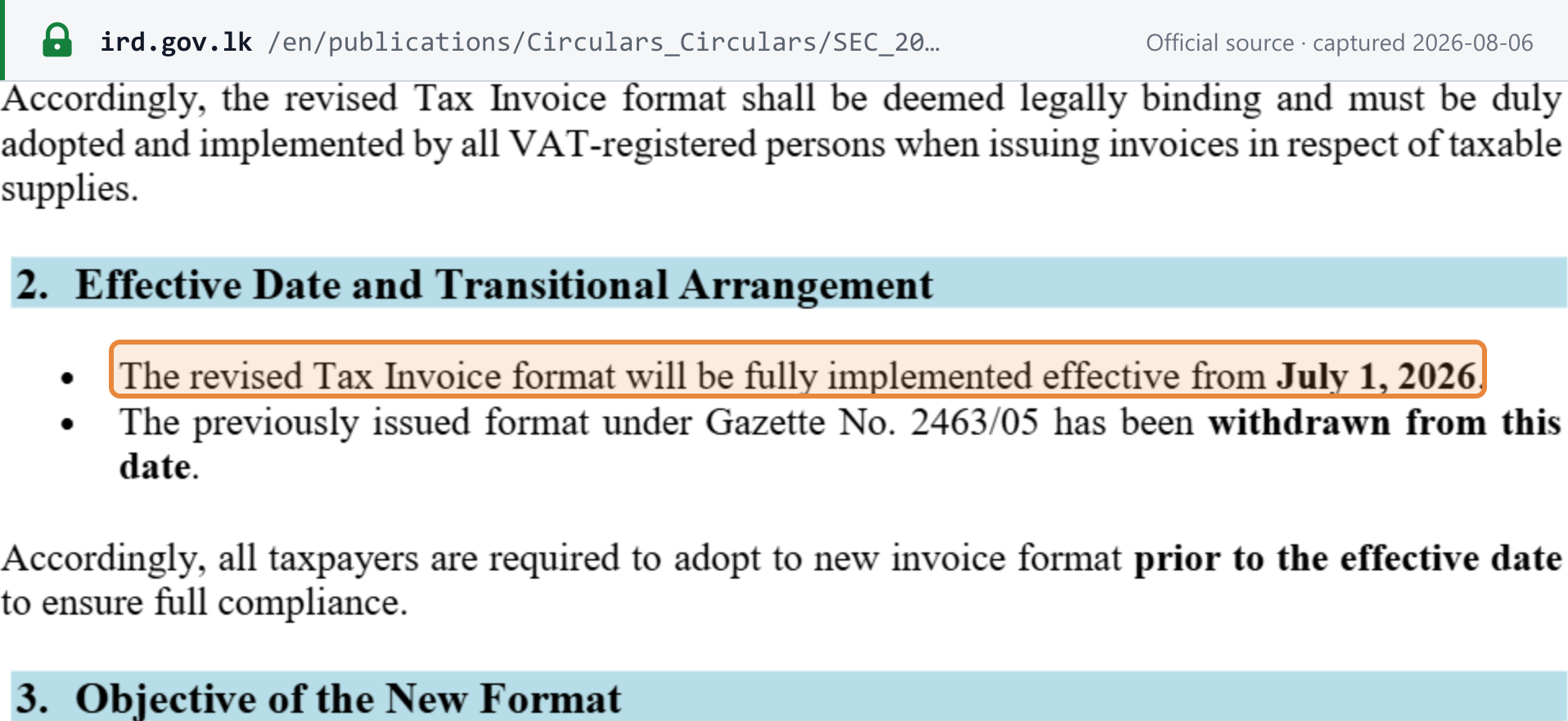 Source snapshot of the official page. Open full size ↗
The previously issued format under Gazette No. 2463/05 has been withdrawn from this date Source snapshot of the official page. Open full size ↗