Thailand's Cabinet approves in principle a draft decree to extend the 7% VAT rate — not yet law
This change is proposed and is not law. The rules below describe what would change if it is adopted.
This page records one dated change. For the rules in Thailand as they stand today, see the Thailand guide →
- Jurisdiction
- Thailand
- Tax
- VAT
- Change type
- Rate change
- Status
- Proposed
- Impact
- Action required
- Announced
- 27 July 2026
- Effective
- 1 October 2026
- Authority
- The Revenue Department (Thailand)
- Systems
- ERP, Invoicing, Tax engine, POS, E-commerce
- Verified
- Fetched from official source · high confidence
Every business charging Thai VAT — the 7% rate is not guaranteed past 30 September 2026, and no Royal Decree number has been assigned to any successor.
Do not assume the 7% Thai VAT rate continues past 30 September 2026 — no decree is gazetted yet. Keep a 10% statutory-rate fallback configurable in rate tables and re-check the Revenue Department's announcements before 1 October 2026.
ERPInvoicingTax enginePOSE-commerce
Thailand's Cabinet resolved on 27 July 2026 to approve in principle a draft Royal Decree issued under the Revenue Code concerning the reduction of the value added tax rate, extending the reduced rate of 7% (inclusive of local tax) for a further year, from 1 October 2026 to 30 September 2027. The Revenue Department states that the current reduction ends on 30 September 2026. No Royal Decree number has been assigned and the decree has not been gazetted. In a follow-up release dated 2 August 2026 the Revenue Department confirmed that VAT on general sales of goods and services continues to be collected at 7%, that essential goods including food raw materials and road transport remain VAT-exempt, and that operators with annual receipts not exceeding THB 1,800,000 remain exempt from VAT.
What changed in detail
This is a proposal, not a rule in force. Thailand’s reduced VAT rate of 7% (inclusive of local tax) is currently due to expire on 30 September 2026, reverting to the statutory 10% unless a new decree is gazetted first. On 27 July 2026, the Cabinet resolved to approve in principle a draft Royal Decree, issued under the Revenue Code, extending the 7% rate for a further year, to 30 September 2027. No Royal Decree number has been assigned and the decree has not been gazetted. A follow-up Revenue Department release dated 2 August 2026 confirmed that VAT continues to be collected at 7% for now, that essential goods such as food raw materials and road transport remain VAT-exempt, and that operators with annual receipts up to THB 1,800,000 remain exempt from VAT.
What it means
Cabinet approval in principle is a signal of intent, not an enacted rate. The legally operative fact today is that the reduction lapses on 30 September 2026 and the statutory 10% rate applies from 1 October unless a numbered decree is published before then. Thai royal decrees on this rate have historically landed close to expiry, so renewal is the base case — but any rate table that cannot fail over to 10% on 1 October has a single point of failure built into it.
Proof
คณะรัฐมนตรีมีมติเมื่อวันที่ ๒๗ กรกฎาคม ๒๕๖๙ อนุมัติหลักการร่างพระราชกฤษฎีกา ออกตามความในประมวลรัษฎากร ว่าด้วยการลดอัตราภาษีมูลค่าเพิ่ม (ฉบับที่ ..) พ.ศ.The Cabinet resolved on 27 July 2026 to approve in principle a draft Royal Decree, issued under the Revenue Code, on the reduction of the value added tax rate (No. ..), B.E. ...., extending the reduced value added tax rate of 7 percent for a further one year.
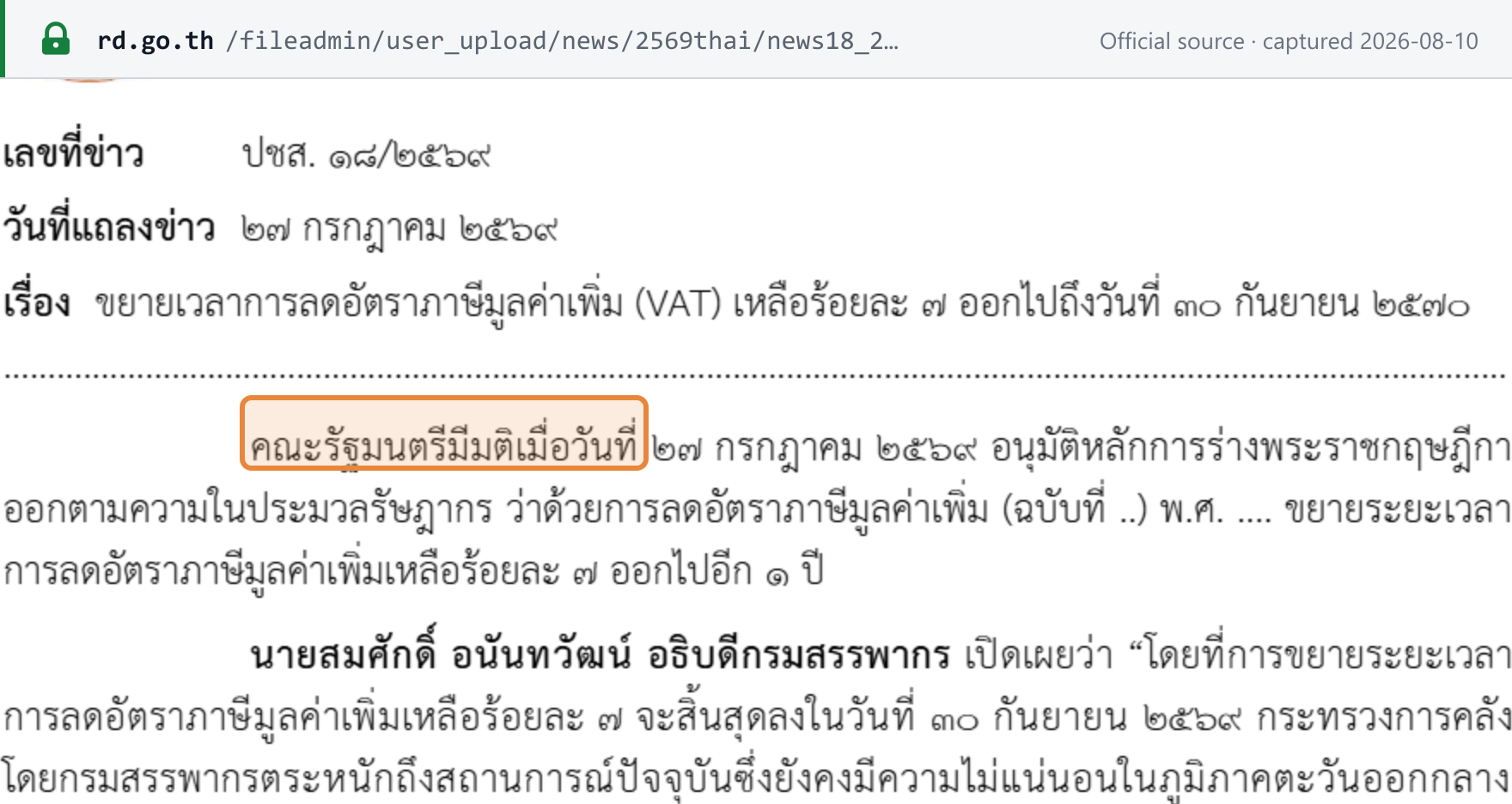 Source snapshot of the official page. Open full size ↗
Archived from the official distribution · Revenue Department press release ปชส. 18/2569, 27 July 2026 · www.rd.go.th