18 recurring Moms (VAT), Lønsumsafgift and Punktafgifter (excise duties) obligations — returns, payments and listings — each with its due rule and official source, plus the dates new Denmark rules take effect.
Dates already include the weekend and public-holiday shift where Denmark applies one — 9 of 18 obligations here do. The rest stand as computed, and each obligation's notes say which applies to it and why. Confirm against the linked official source before relying on a date.
Recurring obligations, with sources
Each deadline cites the official text that states it and the date we last verified it.
Momsangivelse — månedsafregning
Moms (VAT) · Monthly · return filing
25th of the month after the month endsVerified 2026-08-23
Who files
Businesses whose total taxable supplies exceed DKK 50,000,000 a year — monthly is compulsory at that level and momsloven § 57, stk. 2 offers no alternative — plus any business below it that has asked to file monthly. Filing and payment share this date.
Notes
The return and the payment share this date, and the money has to be credited to your skattekonto by then — a transfer started on the day is late. A nil return is still due: file 0 kr. for a period with no sales. Miss the date and Skattestyrelsen makes a provisional assessment of its own, which costs DKK 1,400 for every period you are late plus interest. The June period is the exception: that return is due 17 August, not 25 July.
“Virksomhedens angivelse efter stk. 1 skal foretages senest den 25. i måneden efter afgiftsperiodens udløb.”
Open full size Captured from Retsinformation (Civilstyrelsen) — official Danish legal information system on 2026-08-23
Momsangivelse — juni-perioden (månedsafregning)
Moms (VAT) · Monthly · return filing
17th of the 2nd month after the month endsVerified 2026-08-23
Who files
Monthly filers only — businesses with taxable supplies above DKK 50,000,000 a year, and anyone who has elected monthly filing. Quarterly and half-yearly filers absorb June into their ordinary period and have nothing extra to do.
Notes
The June VAT return is the one Danish deadline that catches people out. It is not 25 July and it is not 25 August — it is 17 August, roughly seven weeks after the period ends, so that the return does not fall in the middle of the Danish summer holiday. Everything else about it is ordinary: the payment rides the same date, a nil return is still due, and the date moves forward if it lands on a weekend or a public holiday.
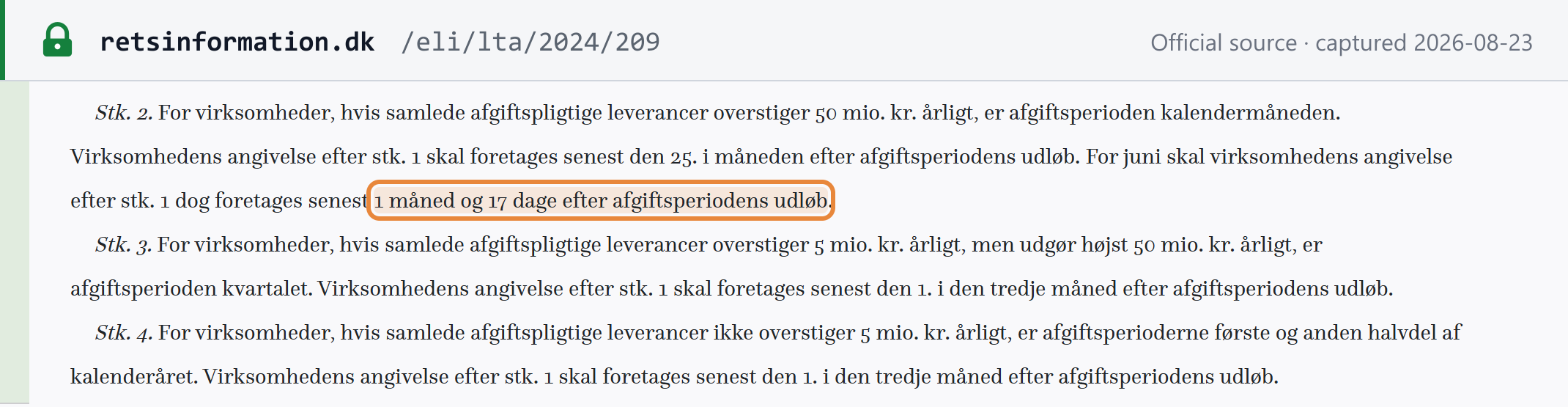
“For juni skal virksomhedens angivelse efter stk. 1 dog foretages senest 1 måned og 17 dage efter afgiftsperiodens udløb.”
Open full size Captured from Retsinformation (Civilstyrelsen) — official Danish legal information system on 2026-08-23
Momsangivelse — kvartalsafregning
Moms (VAT) · Quarterly · return filing
1st of the 3rd month after the quarter endsVerified 2026-08-23
Who files
The default band: taxable supplies over DKK 5,000,000 and up to DKK 50,000,000 a year — and every newly registered business, which momsloven § 47, stk. 6 places here automatically unless it declares expected supplies above DKK 55,000,000. Filing and payment share this date.
Notes
Two months and one day after the quarter ends — 1 June, 1 September, 1 December and 1 March. This is also where every new Danish business starts: Skattestyrelsen puts new registrants on quarterly periods automatically unless they say at registration that they expect supplies above DKK 55m. The return and the payment share the date, the money must be credited to your skattekonto by then, and a nil return is still due for a quarter with no sales.
“Virksomhedens angivelse efter stk. 1 skal foretages senest den 1. i den tredje måned efter afgiftsperiodens udløb.”
Open full size Captured from Retsinformation (Civilstyrelsen) — official Danish legal information system on 2026-08-23
Momsangivelse — halvårsafregning
Moms (VAT) · Bi-annually · return filing
1st of the 3rd month after the half-year endsVerified 2026-08-23
Who files
Businesses whose taxable supplies do not exceed DKK 5,000,000 a year AND that have filed and paid on time throughout the preceding twelve months — momsloven § 57, stk. 6 makes the clean record a condition of the longer period, not a courtesy. Filing and payment share this date.
Notes
The same due day as the quarterly band — the 1st of the third month after the period — so 1 September for the first half of the year and 1 March for the second. Getting into this band takes more than low turnover: Denmark only extends your period if you have filed and paid on time for the whole preceding twelve months, so a single late return costs you the half-yearly cycle. Return and payment share the date, and a nil return is still due.
“For virksomheder, hvis samlede afgiftspligtige leverancer ikke overstiger 5 mio. kr. årligt, er afgiftsperioderne første og anden halvdel af kalenderåret.”
Open full size Captured from Retsinformation (Civilstyrelsen) — official Danish legal information system on 2026-08-23
25th of the month after the month endsVerified 2026-08-23
Who files
Every VAT-registered business supplying goods or services to VAT-registered customers in other EU countries. Monthly is the default; quarterly reporting exists only by permission. The deadline is the 25th whatever your VAT period is, so for most filers it does not coincide with the VAT return.
Notes
Report only the months in which you actually had EU sales — unlike VAT, there is no nil filing here, and an empty period is simply left empty. The trap is that the same figure has to be entered twice, in two places, on two different dates: on your VAT return under your own band's deadline, and here by the 25th. Skattestyrelsen expects the two to agree. And this deadline does not move: 25 December 2026 is both a Friday and Christmas Day, and it is still the date. The VAT return printed directly above it on the same page does move.
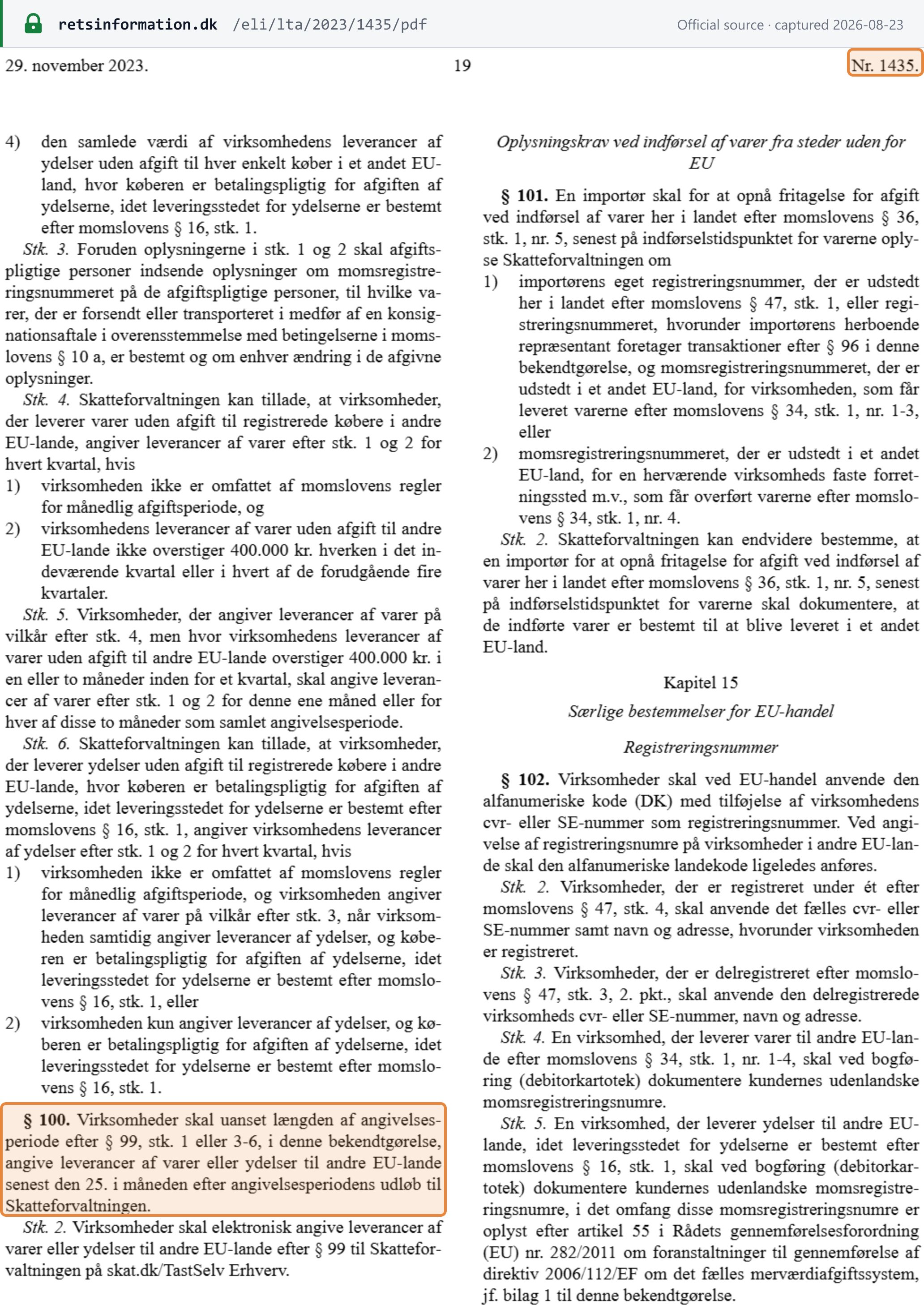
“Virksomheder skal uanset længden af angivelsesperiode efter § 99, stk. 1 eller 3-6, i denne bekendtgørelse, angive leverancer af varer eller ydelser til andre EU-lande senest den 25. i måneden efter angivelsesperiodens udløb til Skatteforvaltningen.”
Open full size Captured from Retsinformation (Civilstyrelsen) — official Danish legal information system on 2026-08-23
25th of the month after the quarter endsVerified 2026-08-23
Who files
Businesses that have been given permission to report quarterly. For goods, exempt EU supplies must stay at or below DKK 400,000 in the current quarter and in each of the preceding four, and the option is closed to a business on monthly VAT periods. A services-only reporter has no value ceiling and no such exclusion — momsbekendtgørelsen § 99, stk. 6, nr. 2 sets neither.
Notes
Quarterly reporting is granted on application, not by default, and the conditions differ by what you sell. For goods you must stay at or below DKK 400,000 of exempt EU supplies in the current quarter and in each of the four before it — break that ceiling in one or two months of a quarter and those months have to be reported on their own. A services-only reporter has no value ceiling. The date is still the 25th, and it still does not move for a weekend — five of the six quarterly dates Skattestyrelsen publishes fall on a Saturday or a Sunday and stand exactly as printed — only the last one, 25 January 2027, is a weekday.
“virksomhedens leverancer af varer uden afgift til andre EU-lande ikke overstiger 400.000 kr. hverken i det indeværende kvartal eller i hvert af de forudgående fire kvartaler.”
Open full size Captured from Retsinformation (Civilstyrelsen) — official Danish legal information system on 2026-08-23
last day of the month after the quarter endsVerified 2026-08-23
Who files
Businesses established in Denmark, and non-EU businesses with a Danish warehouse, that use Denmark as their Member State of identification for EU-scheme distance sales and cross-border B2C services. Payment rides the same date and is made through the One Stop Shop, not the skattekonto.
Notes
Quarterly, due on the last day of the month after the quarter — 30 April, 31 July, 31 October and 31 January. A nil return is due even for a quarter with no sales under the scheme, and Skattestyrelsen states in terms that the last day of the month applies whether it is a working day, a weekend or a public holiday. If you need to correct a return after filing it, the correction goes into a later return rather than a replacement, and you have three years from the original due date to make it.
last day of the month after the quarter endsVerified 2026-08-23
Who files
Businesses established outside the EU with no establishment in the EU, supplying services to consumers in the EU and registered in Denmark as their Member State of identification. Payment rides the same date and is made through the One Stop Shop.
Notes
The non-EU scheme runs on exactly the same quarterly cycle as the EU scheme — the last day of the month after the quarter, with a nil return due for a quarter with no supplies. Like the EU scheme it is a hard month-end date that is not moved for a weekend or a public holiday.
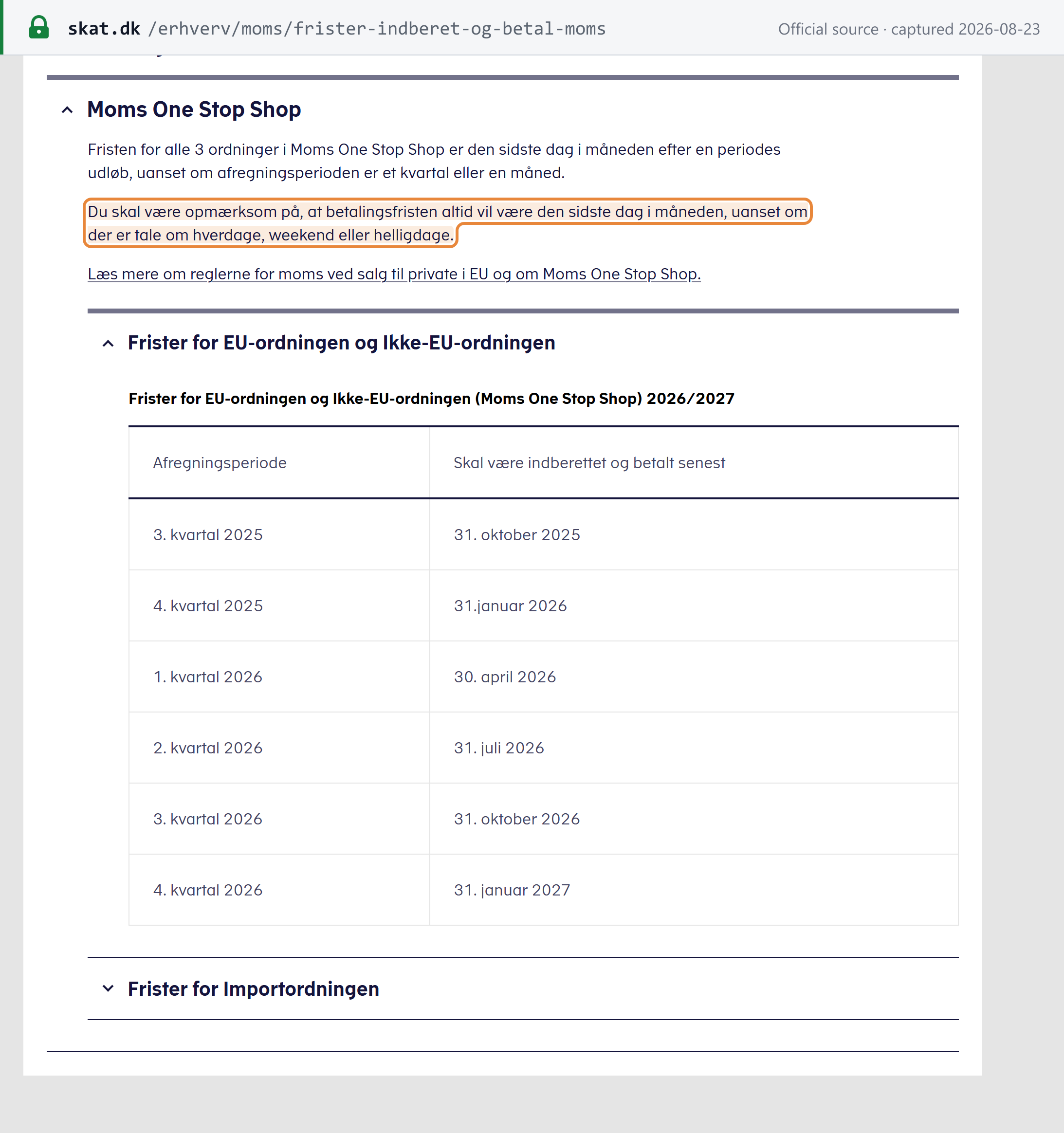
“Fristen for alle 3 ordninger i Moms One Stop Shop er den sidste dag i måneden efter en periodes udløb, uanset om afregningsperioden er et kvartal eller en måned.”
Open full size Captured from Skatteforvaltningen (skat.dk) on 2026-08-23
last day of the month after the month endsVerified 2026-08-23
Who files
Businesses, and intermediaries acting for them, registered in Denmark for the import scheme on distance sales of goods imported from outside the EU in consignments not exceeding EUR 150. Payment rides the same date and is made through the scheme.
Notes
Monthly, due on the last day of the following month, with a nil return due for any month in which you made no distance sales of imported goods. The month end is the deadline whatever day of the week it falls on. Skattestyrelsen publishes 28 February 2026 (a Saturday), 31 May 2026 (a Sunday) and 31 January 2027 (a Sunday) as deadlines exactly as they fall.
“Fristen for alle 3 ordninger i Moms One Stop Shop er den sidste dag i måneden efter en periodes udløb, uanset om afregningsperioden er et kvartal eller en måned.”
Open full size Captured from Skatteforvaltningen (skat.dk) on 2026-08-23
last day of the month after the quarter endsVerified 2026-08-23
Who files
Businesses established in Denmark that use another EU country's small-business exemption under the cross-border SME scheme. EU-wide annual turnover must not exceed EUR 100,000 in the current or preceding calendar year. Values are reported in Danish kroner.
Notes
A quarterly turnover statement, not a VAT return and not a customer listing — you file it in Denmark while using another EU country's small-business exemption. Due within one month of the quarter ending, and a nil statement is due for a quarter in which you made no supplies. Separately, if your EU-wide turnover passes EUR 100,000 you must tell Skattestyrelsen within 15 working days of the breach, and the exemption stops from the moment you cross. Skattestyrelsen has not said whether this date moves when it falls on a weekend, so treat the month end as the deadline.
“Den afgiftspligtige person skal meddele de i stk. 1 omhandlede oplysninger inden for 1 måned fra kalenderkvartalets udgang.”
Captured from Retsinformation (Civilstyrelsen) — official Danish legal information system on 2026-08-23
Lønsumsafgift — kvartalsangivelse (metode 1, 3 og 4)
Lønsumsafgift · Quarterly · return filing
15th of the month after the quarter endsVerified 2026-08-23
Who files
Businesses whose annual lønsumsafgift base exceeds DKK 80,000, supplying services exempt from VAT under momsloven § 13 — healthcare, passenger transport, newspapers, lotteries, and organisations and public enterprises on methods 1, 3 and 4. Banks, insurers and finance businesses are on monthly periods instead.
Notes
The levy that sits where VAT does not: businesses whose supplies are exempt from VAT pay it on their wage bill instead. Filed and paid by the 15th of the month after the quarter. What that quarterly payment IS depends on your method, and it is worth knowing which you are: on method 4 it is a provisional payment that the annual reckoning later trues up, while on methods 1 and 3 there is no annual reckoning and the quarterly return is your final tax. A method 4 business with no employees files annually only and has nothing quarterly to do. This deadline does shift: if the 15th is a Saturday, Sunday or public holiday it moves forward to the next banking day.
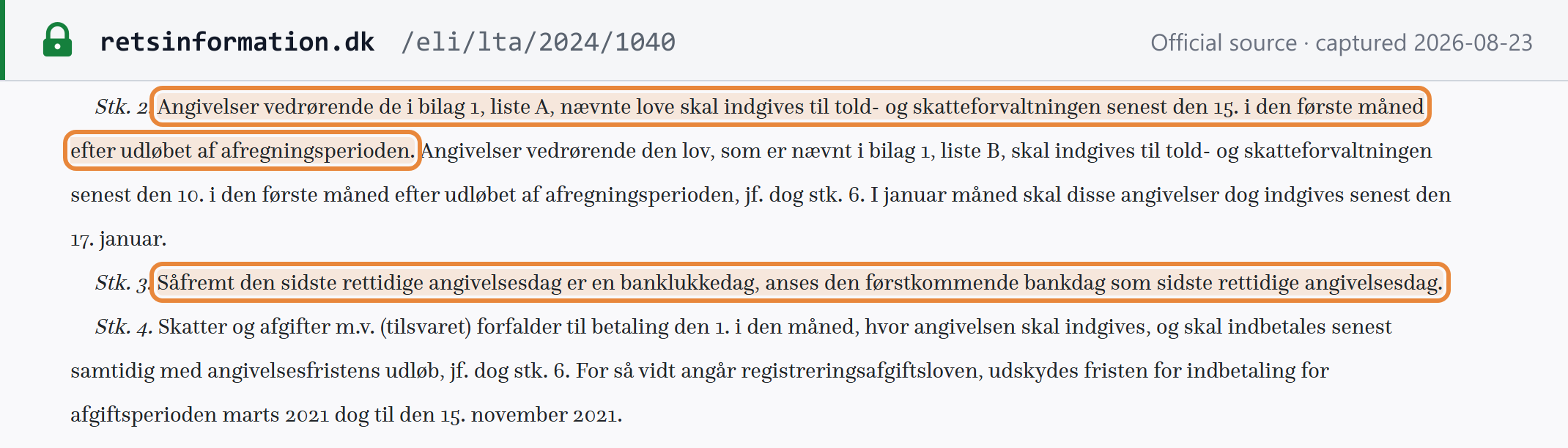
“Angivelser vedrørende de i bilag 1, liste A, nævnte love skal indgives til told- og skatteforvaltningen senest den 15. i den første måned efter udløbet af afregningsperioden.”
Open full size Captured from Retsinformation (Civilstyrelsen) — official Danish legal information system on 2026-08-23
Lønsumsafgift — månedsangivelse (metode 2)
Lønsumsafgift · Monthly · return filing
15th of the month after the month endsVerified 2026-08-23
Who files
Banks, insurers, pension funds and credit and finance businesses with an annual lønsumsafgift base above DKK 80,000 — lønsumsafgiftsloven § 4, stk. 2, nr. 1, which skat.dk heads »Metode 2: Banker, forsikring, pensionskasser, kredit- og finansiering«. Every other lønsumsafgift method is on quarterly periods.
Notes
The financial sector is on monthly periods rather than quarterly, filing and paying by the 15th of the following month. The deadline shifts forward off weekends and public holidays, but the Friday after Ascension Day does not count as one: Skattestyrelsen publishes 15 May 2026, that Friday, as a deadline unchanged.
“§ 2, stk. 1, i lov om opkrævning af skatter og afgifter m.v. finder tilsvarende anvendelse for virksomheder, der er omfattet af § 4, stk. 2, nr. 1.”
Captured from Retsinformation (Civilstyrelsen) — official Danish legal information system on 2026-08-23
Lønsumsafgift — årsangivelse (andre end personligt ejede virksomheder)
Lønsumsafgift · Annually · return filing
15th of the 8th month after the year endsVerified 2026-08-23
Who files
Companies and other businesses that are not personally owned AND that compute the tax base under method 4 — healthcare, passenger transport and the other § 4, stk. 1 activities. Methods 1, 2 and 3 have no annual reckoning at all; their periodic return is final. The date shown is for a calendar income year; a business with a shifted income year reads the same rule off its own year end.
Notes
The annual reckoning that trues up the provisional payments made during the year. Companies file by the 15th of the eighth month after their income year ends, which for a calendar income year is 15 August. A business with a shifted income year reads the same rule off its own year end, and Skattestyrelsen publishes the mapping. The return has to be signed by the responsible management, and the deadline moves forward off weekends and public holidays.
“Andre virksomheder end personligt ejede skal senest den 15. i den ottende måned efter udløbet af den måned, hvori indkomståret udløber, angive afgiftsgrundlaget og afgiftens størrelse.”
Captured from Retsinformation (Civilstyrelsen) — official Danish legal information system on 2026-08-23
Personally owned businesses — sole traders and partnerships rather than companies — that compute the tax base under method 4. Methods 1, 2 and 3 have no annual reckoning. The date shown is for a calendar income year.
Notes
Personally owned businesses file by the 15 August that falls at least five months after their income year ends. For a calendar income year that is the following August — but a year ending in March or later skips a whole year, because the next 15 August is less than five months away. Skattestyrelsen publishes the mapping year by year. Like the company version, the return must be signed by the responsible management and the date moves forward off weekends and public holidays.
“Personligt ejede virksomheder skal senest den 15. august, der følger mindst 5 måneder efter indkomstårets udløb, til told- og skatteforvaltningen angive afgiftsgrundlaget og afgiftens størrelse.”
Captured from Retsinformation (Civilstyrelsen) — official Danish legal information system on 2026-08-23
15th of the month after the month endsVerified 2026-08-23
Who files
Businesses registered for a Danish excise duty under one of the Acts listed in opkrævningsloven bilag 1, liste A — energy, mineral oil, electricity, natural gas, coal, CO2, spirits, beer and wine, tobacco, chocolate and confectionery, packaging, NOx, sulphur, waste and raw materials, water, wastewater and air-passenger duty among others. Individual excise Acts may set a different period.
Notes
The general rule for Danish excise duties: a calendar month period, filed and paid by the 15th of the following month, moving forward if that lands on a weekend or a public holiday. File a nil return if you have nothing to declare for a period — Skattestyrelsen provides a 'nulindberet' option and expects you to use it. Read this as the default rather than the last word: Skattestyrelsen says plainly that individual excise Acts can depart from the general rules, and several do, so check the Act that applies to your goods before relying on this date.
“Angivelser vedrørende de love, som er nævnt i OPKL, bilag 1, liste A, skal indgives til SKAT senest den 15. i den første måned efter udløbet af afregningsperioden. Se OPKL § 2, stk. 2.”
Captured from Skatteforvaltningen (skat.dk) on 2026-08-23
Meddelelse om ændring i registreringsforhold
Moms (VAT) · One-off · registration
within 8 days of a change in the business's registration particularsVerified 2026-08-23
Who files
Every VAT-registered business whose registration particulars change — ownership, address, or responsible day-to-day management.
Notes
Report a change to your registration particulars — ownership, address or responsible management — within 8 days of it happening, counted in ordinary calendar days rather than working days. File it through Erhvervsstyrelsen: that is where Skatteforvaltningen's own guidance sends these changes, even though the VAT Act itself names the tax administration.
“Ændringer i en virksomheds registreringsforhold skal meddeles til told- og skatteforvaltningen senest 8 dage efter ændringen.”
Captured from Retsinformation (Civilstyrelsen) — official Danish legal information system on 2026-08-23
Underretning om virksomhedens ophør
Moms (VAT) · One-off · registration
within 8 days of ceasing to carry on registrable activityVerified 2026-08-23
Who files
The owner or responsible day-to-day management of a business that stops carrying on registrable activity.
Notes
Tell Skattestyrelsen within 8 calendar days of ceasing registrable activity. Closing down does not bring your final return forward: it stays on the ordinary deadline for your band. The only case where a return is accelerated is a registration Skattestyrelsen withdraws.
“Ejeren eller den ansvarlige daglige ledelse af en virksomhed, der ophører med at drive registreringspligtig virksomhed, skal underrette told- og skatteforvaltningen om virksomhedens ophør senest 8 dage efter ophøret.”
Captured from Retsinformation (Civilstyrelsen) — official Danish legal information system on 2026-08-23
Slutangivelse efter inddragelse af registrering
Moms (VAT) · One-off · return filing
within 14 days of notice that the VAT registration has been withdrawnVerified 2026-08-23
Who files
A business whose VAT registration has been withdrawn by Skattestyrelsen. The countdown runs from the notice of withdrawal, not from the end of the VAT period.
Notes
If Skattestyrelsen withdraws your VAT registration, the final return is due within 14 calendar days of the notice — far faster than the ordinary cycle, and counted from the notice rather than from the end of a period. This is the only situation in which a Danish VAT return is brought forward; closing the business down yourself is not.
“Er en virksomheds registrering efter dette kapitel blevet inddraget af told- og skatteforvaltningen, skal virksomhedens angivelse efter stk. 1 foretages senest 14 dage efter meddelelsen om inddragelsen.”
Captured from Retsinformation (Civilstyrelsen) — official Danish legal information system on 2026-08-23
Moms (VAT) in all three turnover bands, EU-salg uden moms, the Moms One Stop Shop schemes, the EU small-business turnover report, lønsumsafgift and punktafgifter (excise). Corporate income tax, A-skat and AM-bidrag payroll withholding and the årsrapport filed with Erhvervsstyrelsen appear on the same skat.dk deadline surfaces but are outside this calendar's indirect-tax scope. Five things a reader should know, none of which is visible from a due-date page. First, the band sets the cadence AND the deadline, but not in the way you would guess. Above DKK 50m of taxable supplies you file monthly, by the 25th of the next month. Between DKK 5m and DKK 50m you file quarterly — and get two months and a day, not one month, so a quarter ending 31 March is due 1 June. At or below DKK 5m you file half-yearly on exactly the same day rule, so 1 September and 1 March. The quarterly and half-yearly bands share their deadline sentence word for word; only the period length differs. Second, and the trap worth the most money: the June period for monthly filers is due 17 August, not 25 July. Denmark deliberately pushes that one return past the summer holiday. Quarterly and half-yearly filers are unaffected. Third, filing and payment share one date for almost every Danish indirect tax, and skat.dk publishes a single column headed 'Skal være indberettet og betalt senest'. Payment runs through the skattekonto and the money must be credited there by the deadline. Miss a filing and Skattestyrelsen makes a provisional assessment of its own — that costs DKK 1,400 per period plus interest, up from DKK 800 until January 2025. Fourth, and this is the one thing about Denmark most reference calendars get wrong: the weekend and public-holiday shift does NOT apply to everything. VAT returns, lønsumsafgift and excise move forward to the next banking day. EU-salg uden moms does not move at all, and neither do the One Stop Shop returns. Skattestyrelsen prints the two behaviours in adjacent tables on one page: for the December 2025 period the VAT return is 26 January 2026 and the listing is 25 January 2026, the same Sunday, one shifted and one not. Assuming a uniform shift would put eight listing deadlines late, by up to four days. Fifth, registration is prospective. The primary duty is to notify Skattestyrelsen at least 8 days BEFORE registrable activity begins — not within some window after crossing a threshold — and the threshold itself is DKK 50,000 of taxable supplies within a calendar year, not a rolling twelve months. Registering late does not delay the registration; VAT liability runs from when the business actually started, and lateness just exposes you to a fine. New registrants are placed on quarterly periods automatically unless they declare expected supplies above DKK 55m — a different figure from the DKK 50m that sets the ongoing monthly band, and both are in the statute. Denmark has no annual VAT return. The VAT year closes with the final periodic return; the only annual VAT item is a one-off disclosure of the provisional partial-deduction percentage, which is a field on whichever periodic return covers June and fixes no date of its own. The annual returns shown here are the lønsumsafgift reckonings.
“Såfremt den sidste rettidige angivelsesdag er en banklukkedag, anses den førstkommende bankdag som sidste rettidige angivelsesdag.”
Captured from Skattestyrelsen (skat.dk) on 2026-08-23
What this calendar does not list
Not yet covered Separate payment deadline — There is no separate payment deadline for any Danish indirect tax. Opkrævningsloven § 2, stk. 4 makes the tax fall due on the 1st of the month in which the return is filed and payable no later than the filing deadline itself — 'Skatter og afgifter m.v. (tilsvaret) forfalder til betaling den 1. i den måned, hvor angivelsen skal indgives, og skal indbetales senest samtidig med angivelsesfristens udløb' — and skat.dk publishes one combined column headed 'Skal være indberettet og betalt senest'. Payment is made through the skattekonto and the money must be credited there by the deadline, so a transfer started on the day is late. The one structural exception is the One Stop Shop schemes, which are paid on the same date but through the scheme rather than the skattekonto. Note for completeness that the forfaldsdag and the sidste rettidige betalingsdag are distinct concepts in Danish law and interest runs from the latter. ONE DANISH INDIRECT TAX BREAKS THIS AND THAT IS WHY THIS IS A GAP RATHER THAN A CLOSED QUESTION: momsloven § 66 y, stk. 3 makes import VAT under the simplified arrangement for consignments up to EUR 150 payable by the 16th of the month after the settlement period — 'Uanset toldlovens §§ 32 og 33 skal importmomsen nævnt i stk. 1 betales senest den 16. i måneden efter afregningsperioden.' — and stk. 1 deems the tax already declared by the monthly import specifications generated from customs declarations. That is a payment date standing apart from any filing date, and it is not the opkrævningsloven § 2, stk. 4 date. It is recorded as a gap rather than shipped as a row because the population — postal operators and customs declarants using the forenklede ordning — has not been researched to the point where a general calendar should render dates for it.
Not applicable E-invoicing / e-reporting cycle — Denmark's e-invoicing obligations are invoice-triggered and system-level, not periodic. Bogføringsloven (lov nr. 700 af 24. maj 2022) § 15 requires a digital bookkeeping system to support automatic sending and receiving of e-invoices, § 16 requires businesses above DKK 300,000 net turnover in two consecutive income years — and every business filing an annual report — to use one, and § 18 lets the minister require purchases and sales to be evidenced by e-invoices. None of those provisions fixes a date on which anything is submitted to an authority. Denmark's B2G mandate (NemHandel/OIOUBL and Peppol BIS) is triggered by issuing an invoice to a public body rather than by a reporting cycle, and Denmark has no B2B e-reporting mandate with a legislated commencement date. Checked against bogføringsloven and skat.dk's VAT deadline pages on 2026-08-23; neither publishes an e-invoicing filing cycle. Erhvervsstyrelsen's own phase-in timetable returned HTTP 403 to this network and could not be read, so a reviewer on a different network should re-read it before upholding this entry.
New Denmark rules taking effect
Confirmed changes from the weekly scan — each links to its full record with the official source.
Which Denmark tax deadlines does this calendar cover?
18 recurring indirect-tax obligations — Moms (VAT), Lønsumsafgift and Punktafgifter (excise duties) returns, payments and related filings — each with the due-date rule, who must file, and the official source that states the deadline. Direct-tax, payroll and company-registry deadlines are out of scope.
How current are these due dates?
Every obligation carries the date it was last verified against its official source (newest: 2026-08-23). Law-change dates come from the weekly Last Week in Taxes scan and link to their full change records.
Do the dates account for weekends and public holidays?
No — the calendar shows the statutory due date. Where the authority shifts deadlines falling on non-working days, the obligation notes say so. Confirm against the linked official source before relying on a date.

 Open full size Captured from Retsinformation (Civilstyrelsen) — official Danish legal information system on 2026-08-23