Denmark requires bookkeeping-software providers to register customers for NemHandel e-invoicing by default from 1 March 2027
This page records one dated change. For the rules in Denmark as they stand today, see the Denmark guide →
- Jurisdiction
- Denmark
- Tax
- VAT
- Change type
- E-invoicing
- Status
- Enacted
- Impact
- Plan ahead
- Announced
- 28 September 2026
- Effective
- 1 March 2027
- Authority
- Erhvervsstyrelsen (Danish Business Authority)
- Systems
- ERP, Invoicing
- Verified
- Fetched from official source · high confidence
Providers of registered digital bookkeeping systems in Denmark, and their business customers, who are registered for e-invoicing unless they opt out.
Bookkeeping-software providers: plan MitID validation and NemHandel default-registration notices for 1 March 2027.
ERPInvoicing
Erhvervsstyrelsen published on 28 September 2026 amendments to the executive order on requirements for registered digital bookkeeping systems. From 1 March 2027 providers of registered systems must ask customers to validate the business with MitID and inform them that they are automatically registered for e-invoicing (NemHandel) unless they actively opt out; SAF-T requirements apply from 1 January 2027 and further e-invoicing requirements from 1 January 2028. Registration is by default; it does not create a general B2B e-invoicing obligation.
What changed in detail
On 28 September 2026 Erhvervsstyrelsen published amendments to the executive order on requirements for registered digital bookkeeping systems. It moves the position set out in the consultation draft, recorded in dk-nemhandel-default-registration-draft-2027, which had the registration step on 1 January 2027.
From 1 March 2027, providers of registered systems must ask their customers to validate the business with MitID, and then inform them that they are automatically registered for e-invoicing (NemHandel) unless they actively opt out. A business that wants e-invoicing need do nothing; a business that does not must decline when its provider notifies it.
Other dates in the order: SAF-T requirements apply from 1 January, and further e-invoicing requirements from 1 January 2028.
Registration is the default, but it does not create a general B2B e-invoicing obligation. Erhvervsstyrelsen states that e-invoicing becomes an option: a registered business can still agree other invoice forms with its customers and suppliers.
What it means
The date moved from 1 January to 1 March 2027, which gives providers two more months to build the MitID validation step and the opt-out notice. The notice wording and the opt-out path are the parts customers will see, so they are the ones to test first.
For businesses, the point to avoid misreading is that default registration is a connection to the NemHandel network, not a duty to send e-invoices. Companies that prefer another invoicing channel should expect the notice and decide whether to opt out.
Proof
Senest den 1. marts skal udbyderne af registrerede bogføringssystemer bede deres kunder om at validere virksomheden med MitID.By 1 March at the latest, providers of registered bookkeeping systems must ask their customers to validate the business with MitID.
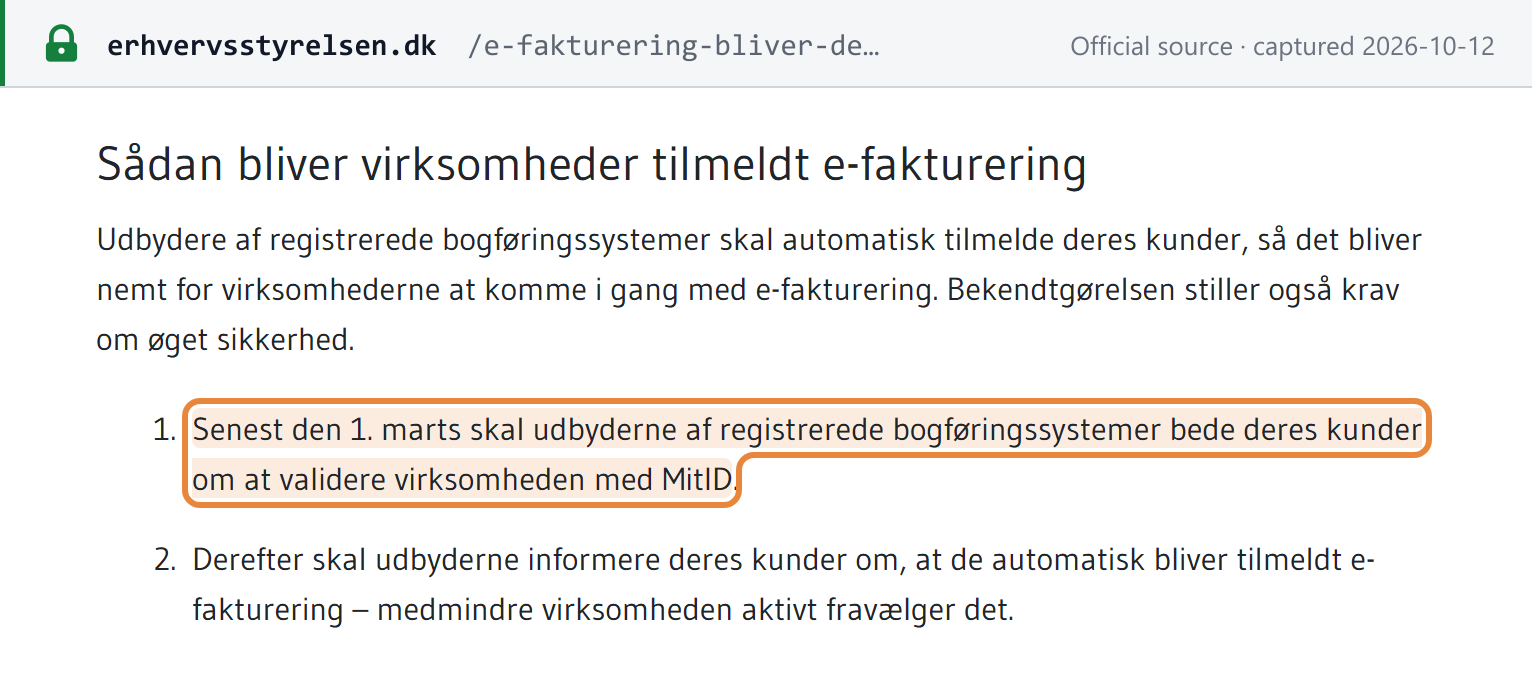 Source snapshot of the official page. Open full size ↗