New Zealand compliance calendar

14 recurring Goods and services tax (GST), Online gambling duty (12%), Gaming machine duty (20%) and problem gambling levy and 4 more obligations — returns, payments and listings — each with its due rule and official source, plus the dates new New Zealand rules take effect.

Mon
Tue
Wed
Thu
Fri
Sat
Sun
26
27
28
29
30
31
1
2
3
4
5
6
Return filing Payment Law change takes effect

Dates already include the weekend and public-holiday shift where New Zealand applies one — 12 of 14 obligations here do. The rest stand as computed, and each obligation's notes say which applies to it and why. Confirm against the linked official source before relying on a date.

Recurring obligations, with sources

Each deadline cites the official text that states it and the date we last verified it.

GST return and payment — monthly filers

Goods and services tax (GST) · Monthly · return filing

28th of the month after the month ends — but the occurrence that would fall in April is due 7 May, and the occurrence that would fall in December is due 15 January Verified 2026-11-12
Who files
GST-registered businesses with sales over NZD 24 million in any 12-month period (compulsory), and any smaller business that chooses monthly filing, for example to get regular refunds.
Notes
Return and payment are both due on the 28th of the month after each month ends, with two fixed exceptions: the March month is due 7 May and the November month is due 15 January, so nothing falls due in April or December. A date on a weekend or national public holiday moves to the next working day. A return is required for every month, even with nothing to report, and Inland Revenue does not grant extensions of time to file.
Source
Filing your GST returns — When to file your GST return Inland Revenue (Te Tari Taake)
See the source text
“Your GST return is due by the 28th of the month after the end of your taxable period.”
Screenshot of Inland Revenue (Te Tari Taake) showing the GST return and payment — monthly filers deadline Open full size Captured from Inland Revenue (Te Tari Taake) on 2026-11-11

GST return and payment — 2-monthly filers, periods ending in odd months

Goods and services tax (GST) · Every 2 months · return filing

28th of the month after the two-month period ends — but the occurrence that would fall in April is due 7 May, and the occurrence that would fall in December is due 15 January Verified 2026-11-12
Who files
GST-registered businesses with sales under NZD 24 million in any 12-month period that file every two months with periods ending January, March, May, July, September and November — the alignment for a 31 March balance date, which most businesses have.
Notes
With a 31 March balance date the two-month periods run April–May, June–July, August–September, October–November, December–January and February–March. That puts the returns on 28 June, 28 August, 28 October, 15 January, 28 February and 7 May: both of the year's exceptional dates land on this cycle. Payment is due with the return, and a weekend or national holiday moves the date to the next working day. A business that never picked a period is put on the two-monthly option matching its balance date.
Source
Which GST accounting basis and filing frequency should I use? — Aligning your GST filing frequency with your balance date Inland Revenue (Te Tari Taake)
See the source text
“2-monthly filers should file for periods ending in odd months (May, July, September, November and January, March).”
Screenshot of Inland Revenue (Te Tari Taake) showing the GST return and payment — 2-monthly filers, periods ending in odd months deadline Open full size Captured from Inland Revenue (Te Tari Taake) on 2026-11-11

GST return and payment — 2-monthly filers, periods ending in even months

Goods and services tax (GST) · Every 2 months · return filing

28th of the month after the two-month period ends Verified 2026-11-12
Who files
GST-registered businesses with sales under NZD 24 million in any 12-month period that file every two months with periods ending February, April, June, August, October and December — usually because their income-tax balance date falls in an even month.
Notes
On the even-month cycle every return falls on the 28th: 28 March, May, July, September and November, and 28 January for the period ending December. Neither the 7 May nor the 15 January exception reaches this cycle, because no period ends in March or November. GST owed is paid by the same date, and a 28th on a Saturday, Sunday or national holiday moves to the next working day — 28 November 2027 is a Sunday, so that return is due Monday 29 November.
Source
GST guide (IR375, March 2026) — page 6, When to file your returns Inland Revenue (Te Tari Taake)
See the source text
“You can choose to file your returns in odd or even months aligned to your balance date.”
Screenshot of Inland Revenue (Te Tari Taake) showing the GST return and payment — 2-monthly filers, periods ending in even months deadline Open full size Captured from Inland Revenue (Te Tari Taake) on 2026-11-11

GST return and payment — 6-monthly filers (31 March balance date)

Goods and services tax (GST) · Bi-annually · return filing

28th of the month after the half-year ends — but the occurrence that would fall in April is due 7 May Verified 2026-11-12
Who files
GST-registered businesses with sales under NZD 500,000 in any 12-month period that choose six-monthly filing and have a 31 March balance date, so their periods end 30 September and 31 March.
Notes
Two returns a year: the half-year to 30 September is due 28 October, and the half-year to 31 March is due 7 May rather than 28 April. Payment goes with each return. A different balance date gives a different pair of period ends, each due on the 28th of the following month, or 15 January for a period ending November. Moving above NZD 500,000 of sales in a 12-month period ends eligibility, so check the threshold before staying on this cycle.
Source
Which GST accounting basis and filing frequency should I use? — Aligning your GST filing frequency with your balance date Inland Revenue (Te Tari Taake)
See the source text
“6-monthly filers should file for periods ending 30 September and 31 March.”
Screenshot of Inland Revenue (Te Tari Taake) showing the GST return and payment — 6-monthly filers (31 March balance date) deadline Open full size Captured from Inland Revenue (Te Tari Taake) on 2026-11-11

GST return and payment — quarterly, non-resident suppliers of remote services, low-value imported goods or listed services

Goods and services tax (GST) · Quarterly · return filing

28th of the month after the quarter ends — but the occurrence that would fall in April is due 7 May Verified 2026-11-12
Who files
Non-resident businesses registered for GST that supply only remote services, low-value imported goods (NZD 1,000 or less) or listed services to New Zealand — registration is required once those supplies exceed NZD 60,000 in a 12-month period.
Notes
Offshore suppliers on the simplified registration file and pay every calendar quarter: 28 October for the quarter to 30 September, 28 January for December, 7 May for March and 28 July for June. A date on a weekend or national holiday moves to the next working day, as it does for resident filers. Starting to make any other kind of supply in New Zealand means switching to monthly, two-monthly or six-monthly filing.
Source
Online gambling duty — Return periods and due dates for return filing and payment Inland Revenue (Te Tari Taake)
See the source text
“These are the same as the dates for GST returns and payments for non-resident suppliers of remote services.”
Screenshot of Inland Revenue (Te Tari Taake) showing the GST return and payment — quarterly, non-resident suppliers of remote services, low-value imported goods or listed services deadline Open full size Captured from Inland Revenue (Te Tari Taake) on 2026-11-11

Online gambling duty return and payment — quarterly

Online gambling duty (12%) · Quarterly · return filing

28th of the month after the quarter ends — but the occurrence that would fall in April is due 7 May Verified 2026-11-12
Who files
Offshore online gambling operators registered, or liable to be registered, for GST because they make NZD 60,000 or more of taxable supplies to New Zealand residents in 12 months, and offshore websites owned by New Zealand casinos.
Notes
The 12% duty on online gambling profits (amounts received from New Zealand residents less prizes paid to them) has applied since 1 July 2024. Its return and payment follow the quarterly GST calendar for offshore suppliers exactly, so both fall due on the same day: 28 October, 28 January, 7 May and 28 July. A date on a weekend or national public holiday moves to the next working day.
Source
Online gambling duty — Return periods and due dates for return filing and payment Inland Revenue (Te Tari Taake)
See the source text
“7 May for the return period ending 31 March”
Screenshot of Inland Revenue (Te Tari Taake) showing the Online gambling duty return and payment — quarterly deadline Open full size Captured from Inland Revenue (Te Tari Taake) on 2026-11-11

Gaming machine duty (GMD) return and payment — monthly (IR680)

Gaming machine duty (20%) and problem gambling levy · Monthly · return filing

20th of the month after the month ends Verified 2026-11-12
Who files
Gaming machine operators — corporate societies licensed under the Gambling Act 2003 to operate gaming machines (pub and club machines), and anyone operating a gaming machine without a licence.
Notes
Duty of 20% of gaming machine profits, plus the problem gambling levy on the same profits, is filed and paid monthly by the 20th of the following month: July's return is due 20 August. A 20th on a weekend or public holiday moves to the next working day. A nil return is still required for a month with a loss or no operation, and losses cannot be carried forward. Operators can ask for a return period ending within 7 days of month-end to match their own accounts; the dates shown assume calendar months.
Source
Gaming machine duty guide (IR180, 2025) — page 8, Part 3: Paperwork and payments Inland Revenue (Te Tari Taake)
See the source text
“You must send us your return and payment by the 20th of the month following the month in which the gaming machine profits were collected.”
Screenshot of Inland Revenue (Te Tari Taake) showing the Gaming machine duty (GMD) return and payment — monthly (IR680) deadline Open full size Captured from Inland Revenue (Te Tari Taake) on 2026-11-12

Casino duty return and payment — monthly

Casino duty (4%) and problem gambling levy · Monthly · return filing

20th of the month after the month ends Verified 2026-11-12
Who files
Licensed casino operators in New Zealand.
Notes
Casino duty is 4% of casino wins, and the problem gambling levy is due on the same profits. Inland Revenue opens each month's return in myIR at month-end, and the return and payment are due by the 20th of the next month, filed in myIR. Where the 20th is not a working day, Inland Revenue accepts payment on the next one.
Source
Casino operators — File and pay your casino duty Inland Revenue (Te Tari Taake)
See the source text
“Your return and payment are due by the 20th of the month after the period the duty applies to.”
Captured from Inland Revenue (Te Tari Taake) on 2026-11-12

GST registration — apply within 21 days of becoming liable

Goods and services tax (GST) · One-off · registration

within 21 days of becoming liable to register (the NZD 60,000 turnover test is met) Verified 2026-11-12
Who files
Any person whose taxable supplies exceeded NZD 60,000 in the past 12 months, or are expected to exceed it in the next 12 months, and who is not yet registered.
Notes
The application is due within 21 days of becoming liable. Liability arises at the end of a month in which sales over the previous 12 months have passed NZD 60,000, or at the start of a month in which the next 12 months are expected to pass it. Inland Revenue can backdate a registration to when liability arose, so GST is owed on sales from that point whether or not the business has applied yet.
Source
Standard Practice Statement SPS 18/03 — Effective date of GST registrations (appendix reproducing GST Act 1985 s 51) Inland Revenue (Te Tari Taake)
See the source text
“Every person who, by virtue of subsection (1), becomes liable to be registered shall apply to the Commissioner in the prescribed form for registration under this Act, within 21 days of becoming so liable”
Screenshot of Inland Revenue (Te Tari Taake) showing the GST registration — apply within 21 days of becoming liable deadline Open full size Captured from Inland Revenue (Te Tari Taake) on 2026-11-11

GST registration cancellation — within 21 days of stopping taxable activity

Goods and services tax (GST) · One-off · registration

within 21 days of stopping the taxable activity (with no new one planned within 12 months), or closing or selling the business Verified 2026-11-12
Who files
GST-registered persons who stop their taxable activity without intending to start a new one within 12 months, or who close down or sell the business.
Notes
Tell Inland Revenue within 21 days, which you can do in myIR. The final return has to account for GST on the open market value of business assets you keep, whatever accounting basis you used. A registration cannot be cancelled while GST still cannot be excluded from your prices, even if turnover is below NZD 60,000. GST groups follow a separate cancellation process.
Source
GST guide (IR375, March 2026) — page 22, When you must cancel Inland Revenue (Te Tari Taake)
See the source text
“You must cancel your GST registration within 21 days if you stop your taxable activity and do not intend to start a new one within 12 months.”
Screenshot of Inland Revenue (Te Tari Taake) showing the GST registration cancellation — within 21 days of stopping taxable activity deadline Open full size Captured from Inland Revenue (Te Tari Taake) on 2026-11-11

Excise entry (all licensees) and fuel and tobacco excise payment — monthly

Excise duty (alcohol, fuel and tobacco) · Monthly · return filing

15th working day of the month after the month ends Verified 2026-11-12
Who files
Holders of a Customs-controlled area (CCA) licence that remove excisable alcohol, fuel or tobacco — every fuel and tobacco licensee, and alcohol licensees not approved for a 6- or 12-monthly cycle.
Notes
Lodge the excise entry by the 15th working day of the month after the goods were removed, counting only weekdays that are not national public holidays: 21 December 2026 for November, 25 January 2027 for December, 22 February for January. Fuel and tobacco duty is paid on the same day; alcohol duty is due later in the month. An entry is required even when nothing was removed — a nil return stating zero.
Source
Entry lodgement timing — Entry lodgement and payment due dates New Zealand Customs Service (Te Mana Ārai o Aotearoa)
See the source text
“15th working day of the month following the removal of goods.”
Screenshot of New Zealand Customs Service (Te Mana Ārai o Aotearoa) showing the Excise entry (all licensees) and fuel and tobacco excise payment — monthly deadline Open full size Captured from New Zealand Customs Service (Te Mana Ārai o Aotearoa) on 2026-11-12

Alcohol excise payment — monthly

Excise duty (alcohol) · Monthly · payment

last business day of the month after the month ends — but the occurrence that would fall in December is due 15 January Verified 2026-11-12
Who files
CCA licensees manufacturing or storing alcohol on the standard monthly cycle — every new licensee starts here, and those with annual duty above NZD 100,000 cannot leave it.
Notes
Alcohol duty is paid by the last working day of the month after removal, so a month-end Saturday or Sunday brings it back to the Friday: 29 January 2027 for December removals. November is the exception, following the GST pattern: Customs' table shows duty on November 2026 removals due 15 January 2027, not 31 December. The entry itself is still due on the 15th working day.
Source
Entry lodgement timing — Entry lodgement and payment due dates New Zealand Customs Service (Te Mana Ārai o Aotearoa)
See the source text
“Last working day of the month following the removal of goods.”
Screenshot of New Zealand Customs Service (Te Mana Ārai o Aotearoa) showing the Alcohol excise payment — monthly deadline Open full size Captured from New Zealand Customs Service (Te Mana Ārai o Aotearoa) on 2026-11-12

Alcohol excise payment — six-monthly cycle (on Customs approval)

Excise duty (alcohol) · Bi-annually · payment

last business day of the month after the half-year ends Verified 2026-11-12
Who files
Alcohol CCA licensees approved by Customs for six-monthly lodgement and payment: at least 6 months of on-time monthly compliance and annual duty liability not above NZD 100,000.
Notes
Duty for July–December is paid by the last working day of January, and for January–June by the last working day of July. The entry for each half-year is due earlier in the same month; Customs publishes the entry date for each half-year in its table, so lodge by that date. Licensees with annual duty of NZD 50,000 or less can be approved for a yearly cycle instead, covering the year to 30 June: the entry date is likewise in Customs' table, and payment is due by the last working day of July.
Source
Entry lodgement timing — Entry lodgement and payment due dates New Zealand Customs Service (Te Mana Ārai o Aotearoa)
See the source text
“Last working day of January and last working day of July.”
Screenshot of New Zealand Customs Service (Te Mana Ārai o Aotearoa) showing the Alcohol excise payment — six-monthly cycle (on Customs approval) deadline Open full size Captured from New Zealand Customs Service (Te Mana Ārai o Aotearoa) on 2026-11-12

Customs deferred payment account — monthly settlement of import GST and duties

GST on imports and Customs duties · Monthly · payment

20th of the month after the month ends Verified 2026-11-12
Who files
Importers and customs brokers holding an approved Customs deferred payment account, which lets GST, duties and levies on a month’s import entries be paid in one settlement.
Notes
All charges deferred during a month, including the GST on imported goods, are settled by direct debit on the 20th of the following month, or the next working day when the 20th is a weekend or public holiday. Late payment can bring penalty fees and interest, and Customs can suspend or cancel the account. Without an account, import GST is paid entry by entry before the goods are released.
Source
Deferred accounts for importers and brokers — Paying your deferred payment account New Zealand Customs Service (Te Mana Ārai o Aotearoa)
See the source text
“You must pay by the 20th of the following month or the next working day if the 20th falls on a weekend or a public holiday.”
Screenshot of New Zealand Customs Service (Te Mana Ārai o Aotearoa) showing the Customs deferred payment account — monthly settlement of import GST and duties deadline Open full size Captured from New Zealand Customs Service (Te Mana Ārai o Aotearoa) on 2026-11-12

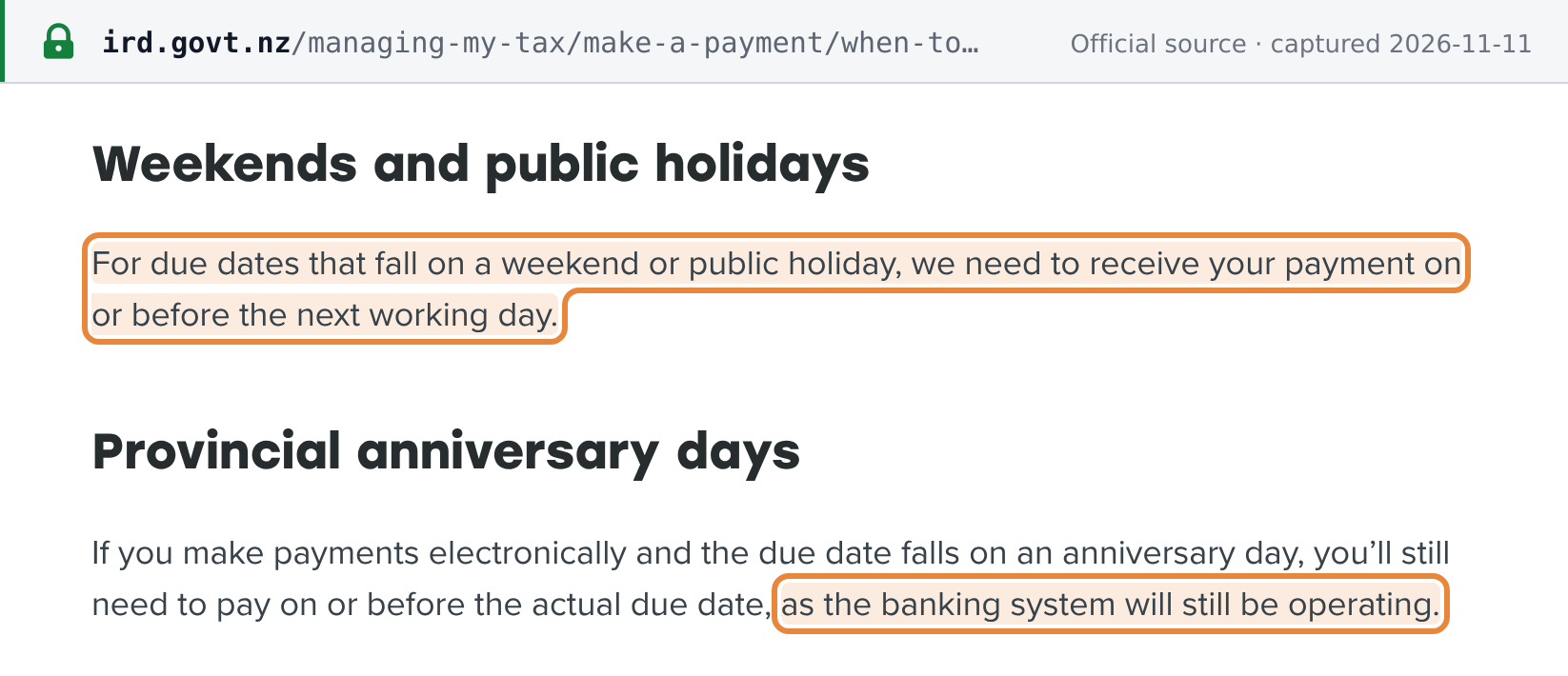
GST returns and payments share one date: the 28th of the month after the taxable period, except that a period ending 31 March is due 7 May and one ending 30 November is due 15 January. How often you file — monthly, every two months or every six months — depends on turnover and on which months your periods end, which follows your income-tax balance date; offshore suppliers registered only for remote services, low-value imported goods or listed services file quarterly. A due date on a weekend or national public holiday moves to the next working day. Provincial anniversary days do not move it for electronic payments, and the summer holiday period does not move 15 January. There is no annual GST return. Excise on alcohol, fuel and tobacco is filed with Customs on a working-day count. Gaming machine and casino duties are filed with Inland Revenue by the 20th of the following month. Totalisator duty has been 0% since 1 July 2021, though TAB NZ still pays the problem gambling levy on its betting profits, and lottery duty is due 14 days after each draw; neither is shown here.

“For due dates that fall on a weekend or public holiday, we need to receive your payment on or before the next working day.”
Screenshot of the official source stating the rule that governs New Zealand's deadlines
When to pay — Weekends and public holidays; Provincial anniversary days — Inland Revenue (Te Tari Taake), captured 2026-11-11

What this calendar does not list

  • Not applicable Annual or reconciliation return — New Zealand has no annual GST return or year-end reconciliation. Inland Revenue's GST guide (IR375) and its filing pages describe only monthly, two-monthly, six-monthly and quarterly returns; the six-monthly return is a periodic return, not an annual one.
  • Not applicable Recapitulative listing — There is no recapitulative statement, sales or purchase listing, or SAF-T filing for GST. Taxable supply information must be kept and provided to a buyer within 28 days of a request, but it is never filed with Inland Revenue on a cycle.
  • Not applicable E-invoicing / e-reporting cycle — There is no business-to-business or consumer e-invoicing mandate for GST. Government Procurement Rule 44.2 requires large suppliers to e-invoice government agencies via Peppol from 1 January 2027, but it sets no tax filing or reporting cycle.

About this calendar

Which New Zealand tax deadlines does this calendar cover?

14 recurring indirect-tax obligations — Goods and services tax (GST), Online gambling duty (12%), Gaming machine duty (20%) and problem gambling levy, Casino duty (4%) and problem gambling levy, Excise duty (alcohol, fuel and tobacco), Excise duty (alcohol) and GST on imports and Customs duties returns, payments and related filings — each with the due-date rule, who must file, and the official source that states the deadline. Direct-tax, payroll and company-registry deadlines are out of scope.

How current are these due dates?

Every obligation carries the date it was last verified against its official source (newest: 2026-11-12). Law-change dates come from the weekly Last Week in Taxes scan and link to their full change records.

Do the dates account for weekends and public holidays?

No — the calendar shows the statutory due date. Where the authority shifts deadlines falling on non-working days, the obligation notes say so. Confirm against the linked official source before relying on a date.

Validate tax IDs in 100+ countries

Put these rules into practice — verify VAT, GST, and EIN numbers in real time with the Lookuptax API.