Armenia moves gold and jewellery VAT onto a margin base and blocks the input deduction
This page records one dated change. For the rules in Armenia as they stand today, see the Armenia guide →
- Jurisdiction
- Armenia
- Tax
- VAT
- Change type
- Update
- Status
- In force
- Impact
- Action required
- Announced
- 21 May 2026
- Effective
- 1 July 2026
- Instrument
- AM-HO-200-N-2026
- Authority
- ARLIS – Armenian Legal Information System (arlis.am)
- Systems
- ERP, Tax engine, Invoicing
- Verified
- Fetched from official source · high confidence
Manufacturers of items made of gold, gold and precious stones, and businesses that resell gold and jewellery items in Armenia. Zero-rated supplies of these goods keep the ordinary VAT treatment and are not subject to the new input-deduction denial.
If you manufacture or resell gold or jewellery in Armenia, switch the VAT base to the margin calculation from 1 July 2026 and stop deducting input VAT on purchase invoices and import declarations for those items, except on zero-rated supplies.
ERPTax engineInvoicing
Armenia’s Law No. HO-200-N, adopted on 6 May 2026 and officially published on 21 May 2026, adds a new part 22 to Article 62 of the Tax Code establishing a margin-based VAT taxable base for the sale of items made of gold, including gold and precious stones. For manufacturers the base is the amount calculated under Article 61, or 80 per cent of real value for below-market or gratuitous transactions, plus the positive difference between the sale price and the documented acquisition cost of the gold and precious stones used, and may not fall below 10 per cent of the Article 61 amount. For gold and jewellery resellers the base is the positive difference between the sale price and the documented VAT-inclusive acquisition cost of the item. A new Article 72(1)(13) denies input VAT deduction to gold and jewellery trading businesses on purchase tax invoices and import declarations relating to such items, except for zero-rated supplies. The law takes effect on 1 July 2026.
What changed in detail
Armenia’s Law No. HO-200-N, adopted on 6 May 2026 and officially published on 21 May 2026, adds a new part 22 to Article 62 of the Tax Code establishing a margin-based VAT taxable base for the sale of items made of gold, including gold and precious stones. For manufacturers the base is the amount calculated under Article 61, or 80 per cent of real value for below-market or gratuitous transactions, plus the positive difference between the sale price and the documented acquisition cost of the gold and precious stones used, and may not fall below 10 per cent of the Article 61 amount. For gold and jewellery resellers the base is the positive difference between the sale price and the documented VAT-inclusive acquisition cost of the item. A new Article 72(1)(13) denies input VAT deduction to gold and jewellery trading businesses on purchase tax invoices and import declarations relating to such items, except for zero-rated supplies. The law took effect on 1 July 2026.
What it means
The margin base and the input-VAT block work together, not separately. A gold trader can no longer net full-price VAT against full-price input tax; the taxable amount for a reseller is now capped to the markup over documented acquisition cost, but every purchase invoice or import declaration for gold or precious stones stops generating a deductible input credit at all, except where the underlying supply is zero-rated. That combination raises the effective VAT cost of moving gold through more than one link in the domestic supply chain, since each seller pays VAT on their own margin without recovering VAT paid upstream. Manufacturers additionally have a floor: the taxable base can never fall below 10 per cent of the ordinary Article 61 value, even where the acquisition cost sat close to the sale price.
Proof
Սույն օրենքն ուժի մեջ է մտնում 2026 թվականի հուլիսի 1-ից։This law enters into force on 1 July 2026.
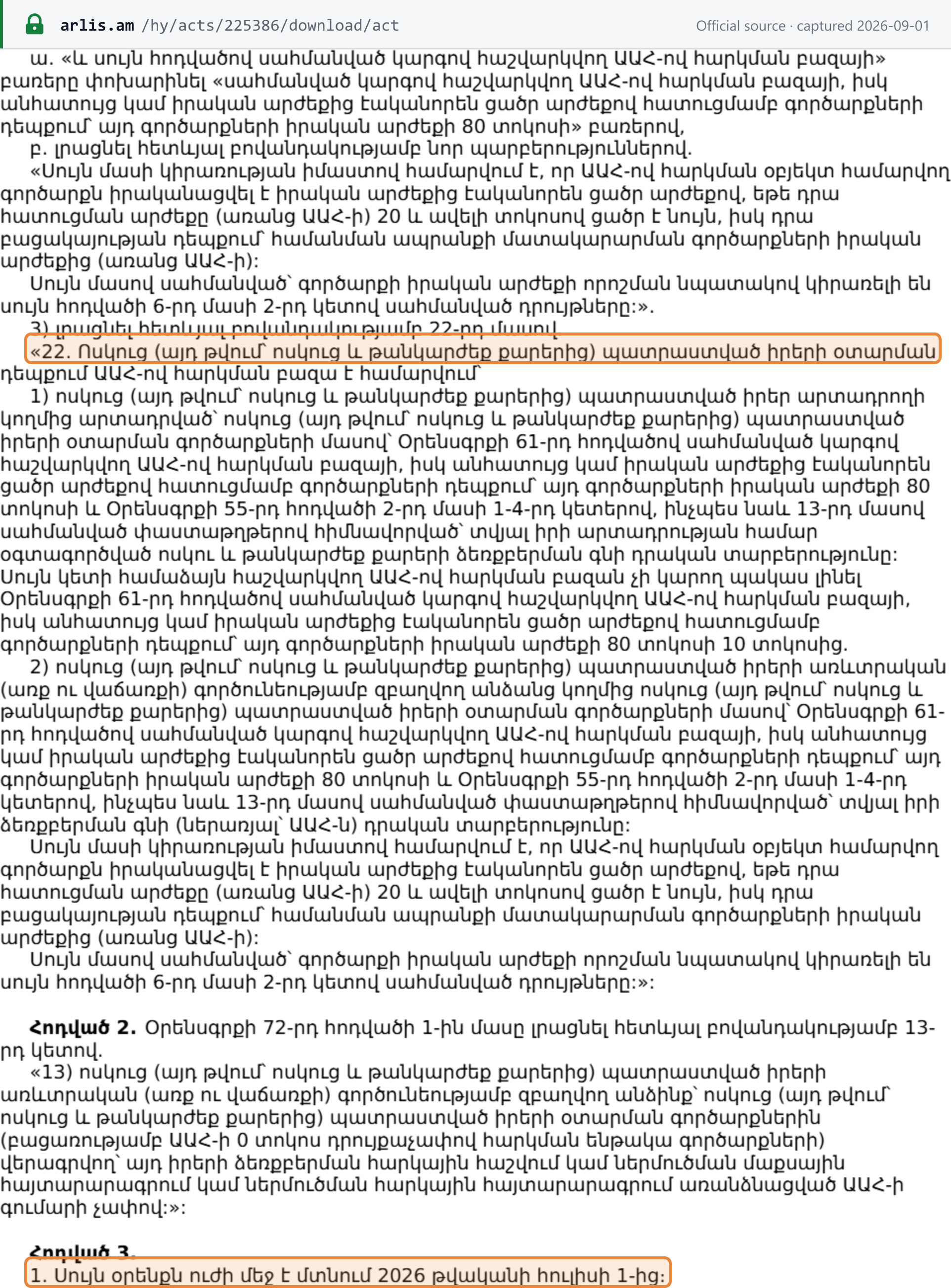 Source snapshot of the official page. Open full size ↗
Archived from the official distribution · www.arlis.am