Botswana sets the registration and invoicing machinery for non-resident remote services VAT
This page records one dated change. For the rules in Botswana as they stand today, see the Botswana guide →
- Jurisdiction
- Botswana
- Tax
- VAT
- Change type
- Digital services
- Status
- In force
- Impact
- Action required
- Announced
- 29 May 2026
- Effective
- 29 May 2026
- Authority
- Botswana Government Extraordinary Gazette (Supplement C) — Minister of Finance
- Systems
- Tax engine, Invoicing, E-commerce, Reporting
- Verified
- Fetched from official source · medium confidence
Non-resident suppliers of remote services to Botswana customers and operators of electronic marketplaces within sections 11A(1)(c) and 11B of the VAT Act.
Non-resident suppliers of digital/remote services to Botswana customers should register with BURS without delay (registration takes effect from the start of the second tax period after eligibility) and prepare to charge 14% Botswana VAT four months after their registration date; confirm invoicing, VAT-number-collection, and monthly return/remittance (25th of month) processes are in place.
Tax engineInvoicingE-commerceReporting
Botswana's Minister of Finance made Statutory Instrument No. 74 of 2026, the Value Added Tax (Remote Services) Regulations, 2026, published in the Botswana Government Extraordinary Gazette (Supplement C) on 29 May 2026. The regulations implement the non-resident digital-services VAT obligations created by the VAT (Amendment) Act, 2025, setting out: the scope of taxable 'remote services' (digital content, cloud/hosting, webinars/distance learning, website design, inbound tourism, remote professional services, electronic-marketplace supplies); the registration application procedure and required supporting documents (incorporation certificate, tax certificate, translated to English); that registration takes effect from the start of the second tax period after eligibility; a monthly return/remittance deadline of the 25th of the following month; mandatory VAT-registration-number disclosure between registered counterparties; electronic tax invoicing; a representative-appointment mechanism; an inbound-tourism carve-out; and a transitional rule requiring suppliers to register immediately from the Amendment Act's commencement and to start charging VAT four months after their registration date, with record-keeping penalties of 75% (deliberate/reckless) or 20% (other) of tax payable, or fixed penalties of BWP 10,000 (company) / BWP 5,000 (other) where no tax is payable. A companion instrument, Statutory Instrument No. 73 of 2026 (VAT (Government Entities and Large Unregistered Persons) Regulations, 2026), made the same day, sets a parallel registration process for reverse-charge accounting by government entities and large unregistered persons.
What changed in detail
The Value Added Tax (Remote Services) Regulations, 2026 — Statutory Instrument No. 74 of 2026, made by the Acting Minister of Finance on 29 May 2026 under section 77 of the VAT Act (Cap. 50:03) and published in Supplement C to the Botswana Government Extraordinary Gazette the same day — set out the operating machinery for the non-resident digital-services obligations.
Scope (reg. 3) covers online digital content, software and gambling; electronic data management including hosting, data warehousing, file-sharing and cloud storage; webinars and distance learning; website design or publishing; inbound tourism products under the Tourism Act; professional services provided remotely or performed physically in Botswana; supplies through an electronic marketplace; and “any other remote service”.
Registration (regs. 4–5) requires the supplier’s registered and trade names, contact details, a compliance contact and the website through which the taxable activity is carried on, with certified copies of the incorporation and home-country tax certificates translated into English. Registration takes effect from the beginning of the second tax period after eligibility.
Returns and remittance (regs. 7–8) are both due by the 25th day of the month following the tax period. Invoicing (regs. 9–10) requires the supplier to request a registered recipient’s VAT number and show it on the invoice, with records kept in English for five years. Record-keeping failures attract 75% of the tax payable where deliberate or reckless and 20% otherwise, or fixed penalties of P10,000 for a company and P5,000 otherwise where no tax is payable.
A supplier may appoint a representative (reg. 11) who assumes its obligations, must not impose VAT on an inbound tourism product (reg. 12), and — under the transitional rule (reg. 13) — registers immediately from the commencement of the Act, starting to charge VAT four months from the date of registration.
A companion instrument made the same day, Statutory Instrument No. 73 of 2026, sets a parallel registration route for government entities and large unregistered persons accounting for reverse-charged supplies.
:::note Correction, 24 September 2026 This record describes Statutory Instrument No. 74 of 2026 as the rules in force. They no longer are. The Value Added Tax Regulations, 2026 (Statutory Instrument No. 94 of 2026), made on 30 June 2026 and operating from 1 July 2026, revoke both S.I. No. 73 and S.I. No. 74 of 2026 (regulation 20) and replace them. The current rules for non-resident suppliers of remote services are in S.I. No. 94 (regulations 17 to 19), under the VAT Act, 2026; the registration threshold for remote services is P500,000 in any 12 months (VAT Act, 2026, s.13(2) and Schedule 5 para 3). The details above — including the 25th-of-the-month deadline — are those of the revoked instrument.
Source: BURS — Value Added Tax Act, 2026 and Regulations :::
What it means
The four-month runway in regulation 13 is the provision to plan against, and it is easy to read backwards. The clock starts at registration, not at the Act’s commencement — so a supplier who delays registering also delays the point at which they must start charging, while sitting in breach of the immediate-registration duty in the meantime. Registering promptly is what buys the four months.
The inbound-tourism carve-out is the structural oddity. Regulation 3 puts inbound tourism products inside the definition of remote services and regulation 12 then forbids charging VAT on them, which means tourism suppliers can be in scope for registration and reporting while charging nothing. Treating “no VAT” as “no obligation” is the mistake that follows.
Proof
13. (1) A supplier of remote services who is liable to register in terms of section 11 (D) shall register immediately from the commencement of the Act. (2) A supplier of remote services under subregulation (1) shall start charging Value Added Tax four months from the date of registration.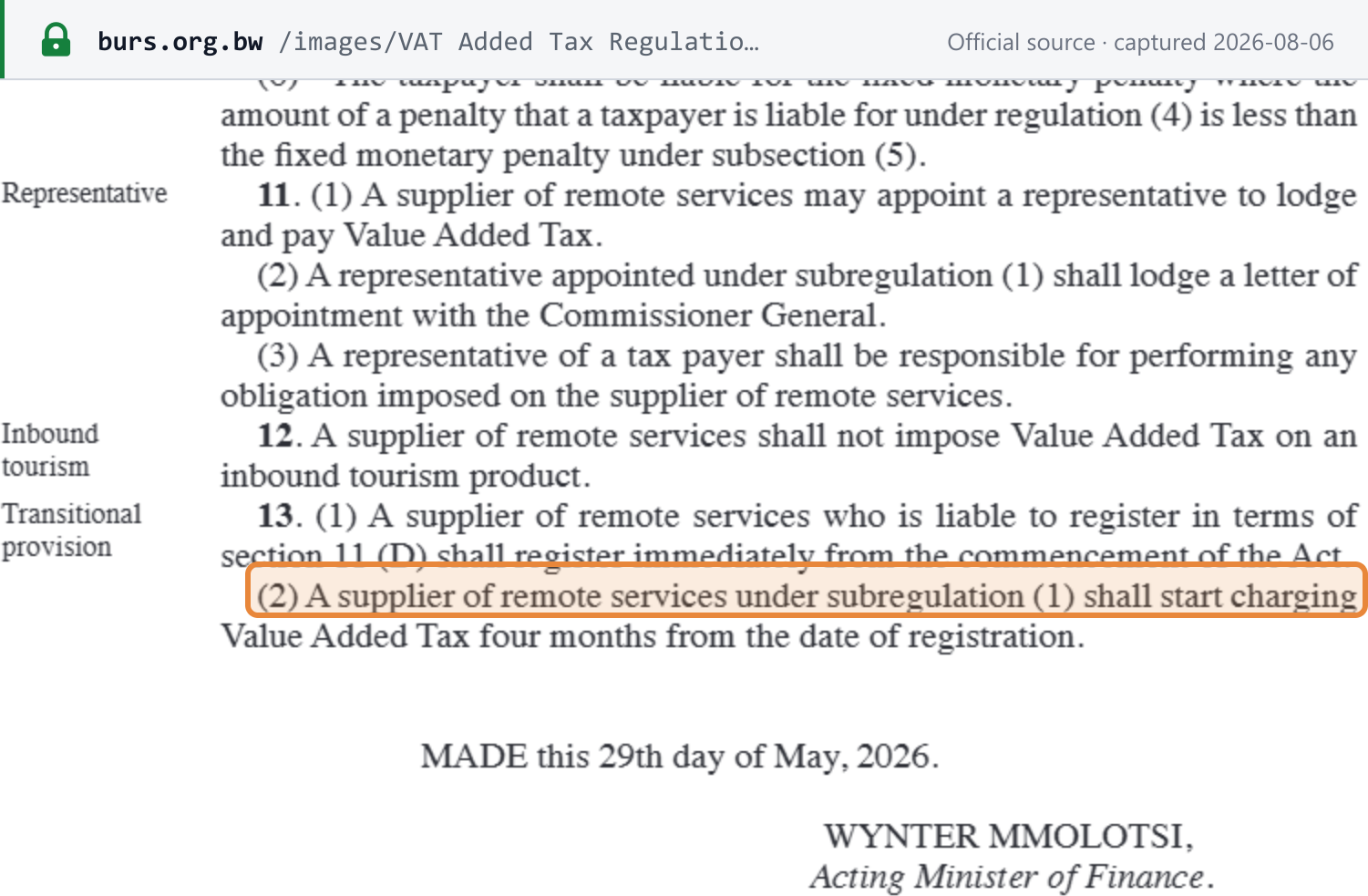 Source snapshot of the official page. Open full size ↗