Botswana publishes the zero-rated foodstuffs list under the VAT Act, 2026
This page records one dated change. For the rules in Botswana as they stand today, see the Botswana guide →
- Jurisdiction
- Botswana
- Tax
- VAT
- Change type
- Rate change
- Status
- In force
- Impact
- Action required
- Announced
- 9 July 2026
- Effective
- 1 July 2026
- Authority
- Botswana Unified Revenue Service (BURS)
- Systems
- POS, ERP, Tax engine, E-commerce
- Verified
- Fetched from official source · high confidence
Retailers, wholesalers and food manufacturers supplying foodstuffs in Botswana — anyone whose POS or ERP carries a Botswana food tax code.
Update POS/ERP tax codes and retail pricing for the revised zero-rated foodstuffs list without delay (effective 1 July 2026, notice issued 9 July 2026).
POSERPTax engineE-commerce
BURS published a Public Notice revising the list of foodstuffs subject to VAT at a zero rate under the Value Added Tax (VAT) Act, 2026, which commenced 1 July 2026. Zero-rated items now include sorghum/maize meal, millet grain/meal, wheat grain, maize cobs, sugar, brown bread, specified fresh vegetables and fruits, rice, samp, bread flour, and cooking oil; all other foodstuffs remain at the 14% standard rate.
What changed in detail
BURS issued a public notice dated 9 July 2026 setting out the revised list of foodstuffs subject to VAT at a zero rate under the Value Added Tax (VAT) Act, 2026, which commenced on 1 July 2026.
Zero rating applies to a supply of the following in their natural state and not mixed with other products: sorghum or maize meal (except when sold as prepared or cooked food); millet grain; millet meal; wheat grain; maize cobs; sugar; brown bread; rice; samp; bread flour (white, brown and whole wheat); and cooking oil.
Two categories are enumerated rather than generic. Fresh vegetables covers potatoes, tomatoes, onions, cabbage, rape, beetroots, carrots and spinach, excluding dried, canned or bottled vegetables. Fresh fruits covers oranges, apples and bananas, excluding dried, canned or bottled fruit and nuts.
The notice closes with an explicit residual rule: “Any food items not appearing in the above list are subject to VAT at 14%.” Retailers and other affected businesses are directed to adjust their systems and pricing arrangements accordingly.
What it means
The list is closed and it is specific, which is unusual — most zero-rating schedules describe categories and leave the edges to interpretation. Here the edges are stated: a tomato is zero-rated, a tinned tomato is not; a banana is, a nut is not; maize meal is, until it is cooked. That precision removes argument but it also means a POS food hierarchy built on GST-style “basic groceries” logic will get a meaningful share of lines wrong.
The commencement date is the operational problem rather than the content. The Act commenced 1 July and the list was published 9 July, so there is a nine-day window in which retailers were applying a rate they could not yet read. Anyone who guessed during that window should reconcile it rather than assume it netted out.
Proof
The public is informed of the revised list of foodstuffs that are subject to VAT at a zero rate under the Value Added Tax (VAT) Act, 2026 which commenced on the 1st July 2026.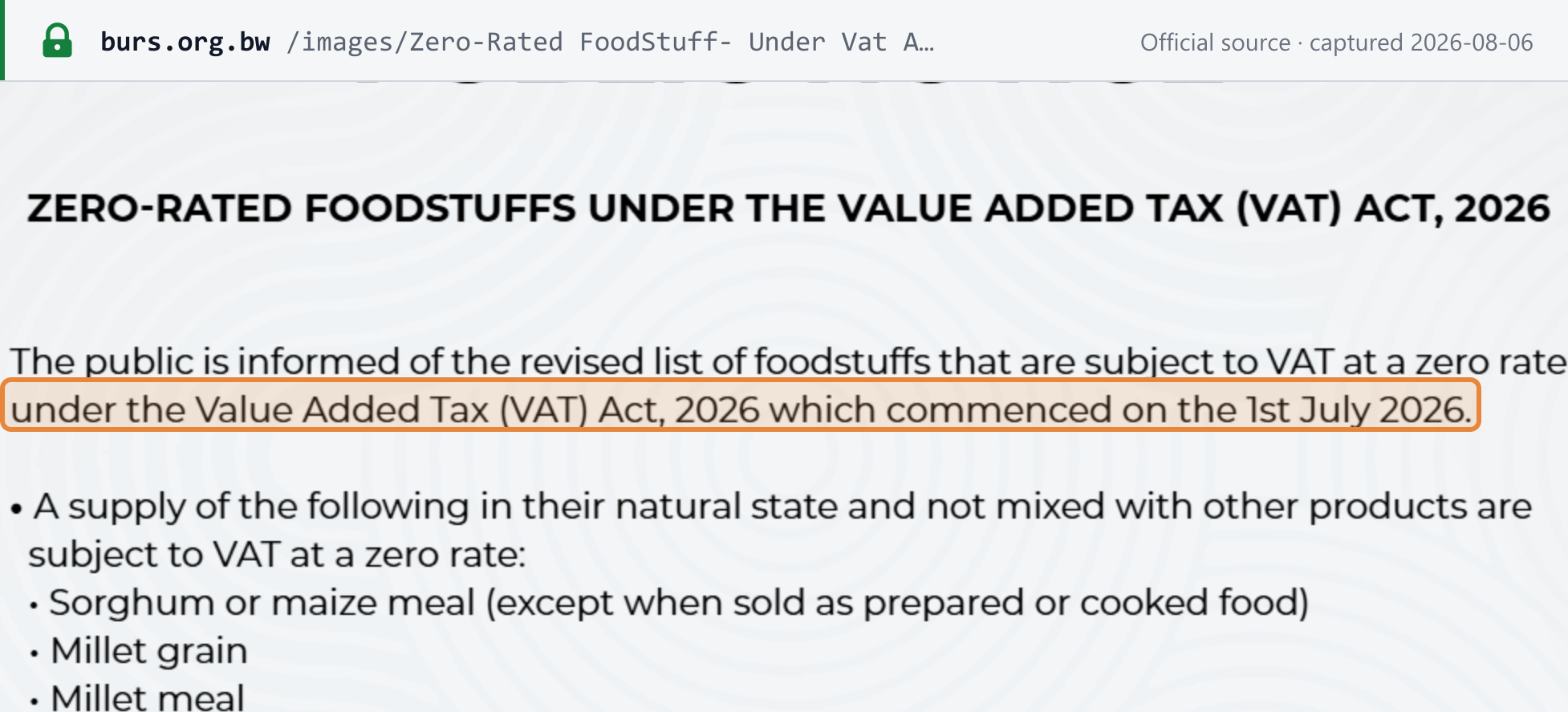 Source snapshot of the official page. Open full size ↗