Botswana's new VAT Act makes electronic tax invoices mandatory
This page records one dated change. For the rules in Botswana as they stand today, see the Botswana guide →
- Jurisdiction
- Botswana
- Tax
- VAT
- Change type
- E-invoicing
- Status
- Enacted
- Impact
- Plan ahead
- Announced
- 1 July 2026
- Effective
- 1 April 2027
- Instrument
- BW-15-OF-2026
- Authority
- Botswana Unified Revenue Service
- Systems
- Invoicing, ERP, Tax engine
- Verified
- Fetched from official source · high confidence
Every VAT-registered person in Botswana. The obligation covers tax invoices, tax credit notes and tax debit notes alike, and has applied since the Act commenced on 1 July 2026.
Plan for electronic issuance of Botswana tax invoices, credit notes and debit notes through a BURS-approved electronic billing system: the obligation is enacted and covers all registered persons, and the system commences around 1 April 2027, nine months after the Tax Administration Act commenced.
InvoicingERPTax engine
Section 59(8) of Botswana's Value Added Tax Act, 2026 (Act No. 15 of 2026), gazetted and commenced 1 July 2026, requires a registered person to issue tax invoices electronically under the electronic billing system, and section 60(4) applies the same obligation to tax credit and debit notes. The duty is on registered persons generally, with no taxpayer segment or turnover band on the face of the provision. Both subsections are expressly subject to section 15 of the Tax Administration Act, 2026, which requires the electronic invoice to be issued using an electronic billing system approved by the Revenue Service. Regulation 34 of the Tax Administration Regulations, 2026 (Statutory Instrument No. 90 of 2026) provides that the electronic billing system commences nine months from the commencement of that Act, which commenced 1 July 2026 - so the obligation is enacted and universal but becomes operative around 1 April 2027, once BURS has approved billing systems.
What changed in detail
Section 59(8) of Botswana’s Value Added Tax Act, 2026 (Act No. 15 of 2026), gazetted and commenced 1 July 2026, requires a registered person to issue tax invoices electronically under the electronic billing system, and section 60(4) applies the same obligation to tax credit and debit notes. The duty is on registered persons generally, with no taxpayer segment or turnover band on the face of the provision. Both subsections are expressly subject to section 15 of the Tax Administration Act, 2026, which requires the electronic invoice to be issued using an electronic billing system approved by the Revenue Service. Regulation 34 of the Tax Administration Regulations, 2026 (Statutory Instrument No. 90 of 2026) provides that the electronic billing system commences nine months from the commencement of that Act, which commenced 1 July 2026 - so the obligation is enacted and universal but becomes operative around 1 April 2027, once BURS has approved billing systems.
What it means
This has been live since 1 July, so it is a compliance check rather than a project. The Act repealed and replaced Cap. 50:03 outright, which means references to the old Act in contracts, system configuration and internal guidance are now pointing at a repealed instrument.
Proof
The electronic billing system shall commence nine months from the date of commencement of the Act.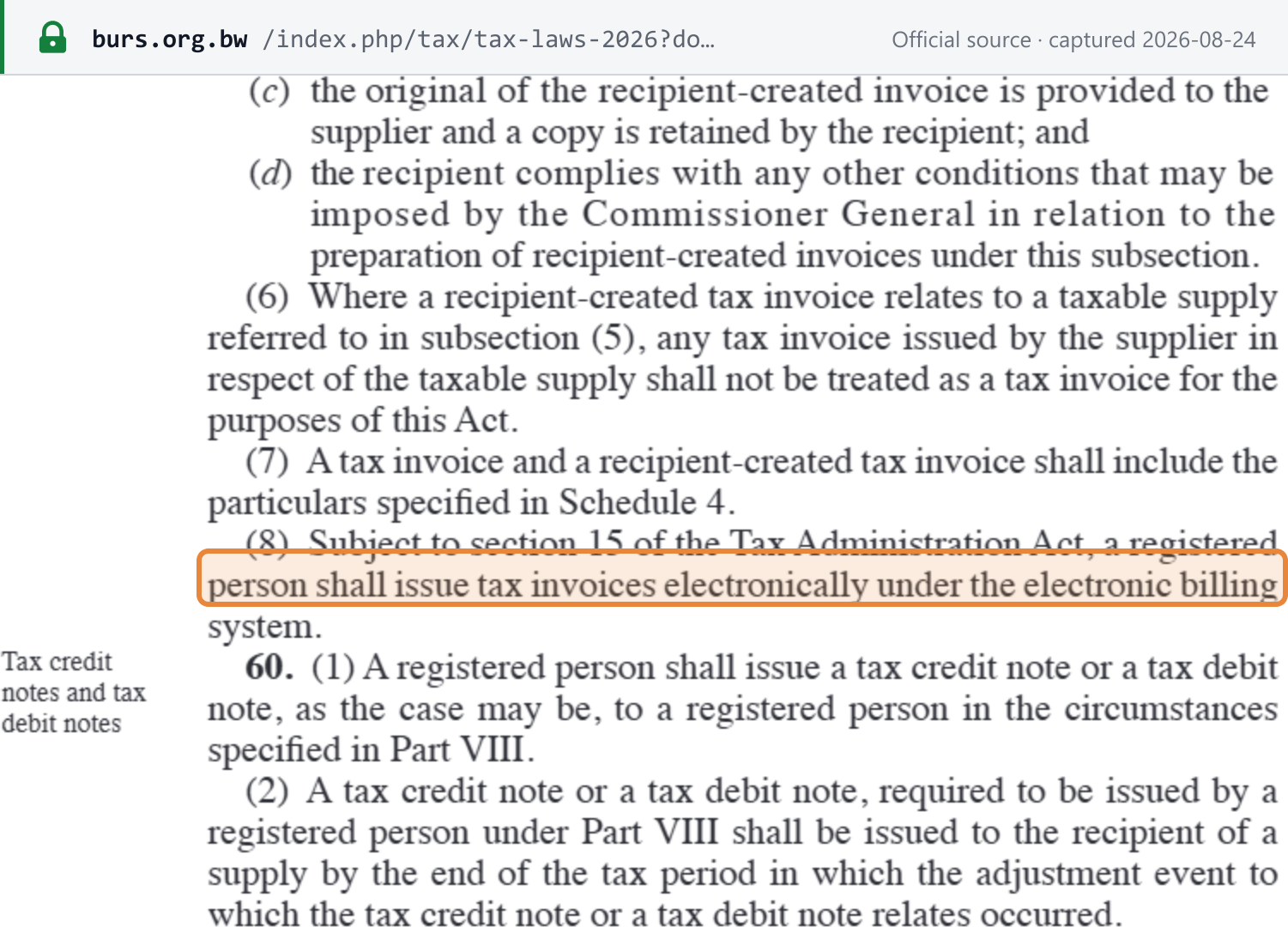 Source snapshot of the official page. Open full size ↗