Botswana prescribes what a tax invoice must show
This page records one dated change. For the rules in Botswana as they stand today, see the Botswana guide →
- Jurisdiction
- Botswana
- Tax
- VAT
- Change type
- Invoice rules
- Status
- In force
- Impact
- Action required
- Announced
- 1 July 2026
- Effective
- 1 July 2026
- Instrument
- BW-15-OF-2026
- Authority
- Botswana Unified Revenue Service
- Systems
- Invoicing, ERP
- Verified
- Fetched from official source · high confidence
Every VAT-registered person in Botswana issuing tax invoices, credit notes or debit notes — and any foreign supplier whose invoices need to support a Botswana customer's input-tax claim.
Update Botswana invoice templates to carry every Schedule 4 particular, including the words 'original tax invoice' in a prominent place and both parties' VAT registration numbers.
InvoicingERP
Schedule 4 of the Value Added Tax Act, 2026 (given operative force by sections 59(7) and 60(3)) prescribes the particulars of a tax invoice: the words 'original tax invoice' in a prominent place; the name, address and VAT registration number of the registered person making the supply and of the registered person receiving it; the individualised serial number and date of issue; a description of the goods or services; the quantity or volume; and the total amount of the VAT charged, the consideration for the supply, and the consideration including VAT. Paragraph 2 allows a tax invoice issued to a non-registered person to omit the recipient's details, and paragraph 3 sets a separate list for recipient-created tax invoices. Section 59(1) requires the original tax invoice for any taxable supply, subject only to the section 59(2) exception for cash consideration not exceeding the Schedule 5 paragraph 7 amount of P20.
What changed in detail
Schedule 4 of the Value Added Tax Act, 2026 (given operative force by sections 59(7) and 60(3)) prescribes the particulars of a tax invoice: the words ‘original tax invoice’ in a prominent place; the name, address and VAT registration number of the registered person making the supply and of the registered person receiving it; the individualised serial number and date of issue; a description of the goods or services; the quantity or volume; and the total amount of the VAT charged, the consideration for the supply, and the consideration including VAT. Paragraph 2 allows a tax invoice issued to a non-registered person to omit the recipient’s details, and paragraph 3 sets a separate list for recipient-created tax invoices. Section 59(1) requires the original tax invoice for any taxable supply, subject only to the section 59(2) exception for cash consideration not exceeding the Schedule 5 paragraph 7 amount of P20.
What it means
The particular that catches foreign suppliers is the prominent ‘original tax invoice’ wording, which few other jurisdictions require. An invoice that satisfies another country’s rules will not automatically satisfy Schedule 4, and because section 60(3) applies the same Schedule to credit and debit notes, a compliant invoice template is not enough on its own.
Proof
Except as the Commissioner General may otherwise allow, a tax invoice required to be provided by a registered person under section 59, shall contain the following particulars - (a) the words 'original tax invoice' in a prominent place; ... (g) the total amount of the VAT charged, the consideration for the supply, and the consideration including VAT.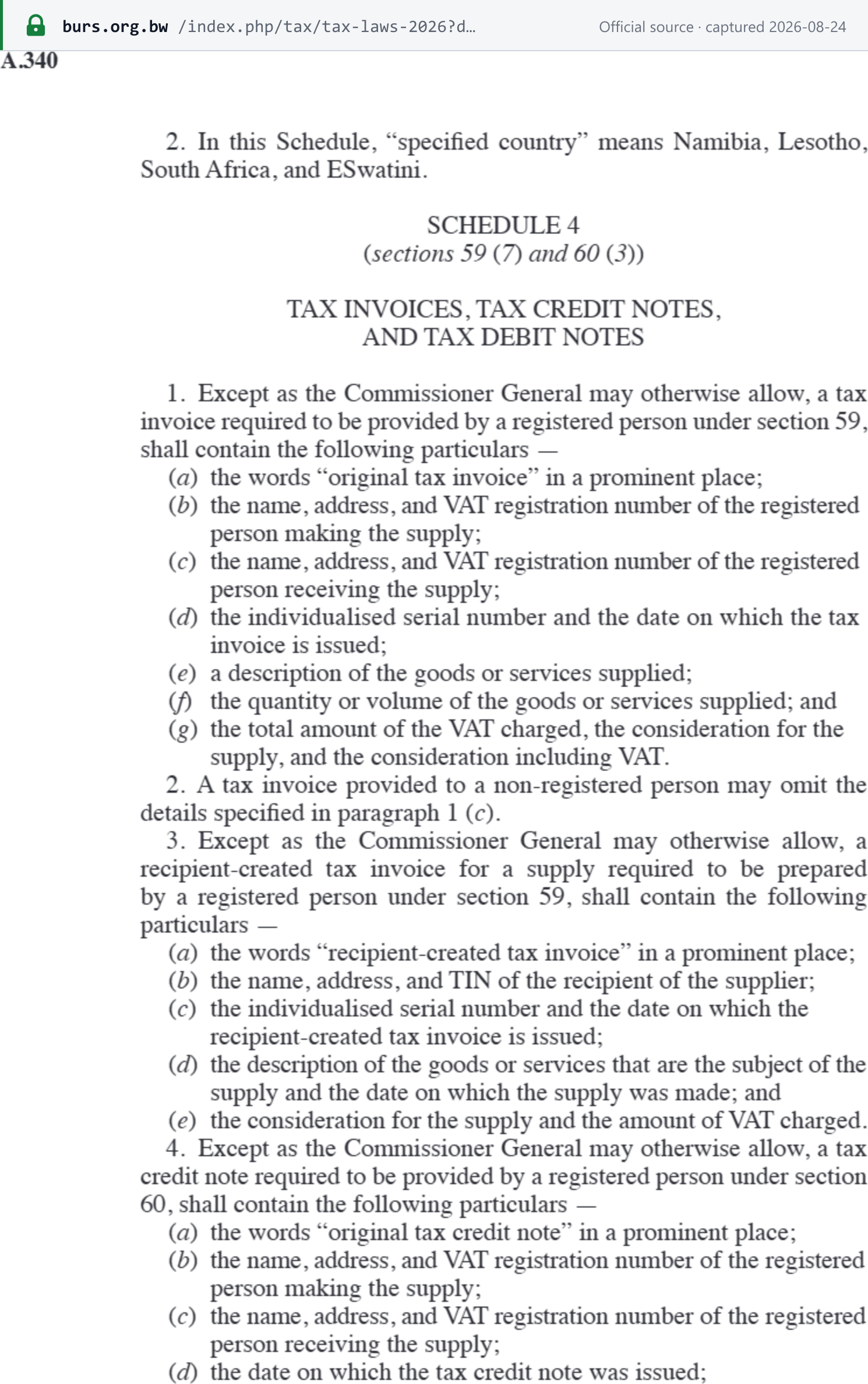 Source snapshot of the official page. Open full size ↗