Not law: Bulgaria drafts mandatory B2B/B2G structured e-invoicing from 2028
This change is proposed and is not law. The rules below describe what would change if it is adopted.
- Jurisdiction
- Bulgaria
- Tax
- VAT
- Change type
- E-invoicing
- Status
- Proposed
- Impact
- Watch
- Announced
- 23 September 2026
- Effective
- 1 January 2028
- Authority
- Министерство на финансите (Ministry of Finance, Bulgaria)
- Systems
- Invoicing, ERP
- Verified
- Fetched from official source · high confidence
VAT-registered suppliers established in Bulgaria, for supplies taxable in Bulgaria (including advance payments) made to a recipient established in Bulgaria who is a taxable person, a non-taxable legal person, or the state or a public authority.
No action — monitoring only.
InvoicingERP
Bulgaria's Ministry of Finance published on 23 September 2026, for public consultation until 23 October 2026, a draft law amending the VAT Act that would require VAT-registered suppliers established in Bulgaria to issue structured electronic invoices for supplies taxable in Bulgaria, including advance payments, where the recipient is established in Bulgaria and is a taxable person, a non-taxable legal person or the state or a public authority. Under the draft's transitional provisions the e-invoicing paragraphs take effect on 1 January 2028, and one provision (article 182a) on 1 July 2028. The draft must still be adopted by the Council of Ministers and the National Assembly.
What changed in detail
This is a draft, not law. Bulgaria’s Ministry of Finance published a draft law amending the VAT Act on 23 September 2026, open for public consultation (No. 12733-K) until 23 October 2026. The draft would require VAT-registered suppliers established in Bulgaria to issue structured electronic invoices for supplies taxable in Bulgaria — including advance payments — where the recipient is established in Bulgaria and is a taxable person, a non-taxable legal person, or the state or a public authority. Under the draft’s transitional provisions, the e-invoicing paragraphs would take effect 1 January 2028, with one provision (article 182a) taking effect 1 July 2028. The draft still requires adoption by the Council of Ministers and the National Assembly before it has any legal effect.
What it means
This puts Bulgaria on the same trajectory as the EU’s broader VAT-in-the-Digital-Age structured-invoicing direction, with a domestic B2B/B2G mandate rather than only a cross-border one. The scope as drafted is domestic-to-domestic — a Bulgarian-established supplier invoicing a Bulgarian-established recipient — so cross-border supplies are not described by this draft’s language. With a 2028 effective date and the draft still in consultation, there is no near-term system requirement, but ERP and invoicing vendors serving the Bulgarian market have a multi-year runway to watch this move from draft to enacted law.
Proof
ще издават задължително структурирани електронни фактури, когато получателят е лице, установено на територията на странатаthey will be required to issue structured electronic invoices, where the recipient is a person established in the territory of the country
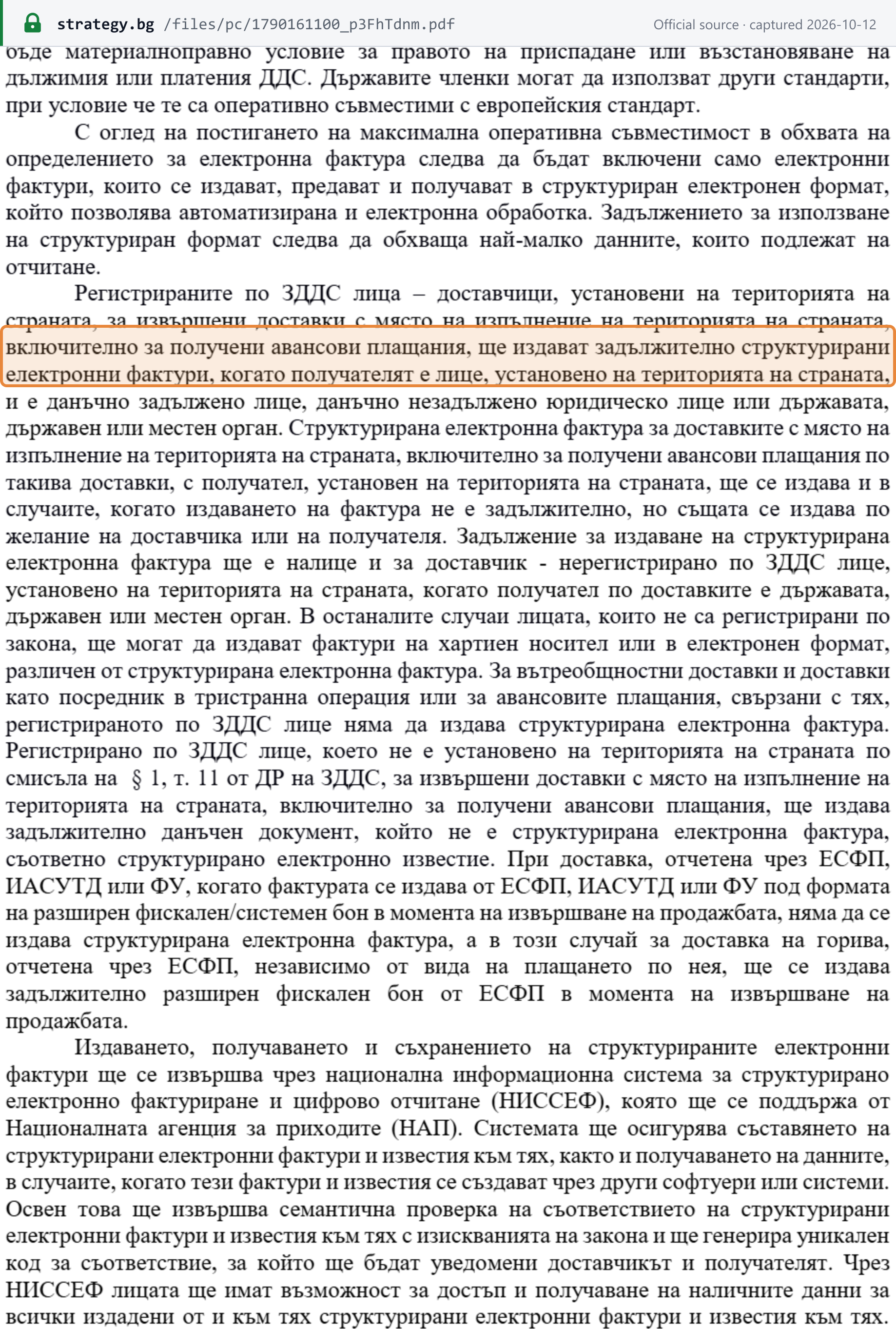 Source snapshot of the official page. Open full size ↗
Archived from the official distribution · Обществена консултация 12733-K — мотиви (draft law amending the VAT Act, explanatory memorandum) · www.strategy.bg