British Columbia removes the PST exemptions for clothing patterns and clothing fabric, yarn and thread, and taxes clothing and footwear services, from 1 October 2026
This page records one dated change. For the rules in Canada as they stand today, see the Canada guide →
- Jurisdiction
- Canada (British Columbia)
- Tax
- PST
- Change type
- Rate change
- Status
- In force
- Impact
- Action required
- Effective
- 1 October 2026
- Authority
- BC Ministry of Finance
- Systems
- Tax engine, POS, E-commerce, ERP
- Verified
- Fetched from official source · medium confidence
Fabric, craft and sewing retailers selling clothing patterns, yarn, fibres, thread and fabric in British Columbia, and businesses providing services to clothing or footwear, such as alterations and repairs.
Configure PST on BC sales of clothing patterns, clothing fabric/yarn/thread and clothing/footwear services from 1 October 2026.
Tax enginePOSE-commerceERP
Effective 1 October 2026, British Columbia's PST exemptions for clothing patterns (including knitting, crocheting and sewing instructions) and for yarn, natural fibres, synthetic thread and fabric commonly used in making or repairing clothing are eliminated, and services to clothing or footwear become taxable. Sales of these items on or after 1 October 2026 carry PST unless another exemption applies. Ministry of Finance Bulletins PST 130 (revised July 2026) and PST 201 (revised October 2026) reflect the change.
What changed in detail
Effective 1 October 2026, British Columbia’s provincial sales tax (PST) exemptions for clothing patterns, including knitting, crocheting and sewing instructions, and for yarn, natural fibres, synthetic thread and fabric commonly used in making or repairing clothing are eliminated. Services to clothing or footwear also become taxable.
Sales of these items on or after 1 October 2026 carry PST unless another exemption applies. The change is reflected in Ministry of Finance Bulletin PST 130 (Fabric and Craft Stores, revised July 2026) and Bulletin PST 201 (Children’s Clothing and Footwear, revised October 2026).
What it means
Retailers need to configure PST on these product lines for British Columbia sales made on or after 1 October 2026. The test is the date of sale, so orders placed before and delivered after the change date need a deliberate rule.
Proof
If you sell clothing patterns on or after October 1, 2026, you must charge PST, unless another exemption applies.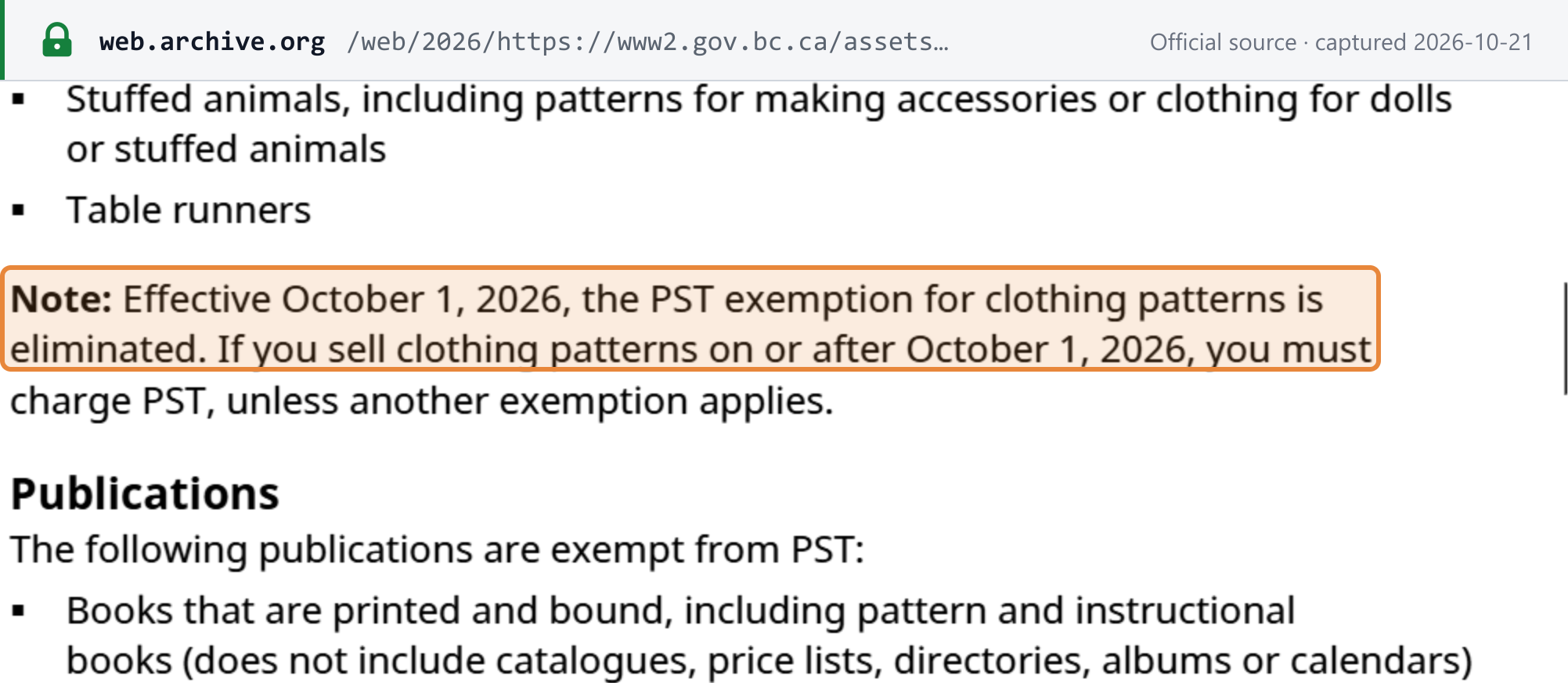 Source snapshot of the official page. Open full size ↗