Côte d'Ivoire customs reorganises the compliance certificate required for VAT-credit refund claims
- Jurisdiction
- Côte d'Ivoire
- Tax
- VAT
- Change type
- Compliance
- Status
- In force
- Impact
- Plan ahead
- Announced
- 15 September 2026
- Effective
- 15 September 2026
- Authority
- Direction Générale des Douanes de Côte d'Ivoire
- Systems
- Reporting, Customs, Invoicing
- Verified
- Fetched from official source · high confidence
Importers and exporters in Côte d'Ivoire claiming VAT-credit refunds, who need an attestation de régularité douanière.
Exporters and importers claiming VAT-credit refunds should apply for the attestation under the new online-plus-physical-file procedure.
ReportingCustomsInvoicing
Côte d'Ivoire's Direction Générale des Douanes issued Circulaire n° 2423/MEFB/DGD of 15 September 2026 reorganising the procedure for issuing customs-compliance certificates (attestations de régularité douanière) required for VAT-credit refund claims, for both imports and exports. The request is registered and completed online, followed by a physical file (until full dematerialisation); export files include the electronic standardised invoice (FNE) and mode-of-transport documents; a requester may submit one file per 48 hours; the instruction period is five working days. The destination-country receipt declaration is not required of Approved Economic Operators (OEA), and other exporters with at least 50% of turnover from exports and no customs sanction in the prior three years may obtain the same waiver for a renewable 12 months. The circular repeals contrary prior provisions.
What changed in detail
The Direction Générale des Douanes of Côte d’Ivoire issued Circulaire n° 2423/MEFB/DGD of 15 September 2026, reorganising the procedure for issuing customs-compliance certificates (attestations de régularité douanière) that are required for VAT-credit refund claims, for both imports and exports.
- The request is registered and completed online, followed by a physical file until the procedure is fully dematerialised.
- Export files include the electronic standardised invoice (FNE) and mode-of-transport documents.
- A requester may submit one file per 48 hours.
- The instruction period is five working days.
- The destination-country receipt declaration is not required of Approved Economic Operators (OEA). Other exporters with at least 50% of turnover from exports and no customs sanction in the prior three years may obtain the same waiver for a renewable 12 months.
The circular repeals contrary prior provisions.
What it means
The certificate is a precondition for the refund, so any delay or rejected file pushes back the cash. The one-file-per-48-hours limit and the five-working-day instruction period mean exporters with many shipments should batch their requests deliberately rather than submit them as they arise.
The waiver of the destination-country receipt declaration is the main benefit. Exporters near the 50% export threshold, with a clean three-year customs record, should consider requesting it, and the physical file with the FNE should be assembled in parallel with the online request.
Proof
Il est à noter que la déclaration de prise en charge des marchandises dans le pays de destination n'est pas exigée pour les entreprises bénéficiant du statut d'Opérateur Economique Agréé (OEA).It should be noted that the declaration of receipt of the goods in the destination country is not required for businesses holding Approved Economic Operator (OEA) status.
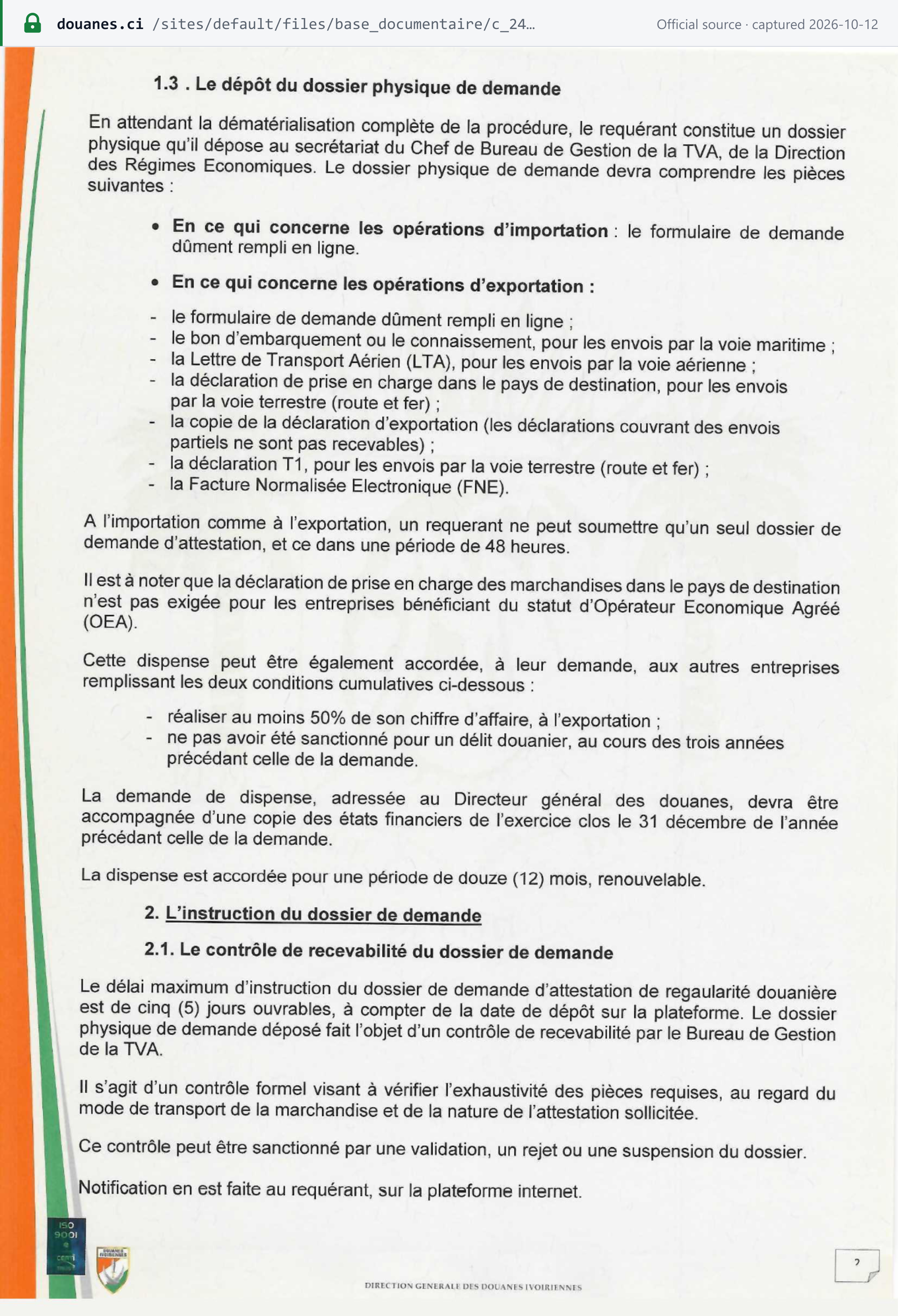 Source snapshot of the official page. Open full size ↗