Czech input-VAT deduction-timing guidance is dated 13 April 2026, not September
- Jurisdiction
- Czechia
- Tax
- VAT
- Change type
- Compliance
- Status
- In force
- Impact
- FYI
- Announced
- 13 April 2026
- Authority
- Generální finanční ředitelství (General Financial Directorate), Czech Republic
- Systems
- Tax engine, Reporting
- Verified
- Fetched from official source · high confidence
Czech VAT payers that receive a supplier invoice in a tax period later than the one in which the taxable supply took place — the same population as the original entry; only the dating of the guidance changes.
No action — monitoring only.
Tax engineReporting
The Finanční správa's Sdělení on the moment at which the VAT input-tax deduction may be claimed (in light of current CJEU case law) carries the publication date 13 April 2026 on the authority's own page, not 9 September 2026 as recorded in the W38 entry. The page bears no 'aktualizováno' marker and shows no September revision. The substance of the guidance is unchanged: where a payer receives the tax document in a tax period following the one in which the taxable supply took place (DUZP), the deduction may be claimed at the earliest for that following tax period; the EU General Court's judgment in T-689/24 I. S. A. does not change the current legal position or the administrative practice applied to date, because a review procedure (C-167/26 RX) suspends its application.
What changed in detail
The Financní správa communication on input-VAT deduction timing is dated 13 April 2026, not 9 September 2026. The authority’s own page carries “13. 4. 2026” directly under its heading, with no “aktualizováno” marker and no September revision. An earlier entry recorded the publication date as 9 September 2026, which put it inside that week’s scan window; the correct date means it never belonged there at all.
The substance is unchanged and was correctly reported: where a VAT payer receives the tax document in a tax period following the one in which the taxable supply took place (DUZP), the deduction may be claimed no earlier than that following period. The General Court’s judgment in Case T-689/24, I. S. A. does not change the current legal position or administrative practice, because a pending review procedure before the Court of Justice (Case C-167/26 RX) suspends its application.
This corrects the earlier entry, whose substance stands except for the publication date itself.
What it means
Nothing about the deduction rule changes — the point of this correction is entirely about when the guidance was published, not what it says. A communication from April is not a September development, and a change-tracking process built on scan-window dates should drop this from any “published this week” view. The substantive position — hold the deduction, do not pull it back to the DUZP period, and watch Case C-167/26 RX rather than the Tribunal judgment — is unaffected and still current.
Proof
Pokud plátce obdrží daňový doklad ve zdaňovacím období následujícím po uskutečnění zdanitelného plnění (DUZP), může uplatnit nárok na odpočet daně, kterou vůči němu uplatnil jiný plátce, nejdříve za toto následující zdaňovací období.If a payer receives the tax document in the tax period following the one in which the taxable supply took place (DUZP), it may claim the right to deduct the tax charged to it by another payer no earlier than for that following tax period.
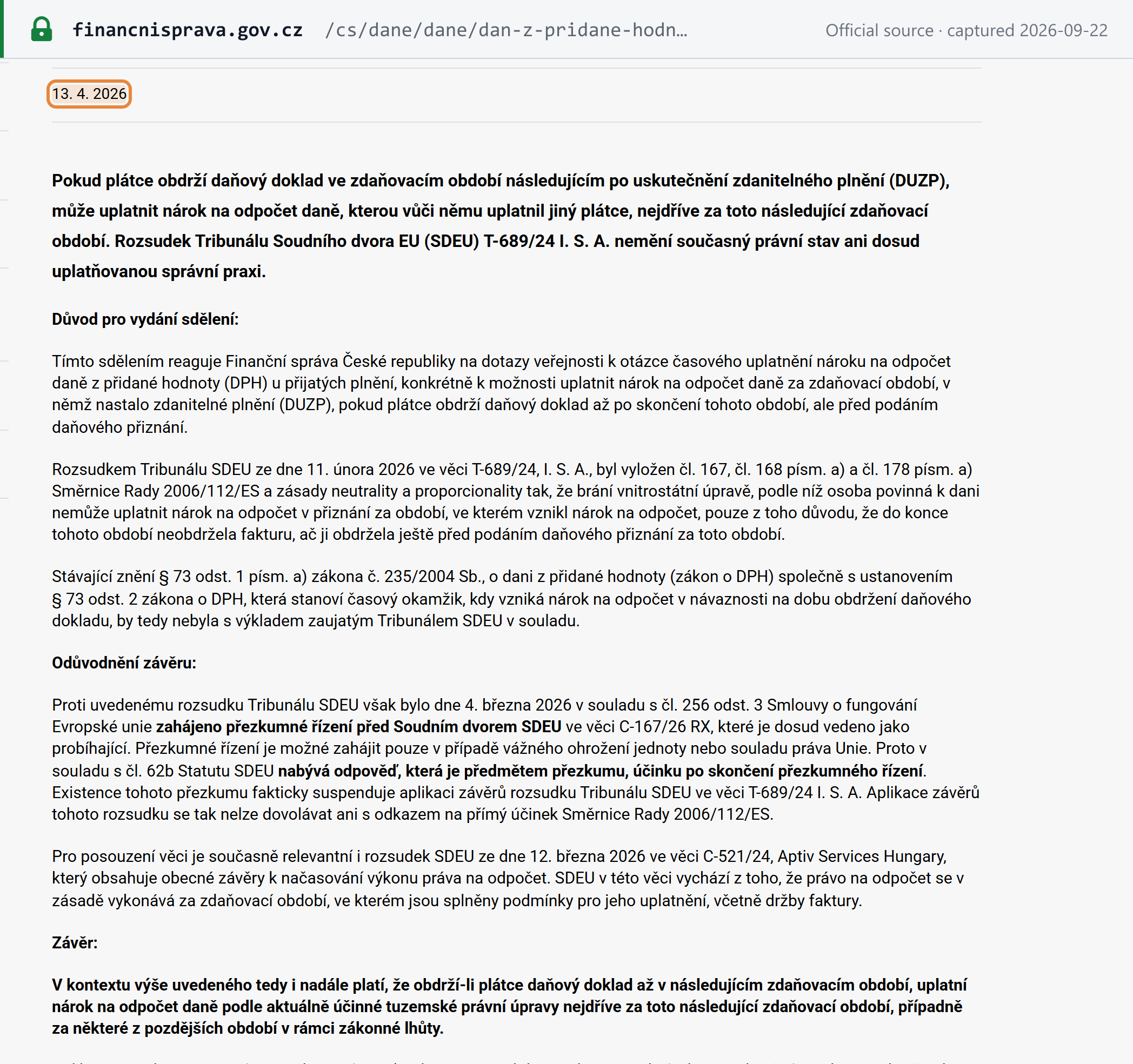 Source snapshot of the official page. Open full size ↗
Sources
What this replaces
- Czech Republic confirms input VAT is deductible no earlier than the period the invoice arrives effective 9 September 2026