Germany's Jahressteuergesetz 2026 bill would end the call-off stock simplification in 2028-2029 and add EU ETS 2 allowances to the reverse-charge list
This change is proposed and is not law. The rules below describe what would change if it is adopted.
This page records one dated change. For the rules in Germany as they stand today, see the Germany guide →
- Jurisdiction
- Germany
- Tax
- VAT
- Change type
- Update
- Status
- Proposed
- Impact
- Plan ahead
- Announced
- 30 September 2026
- Effective
- 1 January 2027
- Authority
- Deutscher Bundestag
- Systems
- ERP, Tax engine
- Verified
- Fetched from official source · high confidence
Businesses using call-off stock (consignment) arrangements in the EU, and traders in EU ETS 2 emission allowances.
Companies using call-off stock in Germany: plan the wind-down before 1 July 2028, subject to enactment.
ERPTax engine
Article 13 of Germany's Jahressteuergesetz 2026 government bill (Bundestag-Drucksache 21/8283, 30 September 2026) would, from 1 January 2027, amend section 6b UStG so the call-off stock (consignment) simplification applies only to goods whose transport begins by 30 June 2028 and ends by 30 June 2029 at the latest, transposing Directive (EU) 2025/516, and would add EU ETS 2 emission allowances (section 3 no. 8 TEHG) to the reverse-charge list in section 13b(2) no. 6 UStG. The bill is before the Bundestag and is not yet law.
What changed in detail
This is a government bill, not law. Article 13 of the Jahressteuergesetz 2026 (Bundestag-Drucksache 21/8283, 30 September 2026) is before the Bundestag.
If enacted, it would from 1 January 2027 amend section 6b UStG so that the call-off stock (consignment) simplification applies only to goods whose transport begins by 30 June 2028 and ends by 30 June 2029 at the latest. The bill transposes Directive (EU) 2025/516.
The bill would also add EU ETS 2 emission allowances (section 3 no. 8 TEHG) to the reverse-charge list in section 13b(2) no. 6 UStG.
The explanatory memorandum for the section 6b change states that only goods whose transport or dispatch begins by 30 June 2028 fall under the simplification.
What it means
Nothing has changed in law yet; the text can still be amended in the Bundestag. The date mechanics matter for planning: goods must start moving by 30 June 2028 and the movement must end by 30 June 2029, so stock placed late in the period needs a defined exit.
Businesses that use call-off stock across the EU should map which flows rely on it and what the alternative treatment would be after the cut-off dates.
For ETS 2 allowances, a reverse-charge listing shifts the VAT accounting duty to the recipient. Traders should check how their invoicing and ledger rules would handle that from 1 January 2027, if the bill passes in this form.
Proof
Die Änderung der Vorschrift (Ergänzung des Datums) regelt, dass nur Gegenstände unter die Konsignationslagerregelung fallen, deren Beförderung oder Versendung spätestens am 30. Juni 2028 beginnt.The amendment of the provision (addition of the date) provides that only goods whose transport or dispatch begins by 30 June 2028 at the latest fall under the consignment stock rules.
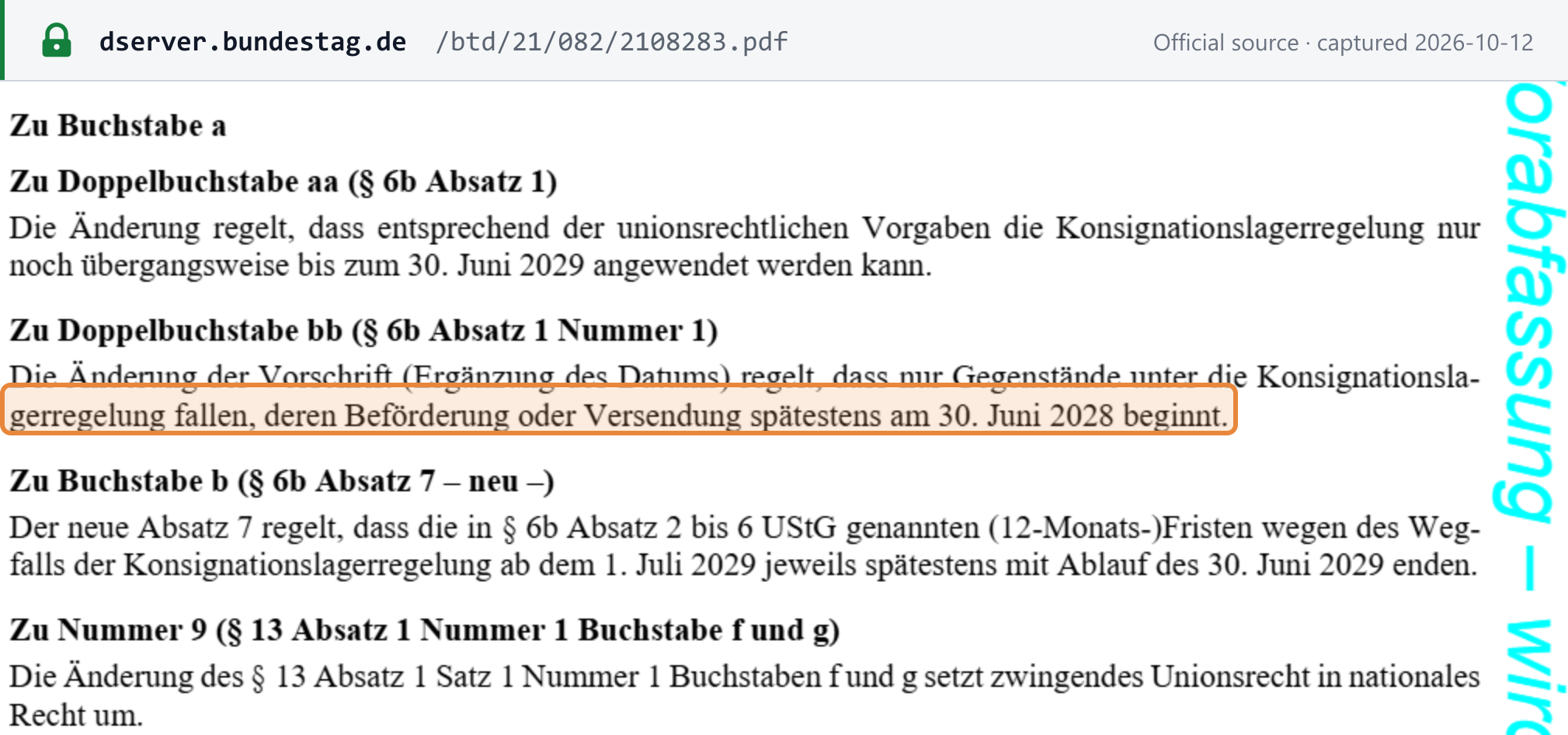 Source snapshot of the official page. Open full size ↗