Hungary: NAV proposes, not yet decided, a phased move from ÁNYK to eÁFA, with most VAT filers mandatory from 1 January 2028
This change is proposed and is not law. The rules below describe what would change if it is adopted.
This page records one dated change. For the rules in Hungary as they stand today, see the Hungary guide →
- Jurisdiction
- Hungary
- Tax
- VAT
- Change type
- Compliance
- Status
- Proposed
- Impact
- Watch
- Announced
- 15 October 2026
- Effective
- 1 January 2028
- Authority
- NAV (Nemzeti Adó- és Vámhivatal / National Tax and Customs Administration of Hungary)
- Systems
- ERP, Tax engine, Reporting
- Verified
- Fetched from official source · high confidence
The largest Hungarian companies (mandatory eÁFA during 2027) and most other VAT filers, such as SMEs (from 1 January 2028).
Re-baseline eAFA migration plan: large-company readiness during 2027, others 1 January 2028; watch for the implementing legal act.
ERPTax engineReporting
On 15 October 2026 Hungary's NAV proposed a phased replacement of the ÁNYK form-filler by eÁFA instead of full ÁNYK withdrawal on 31 December: the largest companies would move to mandatory eÁFA (VAT return) during 2027 (date and criteria not stated), most other VAT filers such as SMEs from 1 January 2028; income tax and corporate tax returns could still be filed in the old system in 2027. NAV describes this as a proposal on timing only.
What changed in detail
This is a proposal on timing only, not a decision. On 15 October 2026 Hungary’s NAV proposed a phased replacement of the ÁNYK form-filler by eÁFA, instead of full ÁNYK withdrawal on 31 December. The largest companies would move to mandatory eÁFA (VAT return) during 2027, with the date and criteria not stated. Most other VAT filers, such as SMEs, would move from 1 January 2028. Income tax and corporate tax returns could still be filed in the old system in 2027.
What it means
Until the phasing is confirmed, the 31 December ÁNYK withdrawal remains the stated plan. Large companies should prepare for eÁFA in 2027 without a published date, while SMEs may gain a year if NAV’s proposal is adopted.
Proof
Az áfabevallók többségének, például a kkv-knak még több idejük maradna a felkészülésre és a tesztelésre, nekik a NAV javaslata szerint 2028. január 1-jétől válna kötelezővé az eÁFA-ra való átállás.Most VAT filers, for example SMEs, would have more time to prepare and test; according to the NAV proposal the switch to eÁFA would become mandatory for them from 1 January 2028.
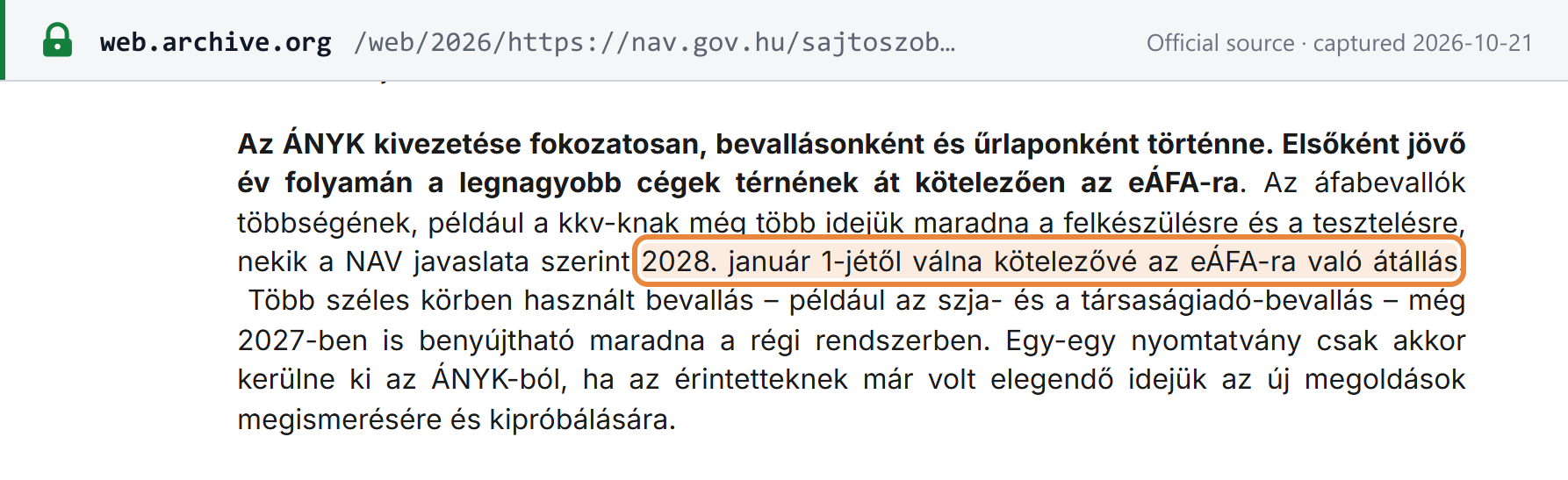 Source snapshot of the official page. Open full size ↗