Ireland's Finance (No. 2) Bill 2026 would mandate structured e-invoicing and transaction reporting from November 2028 — a bill, not yet law
This change is proposed and is not law. The rules below describe what would change if it is adopted.
This page records one dated change. For the rules in Ireland as they stand today, see the Ireland guide →
- Jurisdiction
- Ireland
- Tax
- VAT
- Change type
- E-invoicing
- Status
- Proposed
- Impact
- Watch
- Announced
- 19 October 2026
- Effective
- 1 January 2027
- Authority
- Houses of the Oireachtas (Ireland)
- Systems
- ERP, Invoicing, Tax engine, Reporting
- Verified
- Fetched from official source · high confidence
Irish accountable persons, starting with those administered by Revenue's Large Corporates Division, and their ERP and invoicing providers.
Map invoicing and ERP to EN 16931 structured e-invoice and per-transaction reporting requirements; monitor Bill amendments and Revenue regulations.
ERPInvoicingTax engineReporting
Ireland's Finance (No. 2) Bill 2026 (No. 98 of 2026, as initiated), section 51, inserts a new section 66A and Chapter 6A into the VAT Consolidation Act 2010 with effect from 1 January 2027. Section 66A would require a 'specified person' to issue invoices in a structured electronic format (EN 16931 / Directive 2014/55/EU syntax) for domestic B2B and B2G supplies: from 1 November 2028 to 31 October 2029 for accountable persons established in the State whose tax affairs were administered by Revenue's Large Corporates Division on 1 January 2027, and from 1 November 2029 also for those administered by it on 1 January 2028 or engaged in intra-Community acquisitions or supplies of goods or services. Other accountable persons may issue structured e-invoices. Chapter 6A (from 1 November 2028) requires specified persons to transmit specified transaction data to Revenue when the invoice is issued, and customers self-billing under section 71 to transmit within 5 days. Data content, formats and invoice particulars are left to regulations. Bill as initiated; figures and dates may be amended.
What changed in detail
This is not law. Section 51 of the Finance (No. 2) Bill 2026 (Bill 98 of 2026), as initiated, has not been passed by the Oireachtas, and its figures and dates may be amended.
As initiated, section 51 inserts a new section 66A and a new Chapter 6A into the VAT Consolidation Act 2010, with effect from 1 January 2027. Section 66A would require a ‘specified person’ to issue invoices in a structured electronic format (EN 16931 / Directive 2014/55/EU syntax) for domestic B2B and B2G supplies. The requirement would apply from 1 November 2028 to 31 October 2029 to accountable persons established in the State whose tax affairs were administered by Revenue’s Large Corporates Division on 1 January 2027. From 1 November 2029 it would also apply to those administered by that division on 1 January 2028 or engaged in intra-Community acquisitions or supplies of goods or services. Other accountable persons may issue structured e-invoices.
Chapter 6A, from 1 November 2028, would require specified persons to transmit specified transaction data to Revenue when the invoice is issued, and customers self-billing under section 71 to transmit within 5 days. Data content, formats and invoice particulars are left to regulations.
What it means
The timetable is a phased start, with the largest taxpayers first, so the first live date is more than two years away. Large Corporates Division customers should treat the bill as a planning signal and map invoicing and ERP data to EN 16931 and per-transaction reporting, while watching committee-stage amendments and the Revenue regulations that will set the detailed content.
Proof
(a) during the period from 1 November 2028 to 31 October 2029, to an accountable person established in the State whose tax affairs were administered by the division of the Office of the Revenue Commissioners known as the Large Corporates Division on 1 January 2027, and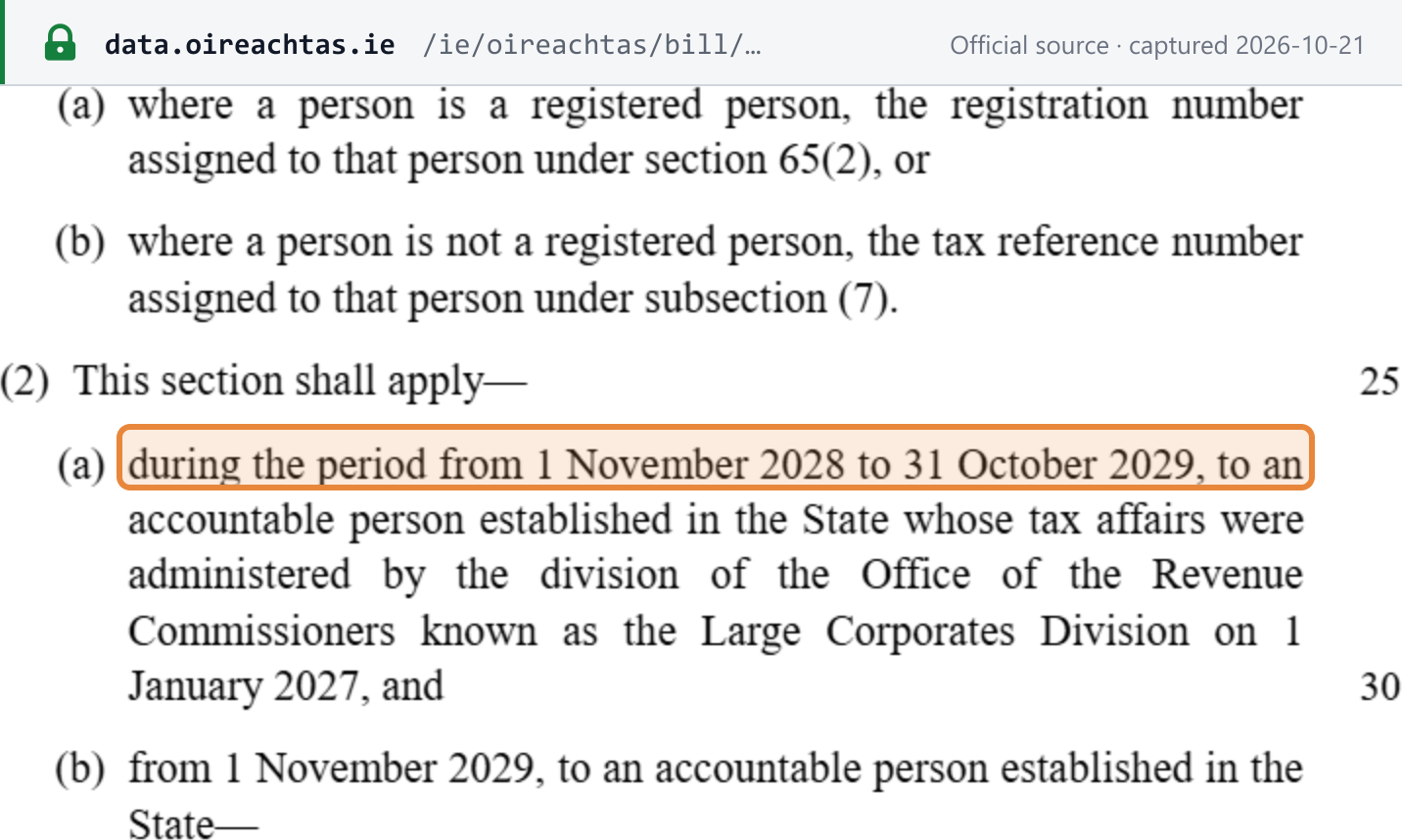 Source snapshot of the official page. Open full size ↗