Ireland publishes a three-phase VAT modernisation timeline starting November 2028
This change is proposed and is not law. The rules below describe what would change if it is adopted.
- Jurisdiction
- Ireland
- Tax
- VAT
- Change type
- E-invoicing
- Status
- Proposed
- Impact
- Watch
- Announced
- 20 July 2026
- Effective
- 1 November 2028
- Authority
- Office of the Revenue Commissioners
- Verified
- Fetched from official source · medium confidence
VAT-registered large corporates first, then VAT-registered businesses in cross-border EU zero-rated B2B trade. Businesses in every phase must be able to receive and process e-invoices from mandated suppliers.
No action — monitoring only. Irish businesses should note November 2028 as the first domestic B2B e-invoicing date when planning ERP roadmaps.
Irish Revenue published a VAT Modernisation Timeline, updated 20 July 2026, setting three phases for mandatory domestic e-invoicing and real-time digital reporting: November 2028 for large VAT-registered corporates on domestic B2B; November 2029 for VAT-registered businesses engaged in cross-border EU zero-rated B2B trade; and July 2030 for full alignment with the EU ViDA cross-border B2B requirements. Businesses in all phases must be able to receive and process e-invoices from mandated suppliers.
What changed in detail
Irish Revenue published a VAT Modernisation Timeline, updated 20 July 2026, setting three phases for mandatory e-invoicing and real-time digital reporting:
- Phase 1 — November 2028. VAT-registered large corporates implement mandatory e-invoicing and real-time reporting for domestic B2B transactions. Revenue notes this phase affects relatively few businesses, many with existing international e-invoicing experience.
- Phase 2 — November 2029. The domestic obligation extends to VAT-registered businesses engaged in cross-border EU B2B trade subject to zero-rate arrangements, giving them time to familiarise themselves domestically before the EU-wide system becomes mandatory.
- Phase 3 — July 2030. Full implementation of the EU ViDA requirements for cross-border EU B2B transactions across all Member States; Irish businesses already on the domestic system transition to the EU obligations.
For all phases, Revenue states that businesses must be able to receive and process e-invoices from any supplier mandated to issue them.
What it means
Ireland has put dates on the board ahead of the legislation that will carry them, so treat these as planning anchors rather than as obligations with a legal basis you can cite yet.
The receive-capability requirement is the one that bites earliest and is easiest to underestimate. It is not phased by size: from Phase 1, any business trading with a mandated large corporate needs to accept a structured invoice, which for many finance teams is a bigger change than issuing one. Scoping this as “we are not a large corporate, so 2028 is not our problem” is the mistake the timeline is written to prevent.
Proof
Phase 1 (November 2028) Value-Added Tax (VAT) registered large corporates will be required to implement mandatory eInvoicing and real-time reporting for domestic business-to-business (B2B) transactions.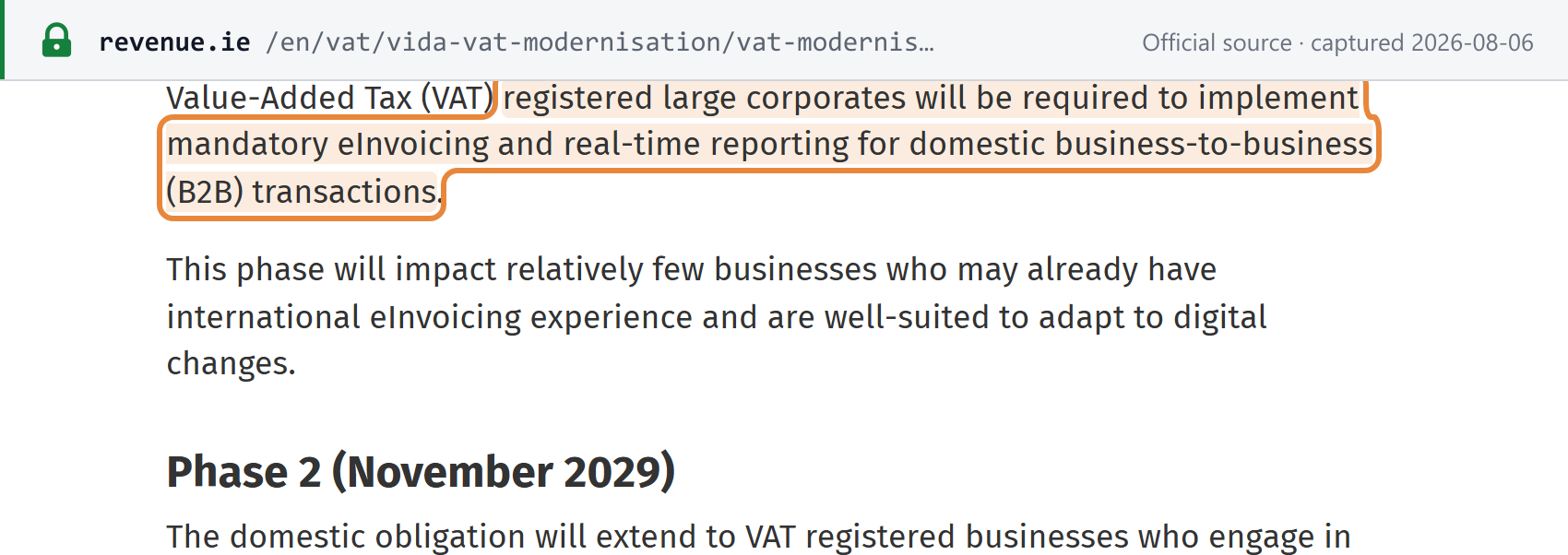 Source snapshot of the official page. Open full size ↗