Japan ends the 20% invoice-registration special (2-wari) and adds a 30% version (3-wari) for individuals in 2027 and 2028
- Jurisdiction
- Japan
- Tax
- Consumption tax
- Change type
- Compliance
- Status
- In force
- Impact
- Action required
- Effective
- 1 October 2026
- Authority
- National Tax Agency of Japan (NTA)
- Systems
- Tax engine, Reporting
- Verified
- Fetched from official source · high confidence
Formerly exempt businesses that became qualified invoice issuers; for 2027 and 2028, such individual business operators (sole traders).
Review small-business customers and suppliers: the 2-wari special (payable tax at 20% of output tax) ends for corporations with tax periods including 30 Sep 2026; individuals keep it for 2026 and move to the 3-wari special (30%) for 2027-2028.
Tax engineReporting
NTA guidance on the FY2026 tax reform states that the 2-wari special provision (2-wari tokurei), under which newly registered qualified invoice issuers that were previously exempt pay consumption tax equal to 20% of output tax, ends with tax periods including days up to 30 September 2026, and that a 3-wari special provision (3-wari tokurei) for individual business operators, limiting payable tax to 30% of output tax, applies for calendar years 2027 and 2028. The special deadline for submitting the simplified-taxation election form is also revised for issuers that used either provision, where the following tax period ends on or after 1 October 2026.
What changed in detail
National Tax Agency guidance on the FY2026 tax reform states that the 2-wari special provision (2-wari tokurei) ends with tax periods that include days up to 30 September 2026. Under it, qualified invoice issuers that were previously exempt and became registered pay consumption tax equal to 20% of output tax. For individuals, whose tax period is the calendar year, it therefore continues for the whole of calendar 2026.
It introduces a 3-wari special provision (3-wari tokurei) for individual business operators for calendar years 2027 and 2028, under which payable tax is 30% of output tax. The special deadline for submitting the simplified-taxation election form is also revised for issuers that used either provision, where the following tax period ends on or after 1 October 2026.
What it means
The two measures do not simply continue one another: the 20% treatment stops with tax periods that include days up to 30 September 2026, and the 30% treatment is for individuals, for 2027 and 2028 only. Both apply only to formerly exempt businesses that became registered issuers, not to every new registrant. Companies and other non-individual registrants should plan on the 2-wari ending. Individuals should check how the 3-wari figure compares with the simplified taxation method before filing the election.
Proof
現行の2割特例は、令和8年9月30日までの日の属する課税期間で終了します。The current 20% special provision ends with tax periods that include days up to 30 September Reiwa 8 (2026).
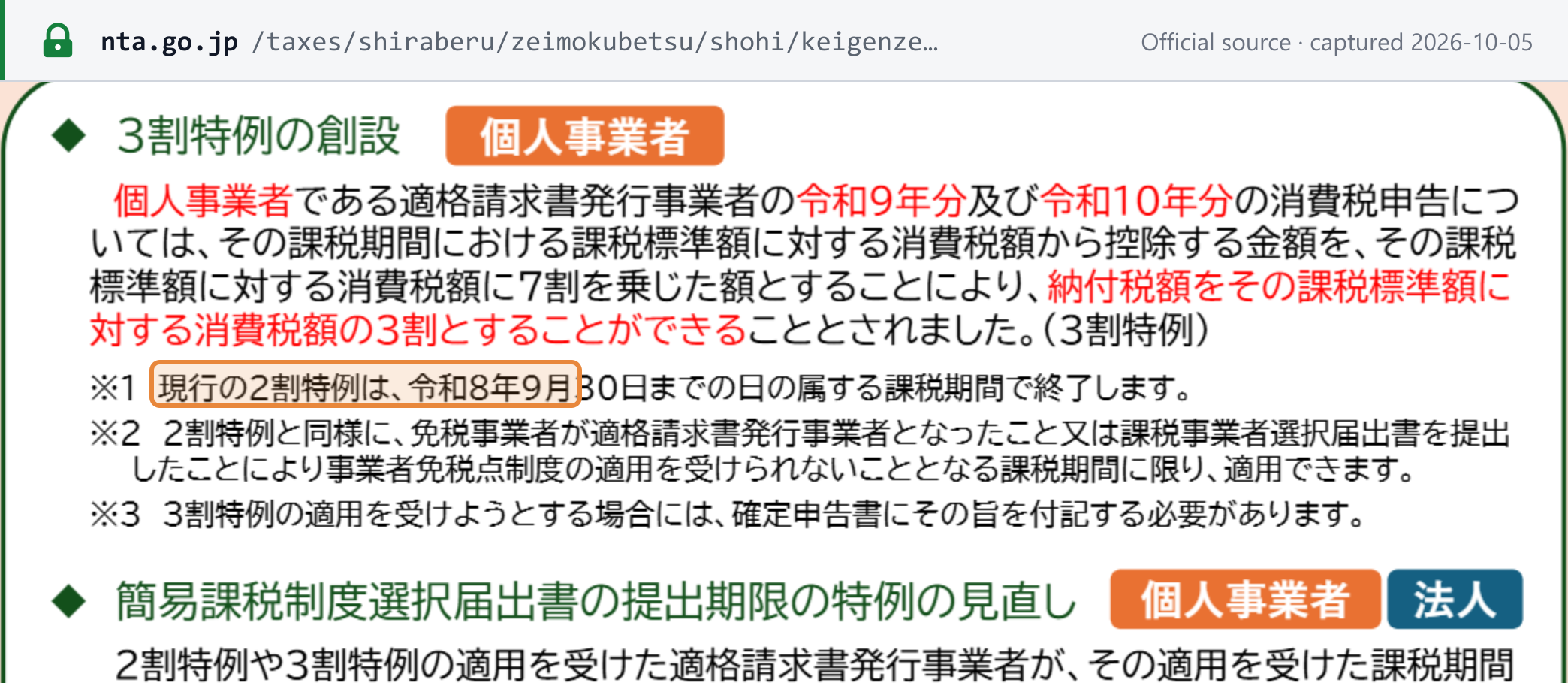 Source snapshot of the official page. Open full size ↗