Japan Cabinet outlines a proposed one-year, 1% consumption tax rate on food — not yet law
This change is proposed and is not law. The rules below describe what would change if it is adopted.
- Jurisdiction
- Japan
- Tax
- Consumption Tax
- Change type
- Rate change
- Status
- Proposed
- Impact
- Plan ahead
- Announced
- 15 September 2026
- Effective
- 1 April 2027
- Authority
- Cabinet Secretariat, Government of Japan
- Systems
- Invoicing, POS, Tax engine, ERP
- Verified
- Fetched from official source · high confidence
Food and beverage retailers, POS and invoicing systems, and consumers — contingent on Diet passage of implementing legislation; no filing or system change is required yet.
Track Diet deliberation of the implementing bill for this Cabinet-decided outline; begin assessing POS, invoicing and tax-engine changes needed for a possible 1 percent combined rate on food and beverages from the proposed 1 April 2027 start, without treating the rate as enacted.
InvoicingPOSTax engineERP
Japan Cabinet decided, on 15 September 2026, an outline titled Outline on the Temporary Reduction of the Consumption Tax Rate on Food and Beverages and the Introduction of a Worker Burden Reduction Support Payment. The outline proposes a temporary two-year reduction of the consumption tax rate on food and beverages (the same scope currently taxed at the 8 percent reduced rate) to 0.78 percent national plus local, combined 1 percent, from 1 April 2027 to 31 March 2029, alongside a new means-tested cash support payment for workers. The National Tax Agency (NTA) published a special explanatory site and leaflet on 15 September 2026 stating explicitly that the content depends on a bill still to be submitted to, deliberated by, and passed by the Diet.
What changed in detail
This is a Cabinet Outline, not a law. On 15 September 2026 Japan’s Cabinet decided the Outline on the Temporary Reduction of the Consumption Tax Rate on Food and Beverages and the Introduction of a Worker Burden Reduction Support Payment. The National Tax Agency’s own explanatory site, published the same day, states explicitly that the content depends on a bill still to be submitted to, deliberated by, and passed by the Diet.
The Outline proposes a temporary two-year reduction of the consumption tax rate on food and beverages — the same scope currently taxed at the 8% reduced rate — to 0.78% national plus local, a combined 1%, running from 1 April 2027 to 31 March 2029. It pairs the cut with a new means-tested cash support payment for workers.
What it means
Nothing changes at checkout today, and nothing will until a bill exists, passes the Diet, and is enacted — an outline is the government stating its intent, not a rate. The proposal is worth tracking precisely because of the systems lead time: a combined 1% rate on food and beverages is a POS, invoicing and tax-engine change with a hard two-year sunset built in from day one, which is an unusual shape for a rate change. Begin scoping the technical work now if the business is exposed, but do not implement anything, and do not represent the rate as enacted, until the Diet actually passes implementing legislation.
Proof
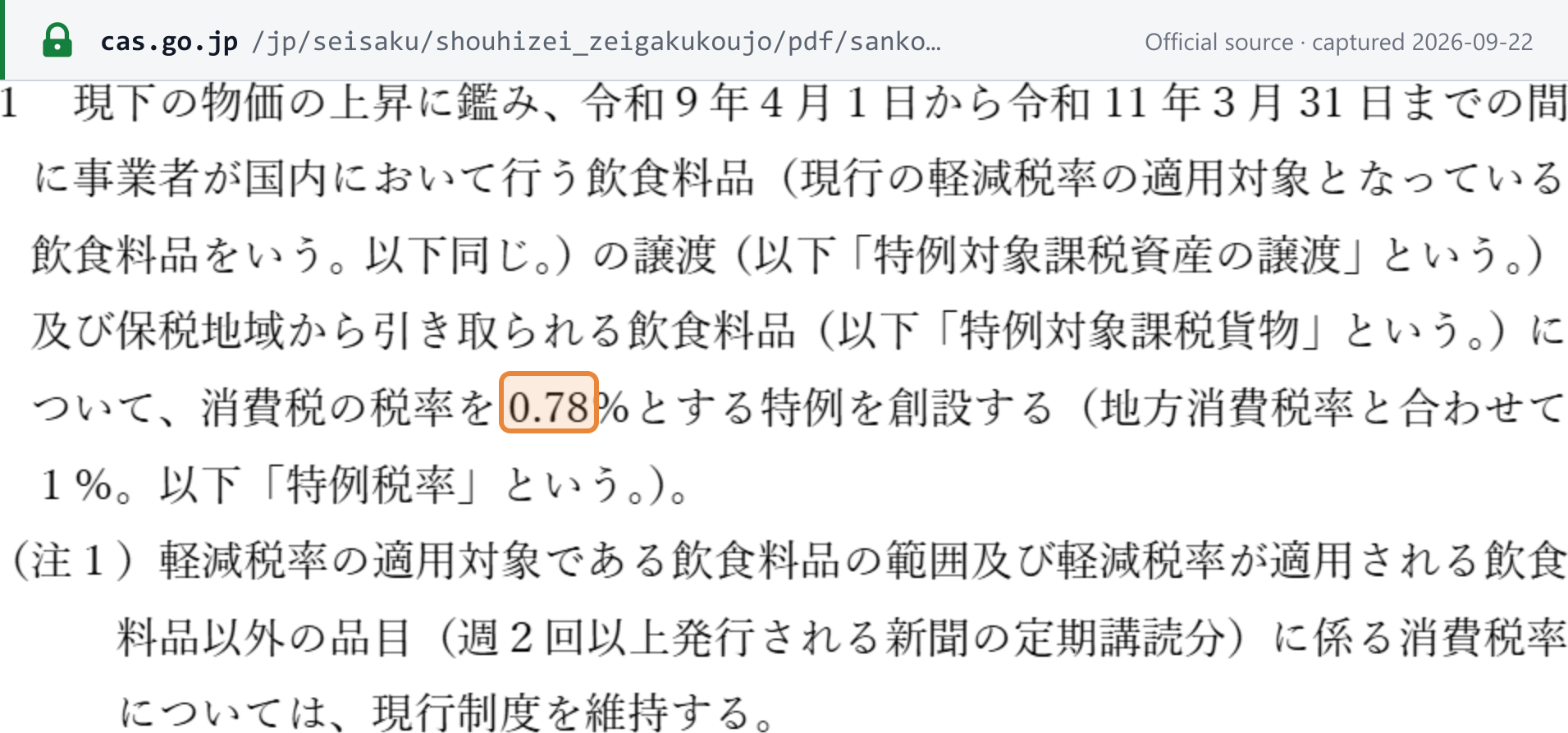
現下の物価の上昇に鑑み、令和9年4月1日から令和11年3月31日までの間に事業者が国内において行う飲食料品(現行の軽減税率の適用対象となっている飲食料品をいう。以下同じ。)の譲渡(以下「特例対象課税資産の譲渡」という。)及び保税地域から引き取られる飲食料品(以下「特例対象課税貨物」という。)について、消費税の税率を0.78%とする特例を創設する(地方消費税率と合わせて1%。以下「特例税率」という。)。In light of the current rise in prices, a special measure is created setting the consumption tax rate at 0.78% (1% combined with the local consumption tax rate, hereinafter the 'special tax rate') on the transfer of food and beverages (meaning food and beverages currently subject to the reduced tax rate; the same applies hereinafter) conducted domestically by business operators, and on food and beverages withdrawn from a bonded area, during the period from 1 April Reiwa 9 (2027) to 31 March Reiwa 11 (2029).
 Source snapshot of the official page. Open full size ↗