Malaysia opens a penalty-free e-Invoice voluntary disclosure window to 31 December 2027
This page records one dated change. For the rules in Malaysia as they stand today, see the Malaysia guide →
- Jurisdiction
- Malaysia
- Tax
- SST
- Change type
- Compliance
- Status
- In force
- Impact
- Plan ahead
- Announced
- 7 July 2026
- Effective
- 7 July 2026
- Instrument
- MY-HASIL-PKPS-EINVOIS-2026
- Authority
- Lembaga Hasil Dalam Negeri Malaysia (HASiL)
- Systems
- Invoicing, ERP, Tax engine
- Verified
- Fetched from official source · high confidence
Malaysian taxpayers past their mandated e-Invoice start date who did not submit every transaction, submitted erroneous or non-compliant data, or have not submitted at all.
Review historical e-Invoice submissions for gaps and errors and file voluntary corrections through MyInvois before 31 December 2027 to obtain the penalty waiver.
InvoicingERPTax engine
The Inland Revenue Board of Malaysia launched the e-Invoice Special Voluntary Disclosure Programme (Program Khas Pengakuan Sukarela e-Invois) on 7 July 2026, running to 31 December 2027. It is open to taxpayers who implemented e-Invoice on their mandated timeline but did not fully submit e-Invoices for certain transactions, who submitted e-Invoices containing errors or non-compliant data, or who have not submitted e-Invoices at all since their mandatory commencement date. Voluntary correction or disclosure through MyInvois during the window is not subject to any penalty. The programme is also set out in section 17 of the IRBM e-Invoice Specific Guideline (Version 4.8, dated 7 July 2026). The government also agreed to allow accelerated capital allowance claims, in full within one year, for ICT equipment and software development or modification costs incurred for e-Invoice implementation.
What changed in detail
The Inland Revenue Board of Malaysia launched the e-Invoice Special Voluntary Disclosure Programme (Program Khas Pengakuan Sukarela e-Invois) on 7 July 2026, running to 31 December 2027.
It is open to three groups: taxpayers who implemented e-Invoice on their mandated timeline but did not fully submit e-Invoices for certain transactions; taxpayers who submitted e-Invoices containing errors or non-compliant data; and taxpayers who have not submitted e-Invoices at all since their mandatory commencement date. Voluntary correction or disclosure through MyInvois during the window is not subject to any penalty. The programme is also set out in section 17 of the IRBM e-Invoice Specific Guideline (Version 4.8, dated 7 July 2026).
Separately, the government agreed to allow accelerated capital allowance claims, in full within one year, for ICT equipment and for software development or modification costs incurred for e-Invoice implementation.
What it means
An eighteen-month amnesty is an unusually candid admission that the first waves did not go cleanly. It is worth running a completeness reconciliation — submitted e-Invoices against ledger revenue, by month, since your start date — because the programme covers gaps you may not know you have, and the window is long enough to fix them properly rather than in a panic. The accelerated capital allowance is the quieter half: it changes the payback maths on remediation spend you were going to incur anyway.
Proof
Ms | 1 PROGRAM KHAS PENGAKUAN SUKARELA (PKPS) E - INVOIS CYBERJAYA , 7 JU LAI 2026 – Selaras dengan pengumuman oleh YAB Perdana Menteri merangkap Menteri Kewangan dalam Persidangan Dewan Rakyat pada hari ini berhubung ikhtiar tambahan bagi membantu mengurangkan kos pematuhan pembayar cukai, khususnya melibatkan P erusahaan M ikro, K ecil dan S ederhana (PMKS), Lembaga Hasil Dalam Negeri Malaysia (HASiL) ingin memaklumkan bahawa pelaksanaan Program Khas Pengakuan Sukarela (PKPS) e - Invois mula berkuat kuasa se hingga 31 Disember 2027 adalah ditawarkan kepada pembayar cukai yang berikut : a.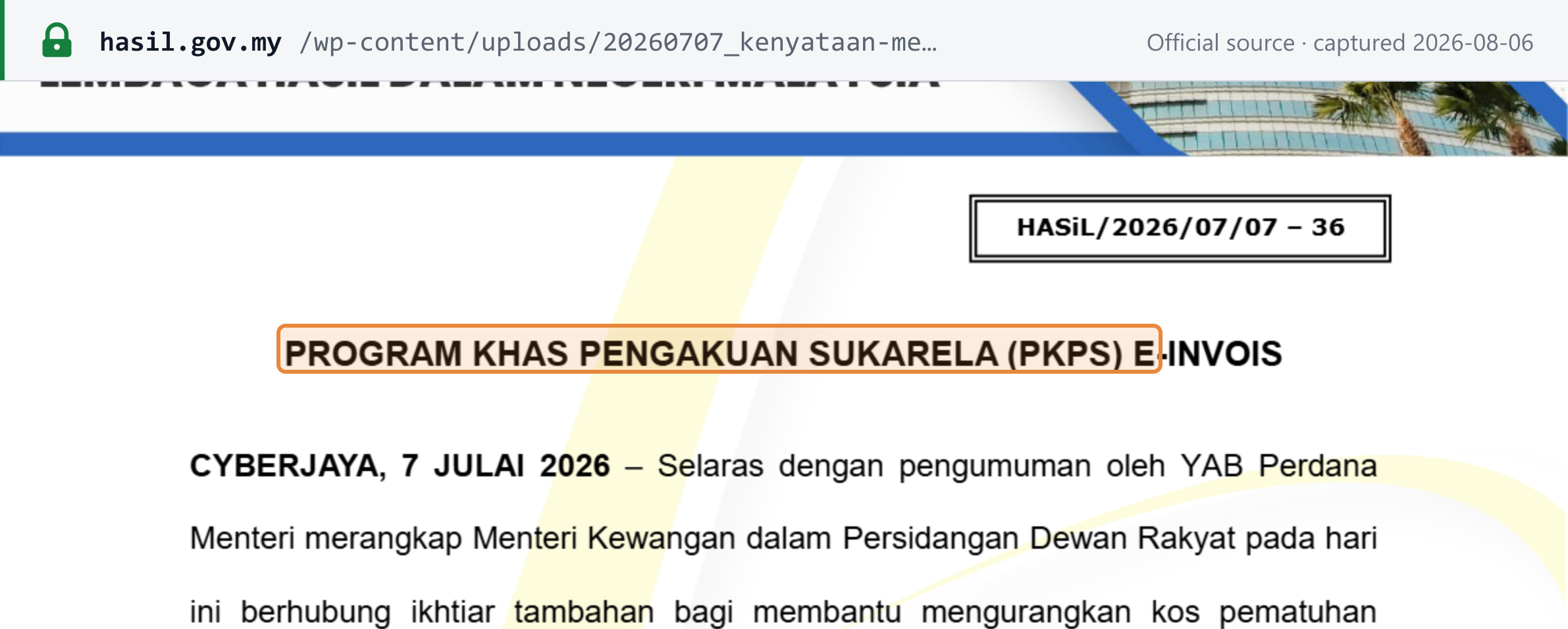 Source snapshot of the official page. Open full size ↗