Malaysia treats joint lessors as separate persons for the service tax threshold
This page records one dated change. For the rules in Malaysia as they stand today, see the Malaysia guide →
- Jurisdiction
- Malaysia
- Tax
- Service Tax
- Change type
- Registration
- Status
- In force
- Impact
- Action required
- Announced
- 22 July 2026
- Effective
- 1 July 2025
- Authority
- Royal Malaysian Customs Department (RMCD)
- Systems
- Invoicing, ERP, Tax engine
- Verified
- Fetched from official source · high confidence
Co-owners, joint venture parties and any other persons who jointly supply rental or leasing services in Malaysia under a single agreement.
Co-owners and joint lessors in Malaysia should test the service tax registration threshold individually and invoice their own share separately, rather than issuing a single undivided invoice.
InvoicingERPTax engine
Royal Malaysian Customs Department Service Tax Policy No. 4/2026, dated 22 July 2026, provides that persons jointly supplying rental or leasing services under a single agreement are treated as separate entities: each must register for service tax on its own taxable turnover and issue an invoice for its own portion of the rental value. Where a single invoice is issued in one party's name without a breakdown, that party carries the full registration and collection obligation. The policy applies with effect from 1 July 2025.
What changed in detail
Service Tax Policy No. 4/2026, dated 22 July 2026, sets out how the registration threshold and the charge apply where rental or leasing services in Group K of the First Schedule to the Service Tax Regulations 2018 are provided by more than one service provider.
Persons who jointly provide rental or leasing services under a single agreement are treated as separate entities. Each must register for service tax individually on its own total taxable services, and each must issue an invoice for its own portion or breakdown of the rental value.
The policy also settles the fall-back. Where the service is provided as a whole under a single agreement through a single invoice with no breakdown, issued in the name of one party — a joint venture or a representative, for example — that party is treated as the service provider and is liable for registration where the threshold value is met.
The policy applies with effect from 1 July 2025, the date rental and leasing became a taxable service under Group K.
What it means
This is a quiet trap for co-owned property. The default paperwork for a jointly owned building is one tenancy agreement and one invoice in one name, and that arrangement now concentrates the entire registration and collection obligation on the named party — potentially pushing one co-owner over the threshold on income that is mostly not theirs.
The fix is invoicing, not restructuring: issue per-owner invoices showing each share, and each owner tests the threshold on its own. Because the policy reaches back to 1 July 2025, the question is not only how to invoice from now on but whether anyone should already have been registered.
Proof
Persons who jointly provide rental or leasing services under a single rental or leasing agreement/contract shall be treated as separate entities and are required to register individually as service providers based on their respective total taxable services (threshold value). Each party is required to issue an invoice for their individual portion or breakdown of the rental or leasing value.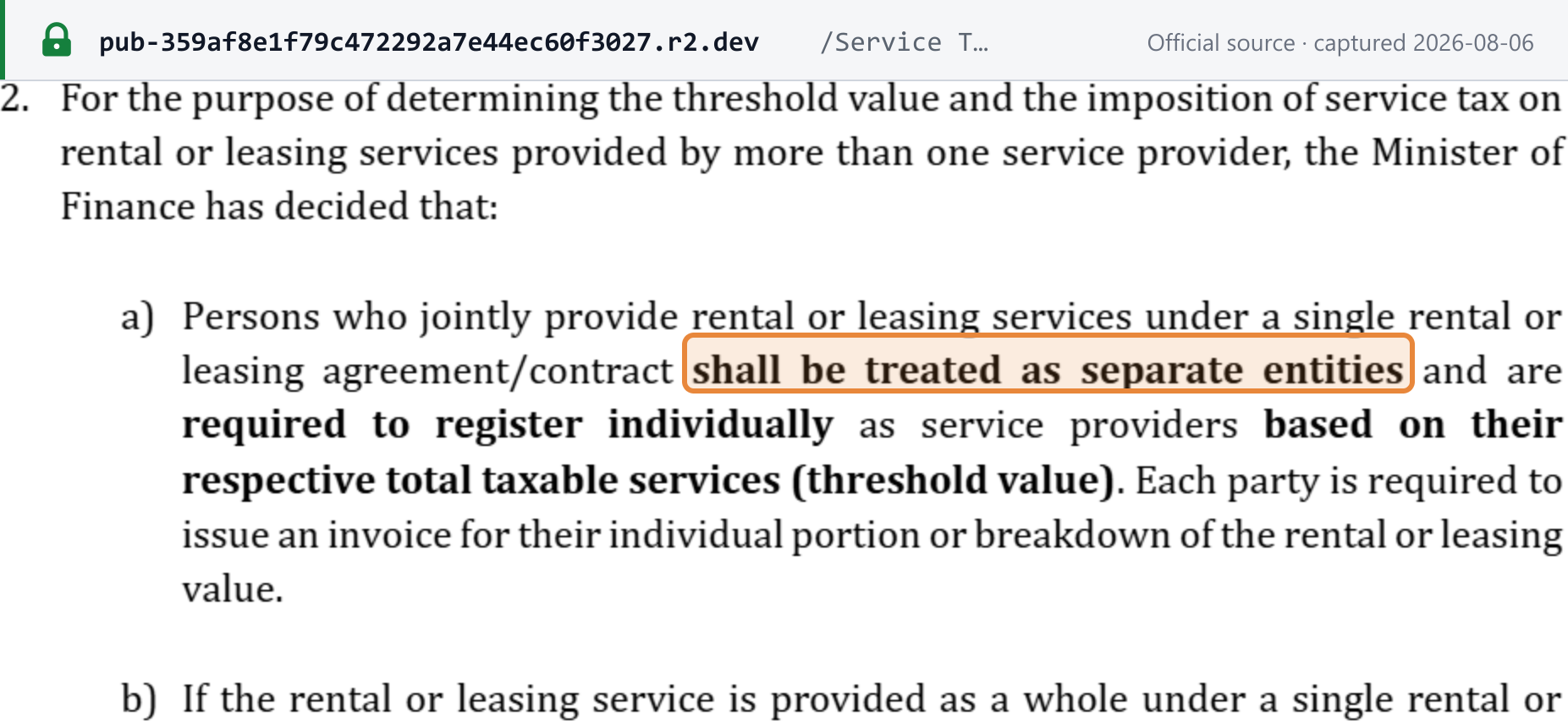 Source snapshot of the official page. Open full size ↗