Mauritania: from 1 November 2026 public entities cannot pay an invoice unless the supplier has declared it on the STT platform
- Jurisdiction
- Mauritania
- Tax
- VAT
- Change type
- E-invoicing
- Status
- Enacted
- Impact
- Action required
- Announced
- 29 September 2026
- Effective
- 1 November 2026
- Authority
- Ministère des Finances - République Islamique de Mauritanie
- Systems
- Invoicing, ERP, Reporting
- Verified
- Fetched from official source · high confidence
Mauritanian public entities; suppliers of goods, works and services to public entities.
Suppliers invoicing Mauritanian public entities should obtain STT access and declare each invoice on STT before submitting it for payment from 1 November 2026.
InvoicingERPReporting
A Ministry of Finance circular dated Nouakchott, 29 September 2026 generalises use by public entities of the STT teledeclaration and telepayment platform run by the Direction Generale des Impots. From 1 November 2026 public entities must file tax returns and pay taxes and withholdings exclusively electronically via STT, must declare on STT the invoices they issue to customers, and must require suppliers of goods, works and services to declare invoices addressed to them on STT beforehand and validate them in their STT space. From 1 November 2026 no invoice subject to the procedure can be paid by a public entity unless the supplier has declared it and the client public entity has validated it on STT; the entity must record payment on the platform after settlement. DGI training sessions during October 2026.
What changed in detail
A Ministry of Finance circular dated Nouakchott, 29 September 2026, generalises the use by public entities of the STT teledeclaration and telepayment platform operated by the Direction Générale des Impôts (DGI).
From 1 November 2026 public entities must:
- file tax returns and pay taxes and withholdings exclusively electronically through STT;
- declare on STT the invoices they issue to their customers;
- require suppliers of goods, works and services to declare invoices addressed to them on STT beforehand, and validate those invoices in their STT space.
From 1 November 2026 no invoice subject to the procedure can be paid by a public entity unless the supplier has declared it and the client public entity has validated it on STT. The entity must record payment on the platform after settlement. The DGI holds training sessions during October 2026.
What it means
For suppliers to the public sector the practical consequence is cash flow: an invoice that has not been declared on STT will not be paid. Suppliers should make sure they have STT access and a routine for declaring each invoice before submitting it to the client. Public entities need the same access to validate invoices and record payments.
Proof
À compter du 1er novembre 2026, aucune facture soumise à cette procédure ne pourra être mise en paiement par une entité publique si elle n'a pas été préalablement déclarée par le fournisseur et validée par l'entité publique cliente sur la plateforme STT.From 1 November 2026, no invoice subject to this procedure may be put forward for payment by a public entity unless it has first been declared by the supplier and validated by the client public entity on the STT platform.
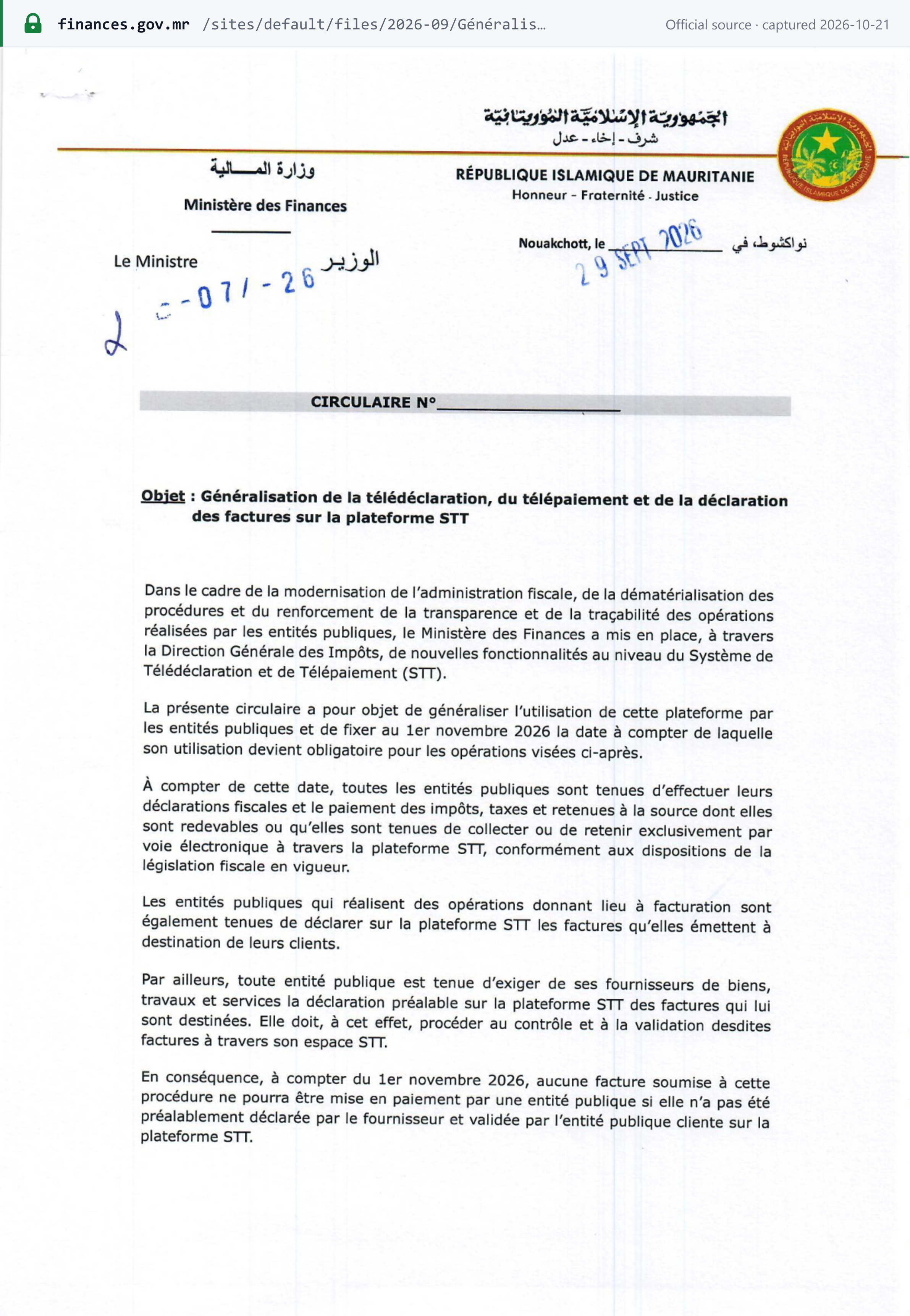 Source snapshot of the official page. Open full size ↗