Mauritius zero-rates e-books in the Finance Act 2026 — and never enacted the salt VAT relief
This page records one dated change. For the rules in Mauritius as they stand today, see the Mauritius guide →
- Jurisdiction
- Mauritius
- Tax
- VAT
- Change type
- Rate change
- Status
- In force
- Impact
- Action required
- Announced
- 13 August 2026
- Effective
- 13 August 2026
- Instrument
- MU-ACT-NO-14-OF-2026
- Authority
- National Assembly of Mauritius / Ministry of Finance
- Systems
- Tax engine, Invoicing, ERP
- Verified
- Fetched from official source · high confidence
Sellers of electronic books in Mauritius, who must zero-rate the supply (not exempt it) from 13 August 2026 and may keep recovering input VAT. Anyone who configured a zero-rated or exempt treatment for common salt on the strength of the June budget must remove it — it was not enacted.
Zero-rate supplies of electronic books in Mauritius from 13 August 2026, and remove any pending configuration for zero-rated common salt — it was not enacted.
Tax engineInvoicingERP
The Finance Act 2026 (Act No. 14 of 2026), passed on 31 July 2026, assented to on 12 August 2026 and gazetted on 13 August 2026, zero-rates electronic books: section 25(s) inserts the words "electronic books," after "printed books," in item 2, paragraph (i) of the Fifth Schedule to the Value Added Tax Act, which is the schedule of zero-rated supplies given effect by section 11 of that Act. The same paragraph replaces the atlas classification H.S. Code 4905.91.10 with H.S. Code 4905.20.10. The Act contains no provision zero-rating or otherwise relieving common salt; the word "salt" does not appear anywhere in its text. This corrects the report in issue 2026-W29 that the Finance Bill would zero-rate common salt and make electronic books VAT-exempt: common salt was not enacted, and electronic books were relieved by zero-rating rather than by exemption.
What changed in detail
The Finance Act 2026 (Act No. 14 of 2026) — passed 31 July 2026, assented to 12 August, gazetted 13 August — zero-rates electronic books. Section 25(s) inserts “electronic books,” after “printed books,” in item 2, paragraph (i) of the Fifth Schedule to the Value Added Tax Act, the schedule of zero-rated supplies given effect by section 11. The same paragraph updates the paired H.S. Code from 4905.91.10 to 4905.20.10. This is a materially different outcome from the widely reported Budget proposal, which described e-books as becoming VAT-exempt.
The Act contains no provision relieving common salt. Searching the complete extracted text of the gazetted Act — all 177,026 characters — for the word “salt” returns no matches. The Budget 2026-2027 proposal to zero-rate common salt was not carried into the enacted law.
What it means
Zero-rating and exemption are not the same treatment, and the gap is exactly input-VAT recovery: a zero-rated seller of e-books still reclaims VAT on its costs, while an exempt seller could not have. Anyone who read the Budget speech and pre-configured “exempt” for e-books has the wrong treatment coded. Separately, any system change staged for common salt on the strength of the same Budget speech should be reversed — it never became law, and nothing in this Act or elsewhere signals it is still pending.
Proof
(B) in paragraph (i) – (I) by inserting, after the words “printed books,”, the words “electronic books,”;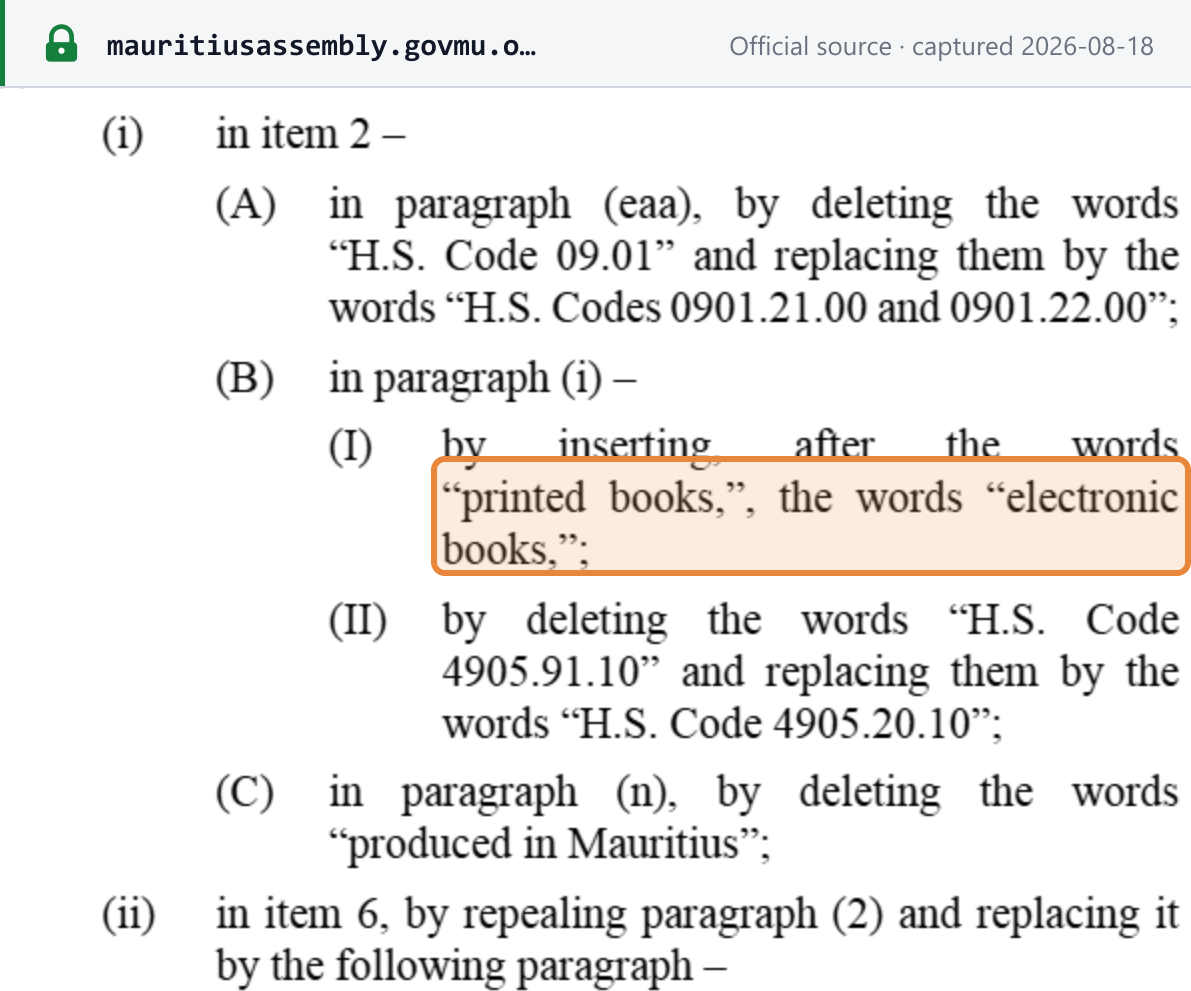 Source snapshot of the official page. Open full size ↗