Mauritius adds a three-month backstop to the time of supply
This page records one dated change. For the rules in Mauritius as they stand today, see the Mauritius guide →
- Jurisdiction
- Mauritius
- Tax
- VAT
- Change type
- Invoice rules
- Status
- In force
- Impact
- Action required
- Announced
- 13 August 2026
- Effective
- 1 October 2026
- Instrument
- MU-14-2026
- Authority
- Mauritius Revenue Authority
- Systems
- Tax engine, ERP, Invoicing
- Verified
- Fetched from official source · high confidence
Every VAT-registered person in Mauritius, and most acutely those with long billing cycles, retentions, or contracts where invoicing lags delivery.
Add a three-month backstop to your Mauritius time-of-supply logic from 1 October 2026: VAT falls due three months after delivery or performance even if no invoice or payment has occurred.
Tax engineERPInvoicing
Section 25(b) of the Finance Act 2026 amends section 5 of the Mauritius VAT Act to add a further time-of-supply trigger of three months from the date the supply is delivered or performed: as a new paragraph (c) in subsections (1) and (2), and as a new sub-paragraph (iii) within the lease limb of subsection (3). Because section 5(3) is structured as (a) hire purchase and (b) lease agreements, with only the lease limb carrying sub-paragraphs, the new trigger reaches leases but not hire-purchase supplies, which keep their own tax point at the time the agreement is made. Effective 1 October 2026.
What changed in detail
Section 25(b) of the Finance Act 2026 amends section 5 of the Mauritius VAT Act to add a further time-of-supply trigger of three months from the date the supply is delivered or performed: as a new paragraph (c) in subsections (1) and (2), and as a new sub-paragraph (iii) within the lease limb of subsection (3). Because section 5(3) is structured as (a) hire purchase and (b) lease agreements, with only the lease limb carrying sub-paragraphs, the new trigger reaches leases but not hire-purchase supplies, which keep their own tax point at the time the agreement is made. Effective 1 October 2026.
What it means
The existing rules turn on invoice date and payment date, both of which a supplier controls. This one does not: VAT falls due three months after the supply is delivered or performed whether or not anything has been invoiced or paid. Any process that relies on delaying invoicing — construction retentions, milestone billing, intercompany recharges settled late — now has a hard outer limit, and the change is in the tax engine rather than the invoicing workflow.
Proof
(b) in section 5 - (i) in subsection (1), by adding the following new paragraph ... (c) 3 months from the date the supply is delivered or performed,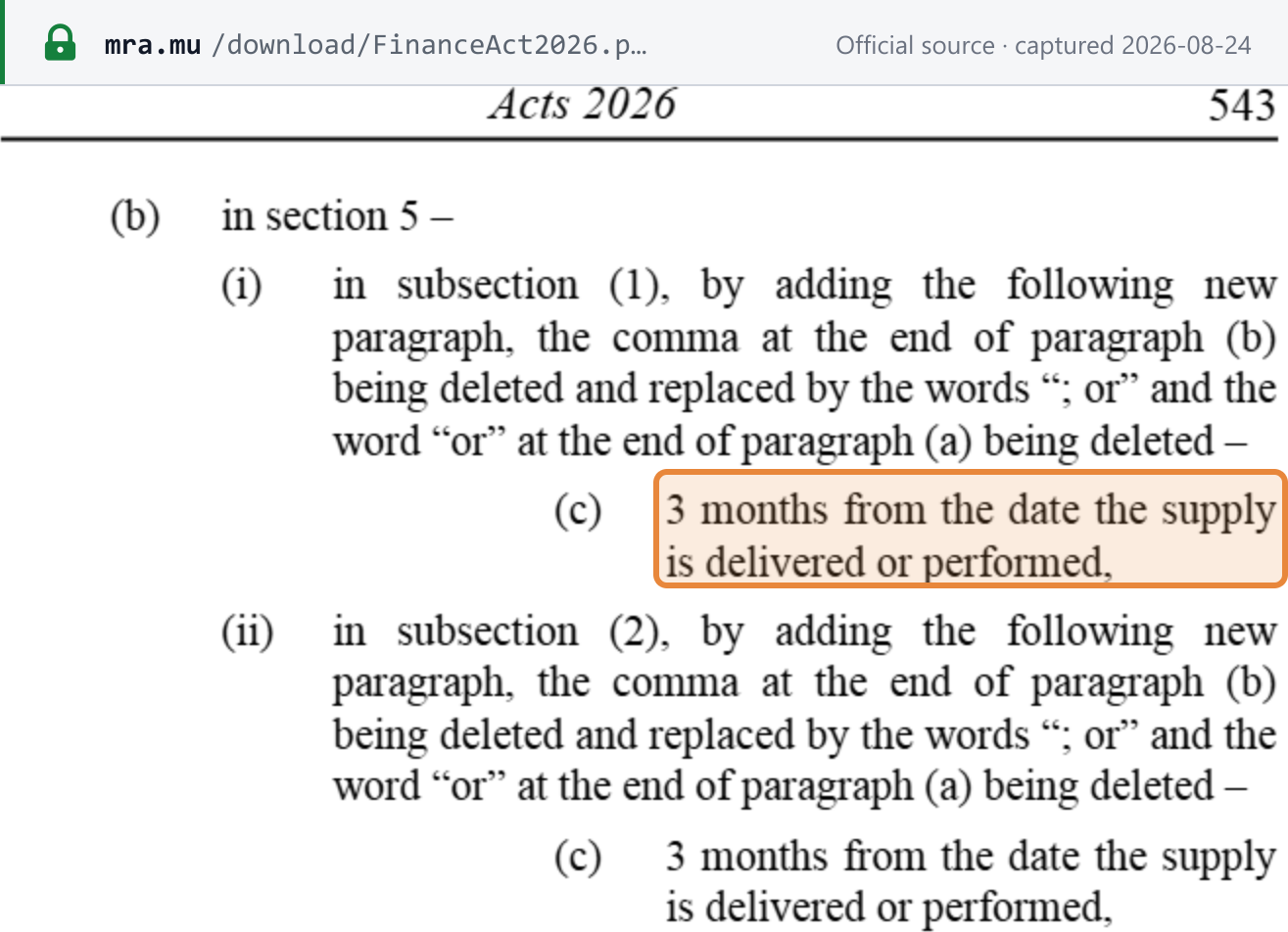 Source snapshot of the official page. Open full size ↗