Nepal's ride-sharing platforms must collect 5% VAT on the driver's fare, and charge 13% on their own commission
This page records one dated change. For the rules in Nepal as they stand today, see the Nepal guide →
- Jurisdiction
- Nepal
- Tax
- VAT
- Change type
- Digital services
- Status
- In force
- Impact
- Action required
- Effective
- 17 July 2026
- Instrument
- NP-2083-03-31
- Authority
- Inland Revenue Department, Nepal
- Systems
- E-commerce, Tax engine
- Verified
- Fetched from official source · high confidence
Ride-sharing and delivery platform operators in Nepal (e.g. Pathao, inDrive, Yango), and the drivers affiliated to their platforms who provide the transport or delivery service.
Ride-sharing and delivery platforms operating in Nepal must collect 5% VAT on the rider’s service fee, issue the prescribed invoice on the rider’s behalf and remit by the 25th of the following month — with no input credit on the amount collected — while continuing to charge 13% on their own commission.
E-commerceTax engine
Nepal's Inland Revenue Department issued a public notice implementing a new sub-section (1-Kha) of Section 7 of the VAT Act 2052, added by the Finance Act 2083, requiring ride-sharing/delivery platform operators (e.g. Pathao, inDrive, Yango) to collect VAT at 5% of the service fee charged by drivers/riders providing transport and delivery services through their platform, issue a prescribed tax invoice on the rider's behalf, and remit the collected tax to the tax office by the 25th of the following month; the platform cannot claim input tax credit on this collected amount. Platforms separately charge the standard 13% VAT on their own commission/booking-fee income. Riders must hold a PAN but are not required to register for VAT themselves.
What changed in detail
Nepal’s Inland Revenue Department issued a public notice implementing a new sub-section (1-Kha) of Section 7 of the VAT Act 2052, added by the Finance Act 2083. Under it, a ride-sharing or delivery platform operator (the notice names Pathao, inDrive and Yango as examples) must:
- collect VAT at 5% of the fare — the fee the driver charges the passenger for the transport or delivery service — on the driver’s behalf, at the time of the transaction;
- issue the prescribed tax invoice for that fare on the driver’s behalf, though the invoiced income is not the platform’s own;
- remit the VAT it has collected on drivers’ behalf to the tax office by the 25th of the following month; and
- separately charge the standard 13% VAT on its own commission and other service-fee income from drivers, under its normal VAT registration.
The platform cannot claim input tax credit on the 5% it collects and remits on a driver’s behalf. A rider must hold a PAN but is not required to register for VAT personally — the platform carries that obligation.
What it means
The two rates apply to two different flows of money, and mixing them up is the easiest mistake to make: 5% is on what the passenger pays the driver (the fare), collected and remitted by the platform as an agent; 13% is on what the driver pays the platform (commission and other service fees), which is the platform’s own ordinary VAT liability. This is a familiar collection design — the platform, not the individual driver, is the point at which VAT is captured, because a population of drivers is expensive to register and audit while a handful of platforms already hold every transaction record. Platforms should build the 25th-of-next-month remittance deadline into their compliance calendar as a distinct, recurring obligation from their own periodic VAT return.
Proof
आफ्नो प्लाटफर्ममा आबद्ध भई यातायात तथा ढुवानी सेवा प्रदान गर्ने राइडरको तर्फबाट त्यस्तो सेवा वापत लिने शुल्कको पाँच प्रतिशतका दरले मूल्य अभिवृद्धि कर सङ्कलन गर्नु पर्दछ।It must collect value added tax, at the rate of five percent, of the fee charged in exchange for such service, on behalf of the rider who, being affiliated to its platform, provides the transport and delivery service.
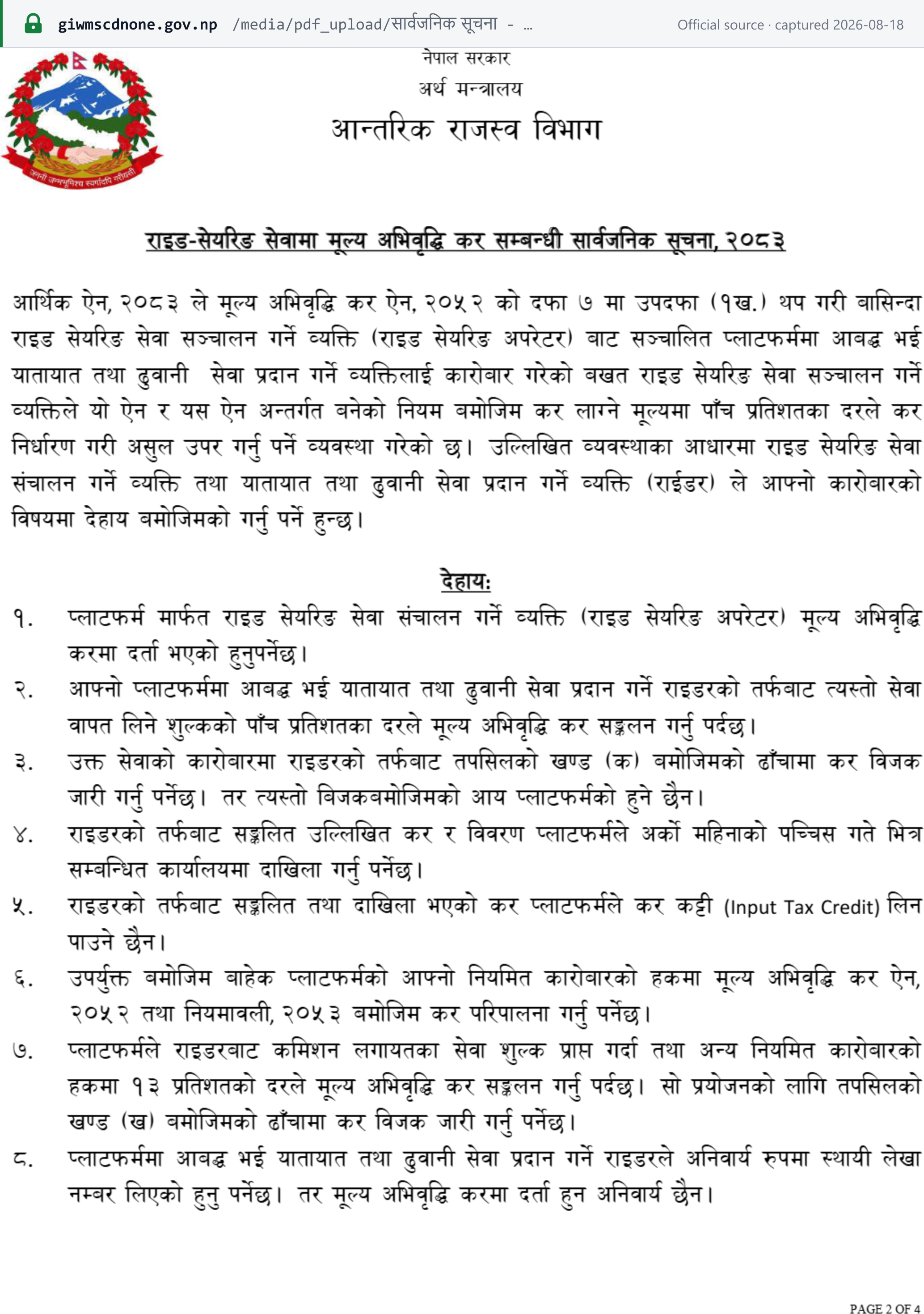 Source snapshot of the official page. Open full size ↗
Archived from the official distribution · सार्वजनिक सूचना — राइड सेयरिङ सेवामा मूल्य अभिवृद्धि कर सम्बन्धी सार्वजनिक सूचना, 2083 · giwmscdnone.gov.np
Sources
What this replaces
- Nepal creates a VAT collection mechanism for ride-sharing operators and their drivers effective 15 June 2026