Nepal creates a VAT collection mechanism for ride-sharing operators and their drivers
This page records one dated change. For the rules in Nepal as they stand today, see the Nepal guide →
- Jurisdiction
- Nepal
- Tax
- VAT
- Change type
- Compliance
- Status
- In force
- Impact
- Action required
- Effective
- 15 June 2026
- Authority
- Inland Revenue Department, Nepal
- Systems
- Tax engine, Invoicing, E-commerce
- Verified
- Fetched from official source · medium confidence
Resident ride-sharing operators in Nepal and the drivers affiliated to their platforms who provide transport and haulage services.
Ride-sharing platform operators and affiliated drivers in Nepal should review the new VAT collection guidelines under Finance Act 2083 (Section 7(1kha) of the VAT Act 2052) and update billing/remittance processes accordingly.
Tax engineInvoicingE-commerce
Nepal's Finance Act 2083 added a new subsection (1kha) to Section 7 of the Value Added Tax Act 2052, establishing a VAT collection procedure specifically for ride-sharing service operators and their affiliated drivers. The Inland Revenue Department (IRD) decided on 2083/03/31 (~14-15 June 2026) to issue implementing 'Guidelines for Collection of Value Added Tax in Ride-Sharing Services, 2083' and published a public notice announcing this to ride-sharing platform operators, affiliated drivers, and other service providers on the platforms.
What changed in detail
Nepal’s Finance Act 2083 adds a new subsection (1kha) to section 7 of the Value Added Tax Act 2052, establishing how VAT is collected on ride-sharing services. Under it, the person operating the ride-sharing service — the ride-sharing operator — collects VAT at the time of the transaction from the person who is affiliated to the operator’s platform and provides the transport or haulage service.
The Inland Revenue Department published a public notice recording that, on 2083/03/31, it decided to issue Guidelines for the Collection of Value Added Tax in Ride-Sharing Services, 2083 to implement the new subsection. The notice states the purpose of the guidelines as simplifying the collection arrangement and making it procedurally straightforward, clear, transparent and predictable, so as to secure compliance with the tax law and broaden tax participation.
The notice is addressed to ride-sharing platform operators, the drivers affiliated to those platforms, and other service providers operating through them, and is published for the information of all concerned.
What it means
This is the same collection design that has spread through platform taxation elsewhere: the platform, not the driver, is the point at which VAT is captured. The reason is practical rather than doctrinal — a population of individual drivers is expensive to register and audit, while a handful of operators already hold every transaction record.
The detail that matters for operators is that the obligation is stated as collecting at the time of the transaction, which puts it in the fare flow rather than in a periodic settlement. Platforms should read the guidelines rather than the Act alone: the statutory subsection is one sentence, and everything about how the collection is evidenced, remitted and reconciled sits in the implementing guidance.
Proof
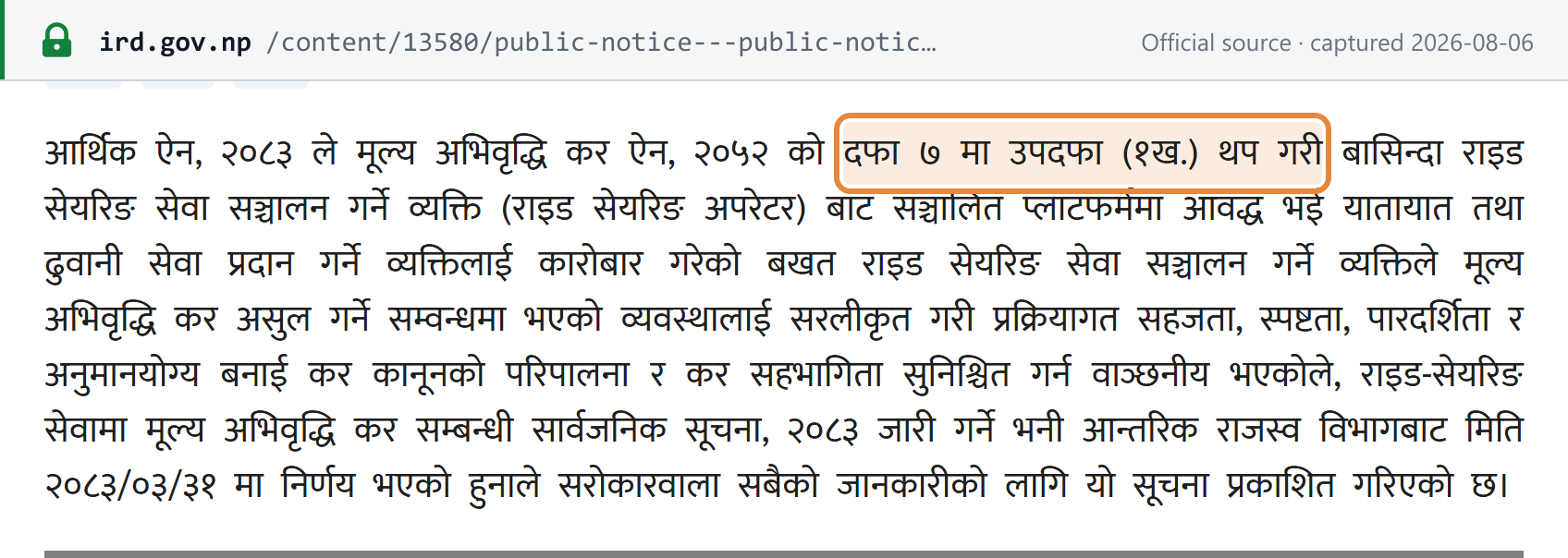
आर्थिक ऐन, २०८३ ले मूल्य अभिवृद्धि कर ऐन, २०५२ को दफा ७ मा उपदफा (१ख.) थप गरी बासिन्दा राइड सेयरिङ सेवा सञ्चालन गर्ने व्यक्ति (राइड सेयरिङ अपरेटर) बाट सञ्चालित प्लाटफर्ममा आवद्ध भई यातायात तथा ढुवानी सेवा प्रदान गर्ने व्यक्तिलाई कारोबार गरेको बखत राइड सेयरिङ सेवा सञ्चालन गर्ने व्यक्तिले मूल्य अभिवृद्धि कर असुल गर्ने सम्वन्धमा भएको व्यवस्थालाई सरलीकृत गरीThe Finance Act 2083 has added subsection (1kha) to section 7 of the Value Added Tax Act 2052, simplifying the arrangement under which a resident ride-sharing operator collects value added tax, at the time of the transaction, from a person who is affiliated to the platform operated by that ride-sharing operator and provides transport and haulage services.
 Source snapshot of the official page. Open full size ↗