BIR gives covered Philippine taxpayers until 31 December 2026 to issue electronic invoices
This page records one dated change. For the rules in Philippines as they stand today, see the Philippines guide →
- Jurisdiction
- Philippines
- Tax
- VAT — electronic invoicing / e-sales reporting
- Change type
- E-invoicing
- Status
- Enacted
- Impact
- Plan ahead
- Announced
- 16 October 2025
- Effective
- 31 December 2026
- Authority
- Bureau of Internal Revenue (BIR), Philippines
- Systems
- Invoicing, E-commerce, POS
- Verified
- Fetched from official source · high confidence
E-commerce and internet-transaction taxpayers classified Small, Medium or Large (Micro exempted); taxpayers under the Large Taxpayers Service; taxpayers classified Large under RA 11976 and RR No. 8-2024; and users of CAS or CBA with accounting records and other invoicing software.
Confirm your taxpayer classification against the RR No. 26-2025 list (e-commerce, LTS, RA 11976 large taxpayers, CAS/CBA users) and ensure electronic invoice issuance capability, including for all branches, is live before 31 December 2026.
InvoicingE-commercePOS
BIR Revenue Regulations No. 26-2025 (issued 16 October 2025) amended the transitory provisions of RR No. 11-2025, giving covered taxpayers — e-commerce/internet-transaction taxpayers (small/medium/large; micro exempt), Large Taxpayers Service taxpayers, Large Taxpayers under RA 11976/RR 8-2024, and taxpayers using CAS/CBA with e-invoicing or other invoicing software — until 31 December 2026 to comply with electronic invoice issuance requirements; head offices and all branches of a covered taxpayer must also issue electronic invoices.
What changed in detail
Revenue Regulations No. 26-2025, issued on 16 October 2025, amends the transitory provisions of RR No. 11-2025, extending the compliance period for electronic invoice issuance by covered taxpayers “in consideration of the operational adjustments required of taxpayers, including reconfiguration and transition to electronic invoicing”.
Four groups have until 31 December 2026 to comply with the electronic invoicing requirements: taxpayers engaged in e-commerce or internet transactions classified as Small, Medium and Large (Micro Taxpayers are exempted); taxpayers under the jurisdiction of the Large Taxpayers Service; taxpayers classified as Large Taxpayers under RA No. 11976 (Ease of Paying Taxes Act) and RR No. 8-2024; and taxpayers using a Computerized Accounting System or Computerized Books of Accounts with accounting records and other invoicing software.
A further set — exporters under sections 106 and 108 of the Tax Code, Registered Business Enterprises with incentives under section 304(D), POS System users, and others the Commissioner requires — is not on that deadline. Those taxpayers become required to issue electronic invoices only once a system capable of storing and processing the data to be transmitted to the BIR is established, and then through separate Revenue Regulations. The same condition and a near-identical list govern the Electronic Sales Reporting System.
The regulations close by reserving to the Commissioner of Internal Revenue the power to further extend the deadlines or compliance period.
Note that the digest presents the amended clause as “SECTION 6. Transitory Provisions” while introducing it as an amendment to “Section 14-Transitory Provisions of RR No. 11-2025”.
What it means
The date to work back from is 31 December 2026, but only if you are in one of the four listed groups, and classification is the part people get wrong. “Large Taxpayer” here has two separate sources — LTS jurisdiction and the RA 11976 classification — and item 4 pulls in anyone running a CAS or CBA regardless of size. A mid-sized company with accounting software can be in scope while a larger one without it is not.
The unconditional deadline and the conditional one are easy to conflate. Exporters, incentive-holding RBEs and POS users have no date at all yet; theirs starts when the BIR’s receiving system exists and a new RR says so. Building a 2026 programme around a date that has not been set is the wasted-effort case here. And the Commissioner’s reserved extension power is a reason to track issuances rather than treat the date as fixed.
Proof
SECTION 6. Transitory Provisions. – The following taxpayers shall have until December 31, 2026 to comply with the electronic invoicing requirements (issuance of electronic invoices) prescribed in these Regulations: 1. Taxpayers engaged in electronic commerce (e-commerce) or internet transactions, classified as Small, Medium and Large Taxpayers, (Micro Taxpayers are exempted); 2. Taxpayers under the jurisdiction of the Large Taxpayers Service (LTS); 3. Taxpayers classified as Large Taxpayers under RA No. 11976 (Ease of Paying Taxes Act) and RR No. 8-2024; 4. Taxpayers using Computerized Accounting System (CAS), and Computerized Books of Accounts (CBA) with Accounting Records (with electronic invoicing) and other invoicing software.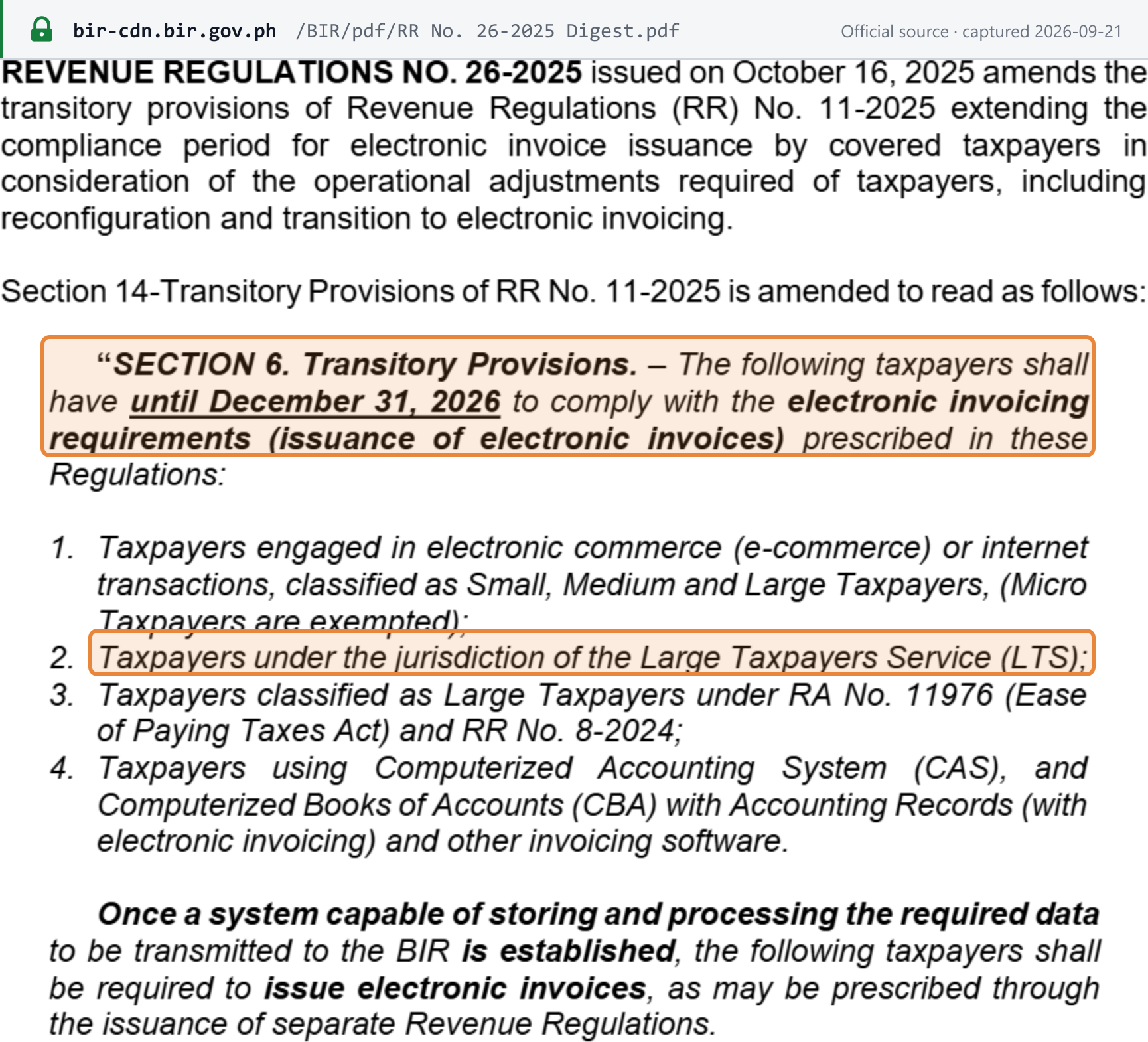 Source snapshot of the official page. Open full size ↗
Archived from the official distribution · Revenue Regulations No. 26-2025 (Digest), Bureau of Internal Revenue — issued 16 October 2025, p.1 of 2 · bir-cdn.bir.gov.ph
The Commissioner of Internal Revenue may further extend the deadlines or compliance period on the transition period prescribed in the Regulations as may be deemed necessary.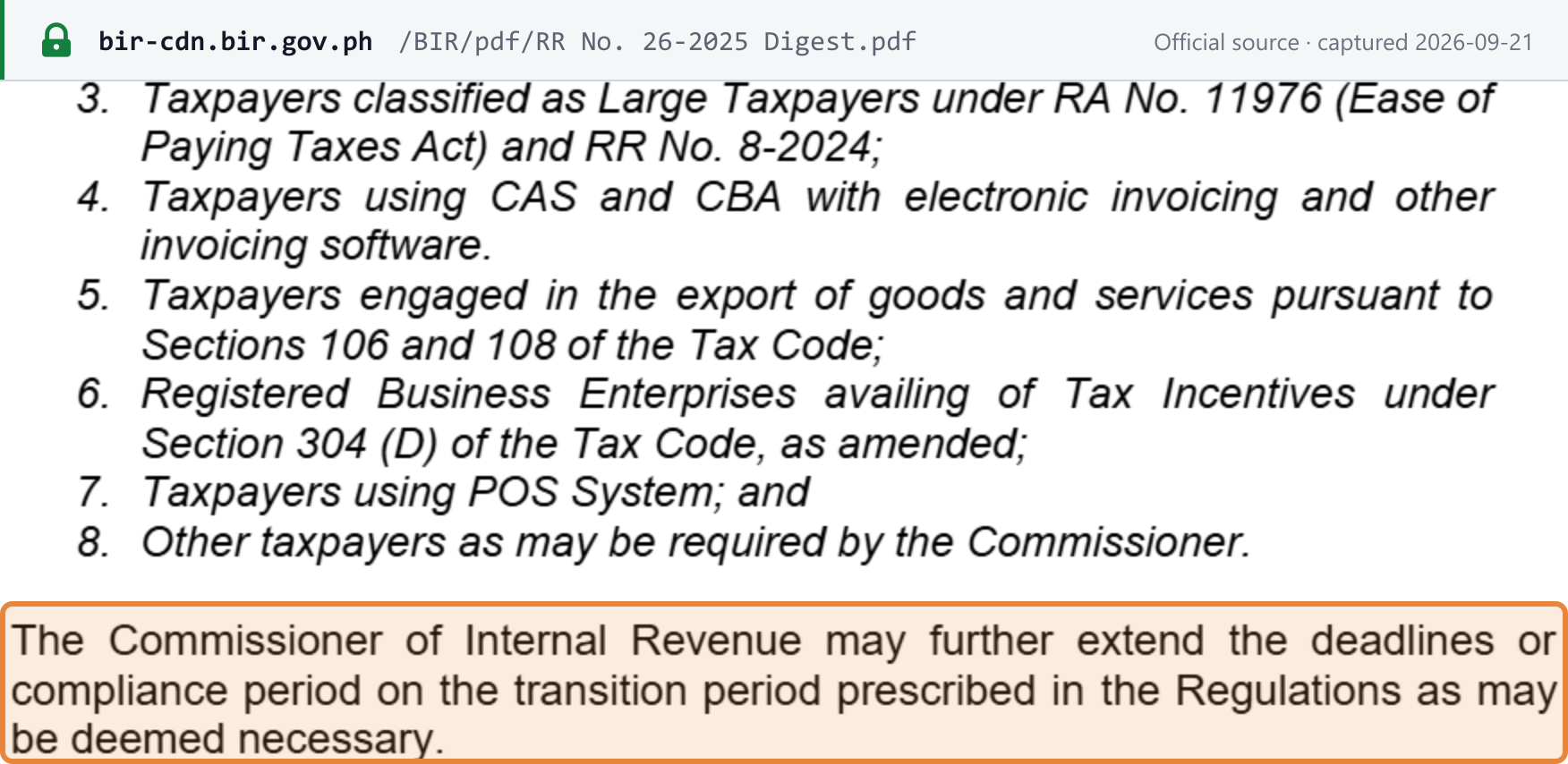 Source snapshot of the official page. Open full size ↗
Archived from the official distribution · Revenue Regulations No. 26-2025 (Digest) — closing paragraph, p.2 of 2 · bir-cdn.bir.gov.ph