Sierra Leone makes supplying digital services to local consumers a GST registration trigger
- Jurisdiction
- Sierra Leone
- Tax
- GST
- Change type
- Registration
- Status
- In force
- Impact
- Action required
- Announced
- 7 January 2026
- Effective
- 1 January 2026
- Authority
- National Revenue Authority (Sierra Leone)
- Systems
- Tax engine, E-commerce
- Verified
- Fetched from official source · high confidence
Any person making a taxable supply of digital services to consumers in Sierra Leone, with or without a physical presence in the country.
Non-resident suppliers of digital services to Sierra Leone consumers must assess GST registration liability under section 15(4)(c), independent of any local physical presence.
Tax engineE-commerce
Sierra Leone's Finance Act, 2026 (Act No. 1 of 2026, gazetted 7 January 2026, effective 1 January 2026) amended section 15(4) of the Goods and Services Tax Act 2009 to add registration liability for a person who makes a taxable supply of digital services to consumers in Sierra Leone, whether or not that person has a physical presence in Sierra Leone. This is a separate limb of the same Finance Act's digital-economy package from the already-published section 100 (representative-appointment) change.
What changed in detail
The Finance Act, 2026 (Act No. 1 of 2026), published as a supplement to the Sierra Leone Gazette Extraordinary Vol. CLXVII, No. 3 of 7 January 2026, amends the Goods and Services Tax Act, 2009. Section 18 of the Finance Act amends section 15(4) of the GST Act by inserting a new paragraph (c) immediately after paragraph (b).
The new paragraph applies where the person makes a taxable supply of digital services to consumers in Sierra Leone, whether or not the person has a physical presence in Sierra Leone. Physical presence is therefore expressly severed from the registration question.
The same Act builds out the rest of the digital-economy package. Section 17 inserts a definition of “digital marketplace” into section 2 of the GST Act — a platform that allows, enables or releases support for direct interactions between buyers and sellers of goods and services through any electronic or digital means for fee, commission, mark-up or direct business or personal benefit. Section 24 replaces section 100, requiring a non-resident digital-services supplier to appoint a local representative in writing (the representative duty).
Section 1 of the Finance Act provides that, unless otherwise stated, the Act is deemed to have come into operation on 1 January 2026. The Act was passed in Parliament on 25 November 2025 and signed by the President on 29 December 2025.
What it means
The registration trigger and the representative duty are two halves of one mechanism, and reading either alone understates the obligation. Section 15(4)(c) puts a non-resident supplier of digital services inside the registration net; section 100 says it must have a named person in Sierra Leone to be within reach of. A supplier that has done neither is not merely unregistered — it is unregistered in a jurisdiction that has written down exactly why it cannot claim to be out of scope.
Note also that this took effect on 1 January 2026, so the exposure is retrospective rather than prospective: it is quarters already invoiced that need checking, not next year’s roadmap. The inserted paragraph sets no turnover floor of its own, so a low-volume supplier should not assume the general threshold answers the question.
Proof
if the person makes a taxable supply of digital services to consumers in Sierra Leone, whether or not the person has a physical presence in Sierra Leone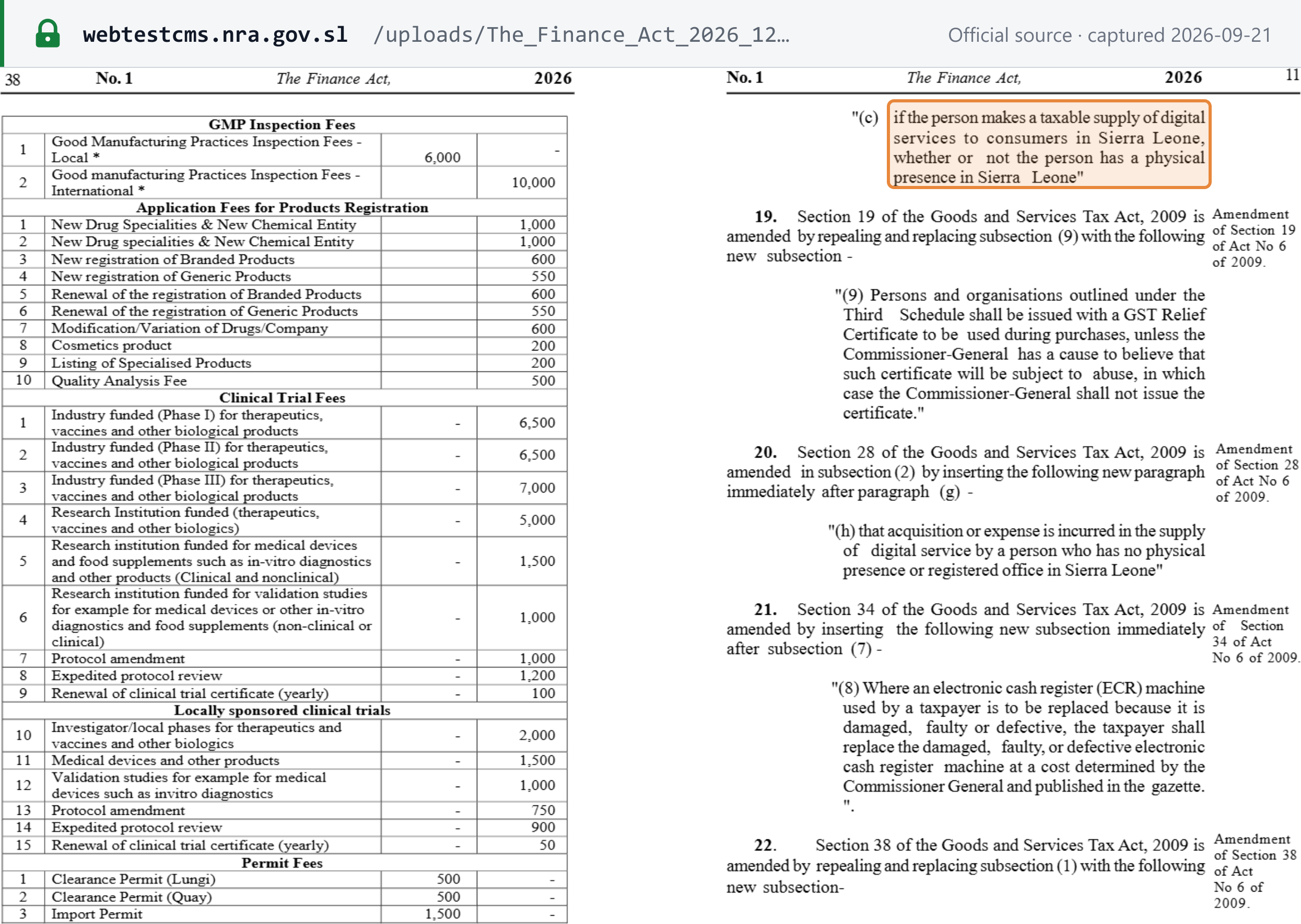 Source snapshot of the official page. Open full size ↗
Archived from the official distribution · The Finance Act, 2026 (Act No. 1 of 2026) — Supplement to the Sierra Leone Gazette Extraordinary Vol. CLXVII, No. 3 of 7 January 2026, s.18 inserting GST Act 2009 s.15(4)(c) · webtestcms.nra.gov.sl