South Korea proposes ending reverse-charge VAT for a foreign corporation's own domestic branch invoices
This change is proposed and is not law. The rules below describe what would change if it is adopted.
- Jurisdiction
- South Korea
- Tax
- VAT
- Change type
- Compliance
- Status
- Proposed
- Impact
- Watch
- Announced
- 3 August 2026
- Authority
- Ministry of Finance and Economy (Republic of Korea) / 재정경제부
- Systems
- Tax engine, Reporting
- Verified
- Fetched from official source · high confidence
Foreign corporations with a registered place of business in Korea that issues the tax invoice for a services transaction — if enacted, that domestic place of business would report and pay VAT itself instead of the agent-payment (reverse-charge) mechanism applying.
No action — monitoring only. Foreign corporations with a Korean place of business should watch whether reverse-charge agent payment ceases to apply to their services transactions.
Tax engineReporting
The same 2026 Tax Reform Proposal, published on 3 August 2026 by South Korea's Ministry of Finance and Economy (재정경제부), includes a Value Added Tax Enforcement Decree amendment providing that where a domestic place of business of a foreign corporation issues the tax invoice for a services transaction, that domestic place of business reports and pays the VAT itself and the reverse-charge agent-payment mechanism does not apply. Legislative notice ran from 4 to 20 August 2026, with submission to the National Assembly scheduled before 3 September 2026.
What changed in detail
The same 2026 Tax Reform Proposal, published 3 August 2026 by South Korea’s Ministry of Economy and Finance, includes a proposed Value Added Tax Enforcement Decree amendment. This is a proposal, not enacted law. It would provide that where a domestic place of business of a foreign corporation issues the tax invoice for a services transaction, that domestic place of business reports and pays the VAT itself, and the reverse-charge agent-payment mechanism does not apply. Legislative notice ran from 4 to 20 August 2026, with submission to the National Assembly scheduled before 3 September 2026.
What it means
This targets a narrow mismatch: a foreign corporation’s own Korean branch currently sits inside the same reverse-charge machinery built for unrelated Korean payers, which doesn’t fit cleanly when the branch itself issued the invoice. Nothing changes until enactment, but foreign corporations with a Korean place of business should track whether agent payment on their own inter-branch service transactions is about to become their own filing obligation instead.
Proof
외국법인과 용역거래시 국내사업장이 세금계산서를 발급한 경우, 대리납부*를 적용하지 않고 국내사업장이 부가가치세 신고ㆍ납부Where, in a services transaction with a foreign corporation, the domestic place of business issues the tax invoice, agent payment (reverse charge) does not apply and the domestic place of business itself files and pays the VAT.
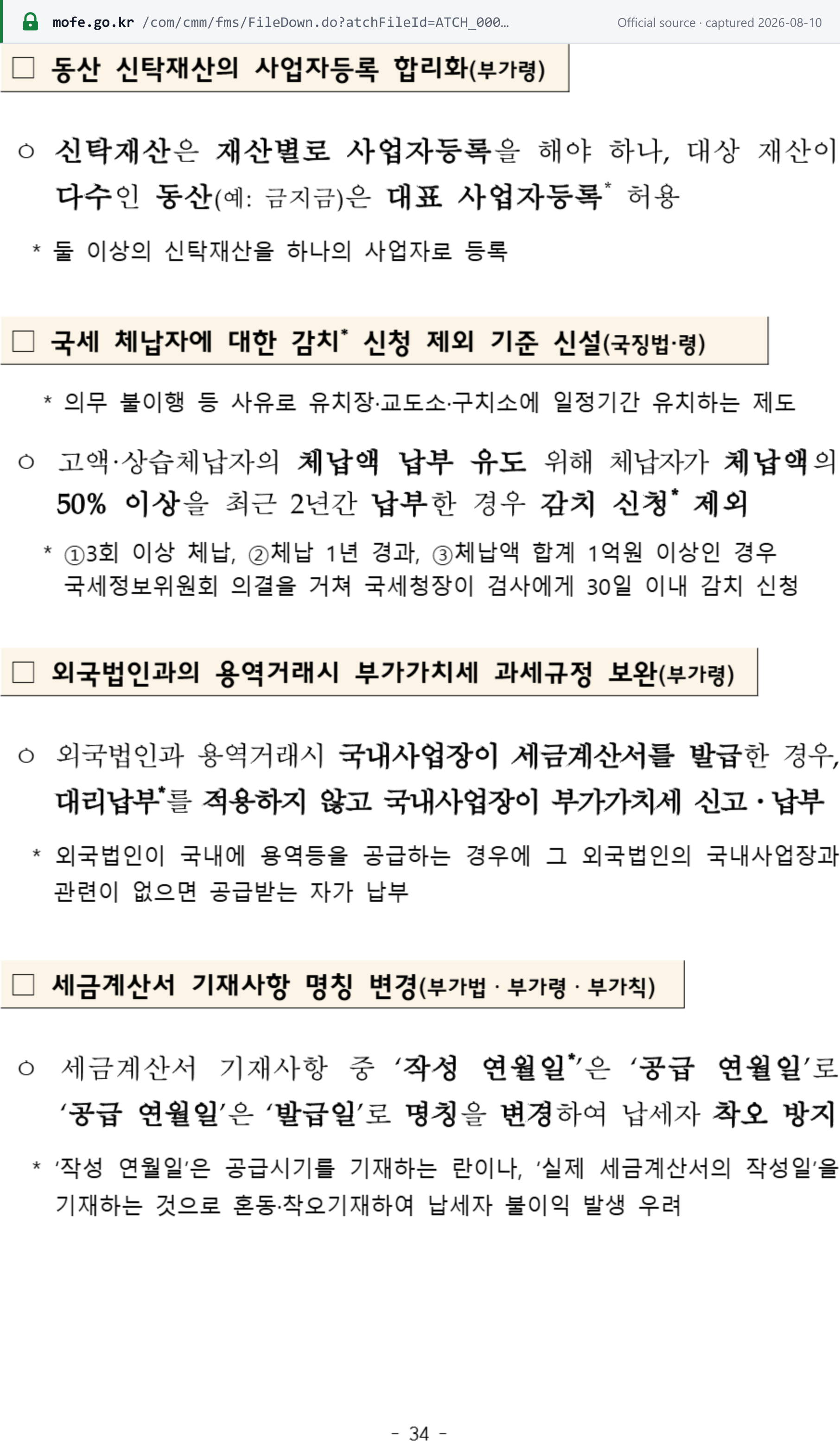 Source snapshot of the official page. Open full size ↗
Archived from the official distribution · 2026년 세제개편안 (outline version) · Ministry of Finance and Economy, 3 August 2026 · mofe.go.kr