South Korea's cabinet finalises the 2026 tax reform package as 11 bills, including the VAT Act, for the National Assembly
This change is proposed and is not law. The rules below describe what would change if it is adopted.
This page records one dated change. For the rules in South Korea as they stand today, see the South Korea guide →
- Jurisdiction
- South Korea
- Tax
- VAT
- Change type
- Update
- Status
- Proposed
- Impact
- Watch
- Announced
- 1 September 2026
- Authority
- Ministry of Finance and Economy (Republic of Korea) / 재정경제부
- Systems
- Invoicing, Tax engine
- Verified
- Fetched from official source · high confidence
Taxpayers under the Value Added Tax Act and the Restriction of Special Taxation Act, including businesses providing urban rail construction services.
No action — monitoring only.
InvoicingTax engine
South Korea's cabinet (State Council) finalised the government's 2026 Tax Reform package on 1 September 2026 as 11 tax-law amendment bills, including the Value Added Tax Act, to be submitted to the National Assembly by 3 September 2026 for review in the regular session. The package had been announced as a proposal on 3 August 2026; the cabinet version also widens the transitional VAT zero-rating for urban rail construction services under the Restriction of Special Taxation Act. The bills are not yet law.
What changed in detail
These are bills, not law. South Korea’s cabinet (State Council) finalised the government’s 2026 Tax Reform package on 1 September 2026 as 11 tax-law amendment bills, including the Value Added Tax Act.
The bills were to be submitted to the National Assembly by 3 September 2026 for review in the regular session.
The package had been announced as a proposal on 3 August 2026. The cabinet version also widens the transitional VAT zero-rating for urban rail construction services under the Restriction of Special Taxation Act.
The Ministry of Finance and Economy’s release states that the bills are scheduled for review in the regular session of the National Assembly. The bills are not yet law.
The earlier proposal-stage entries are kr-tax-invoice-field-renaming-2027 and kr-foreign-corp-domestic-pe-vat-2026.
What it means
The cabinet decision moves the package from proposal to bill, but the National Assembly can still change it, so VAT changes in it should be planned for, not implemented.
The regular session is where the content is likely to move. Teams tracking Korean VAT changes should follow the bills’ progress rather than treat the 3 August proposal or the cabinet text as final.
The urban rail zero-rating change is the one VAT item flagged as altered between the proposal and the cabinet version; anyone supplying construction services to rail projects should check that item first.
Proof
금일 국무회의에서 의결된 11개 세법 개정법률안은 9.3(목)까지 국회에 제출되어 정기국회에서 심사될 예정이다.The 11 tax-law amendment bills decided at today's cabinet meeting will be submitted to the National Assembly by 9.3 (Thu) and are scheduled to be reviewed in the regular session.
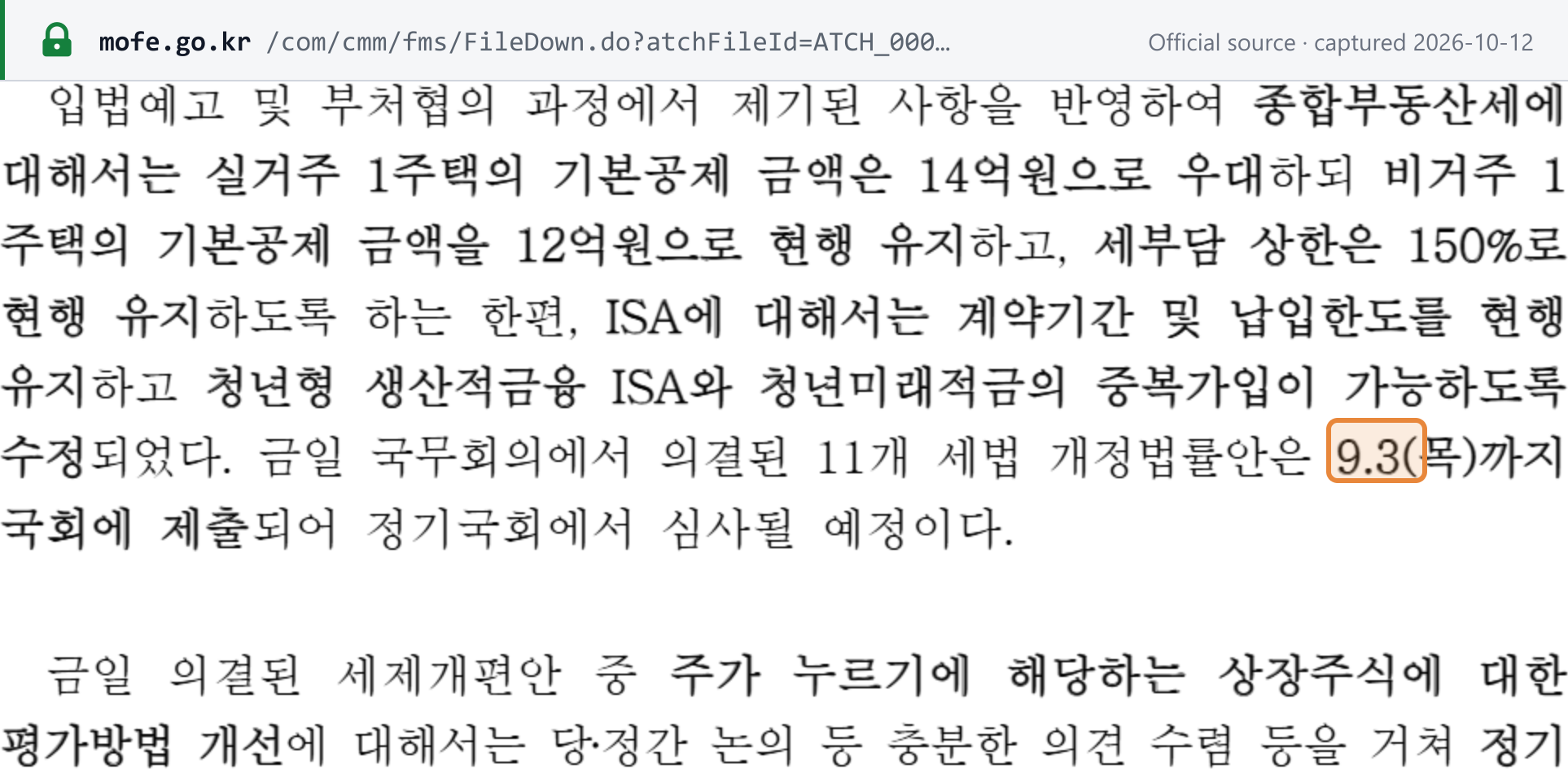 Source snapshot of the official page. Open full size ↗