Tanzania deems the digital marketplace operator the supplier of electronic services
This page records one dated change. For the rules in Tanzania as they stand today, see the Tanzania guide →
- Jurisdiction
- Tanzania
- Tax
- VAT
- Change type
- Digital services
- Status
- In force
- Impact
- Action required
- Announced
- 30 June 2026
- Effective
- 1 July 2026
- Authority
- Office of the Attorney General, United Republic of Tanzania (Government Printer, Dodoma)
- Systems
- Tax engine, E-commerce, Invoicing
- Verified
- Fetched from official source · high confidence
Operators of online intermediation services and digital marketplaces that facilitate electronic services to unregistered persons in Mainland Tanzania, whatever the seller's own registration status.
Digital marketplaces/platforms facilitating electronic services to unregistered Tanzanian consumers must register and account for Tanzania VAT as deemed supplier from 1 July 2026.
Tax engineE-commerceInvoicing
Tanzania's Finance Act 2026 amended Section 51 of the Value Added Tax Act (CAP 148) to introduce a marketplace 'deemed supplier' rule: where an electronic service is supplied to an unregistered person in Mainland Tanzania by a digital intermediary (online intermediation service or digital marketplace), the operator of that platform is deemed to be the supplier and must account for VAT. The definition of 'electronic services' was also expanded to cover 'any other service of a similar nature delivered through internet or a telecommunications network.'
What changed in detail
Section 94 of the Finance Act, 2026 (Act No. 2 of 2026), published in Special Gazette No. 8 Vol. 107 of 30 June 2026 and in operation from 1 July 2026, amends section 51 of the Value Added Tax Act (CAP. 148).
A new subsection (2) provides that where an electronic service is supplied to an unregistered person in Mainland Tanzania by a digital intermediary through online intermediation services or any other digital marketplace, the operator of that service or marketplace is deemed, for the purposes of the Act, to be the supplier of the service. A new subsection (3) defines “digital intermediary” as an electronic interface — including a website, internet portal, application, online store or digital marketplace — that allows recipients and persons offering services through the interface to enter contact resulting in a sale through it.
The existing subsection (2) is renumbered as subsection (4), and a new paragraph (k) is added to its list of electronic services: “any other service of a similar nature delivered through internet or a telecommunications network.”
What it means
Liability moves from thousands of individual sellers to the platform, which is the same design the EU, the UK and a growing list of African jurisdictions have converged on. The operational consequence is specific: the deeming rule turns on whether the customer is registered, not on whether the seller is. A marketplace serving Tanzanian buyers therefore needs a per-customer registration-status determination at transaction time, not a per-seller onboarding check.
The new paragraph (k) is worth reading separately. A catch-all for “any other service of a similar nature delivered through internet or a telecommunications network” makes the electronic services list open-ended, so a service you concluded was outside the old enumerated list should be re-tested rather than assumed to be still outside.
Proof
"(2) Notwithstanding subsection (1), where an electronic service is supplied to an unregistered person in Mainland Tanzania by a digital intermediary through online intermediation services or any other digital market place, the operator of such online intermediation service or digital market place shall, for purposes of this Act, be deemed to be the supplier of the service.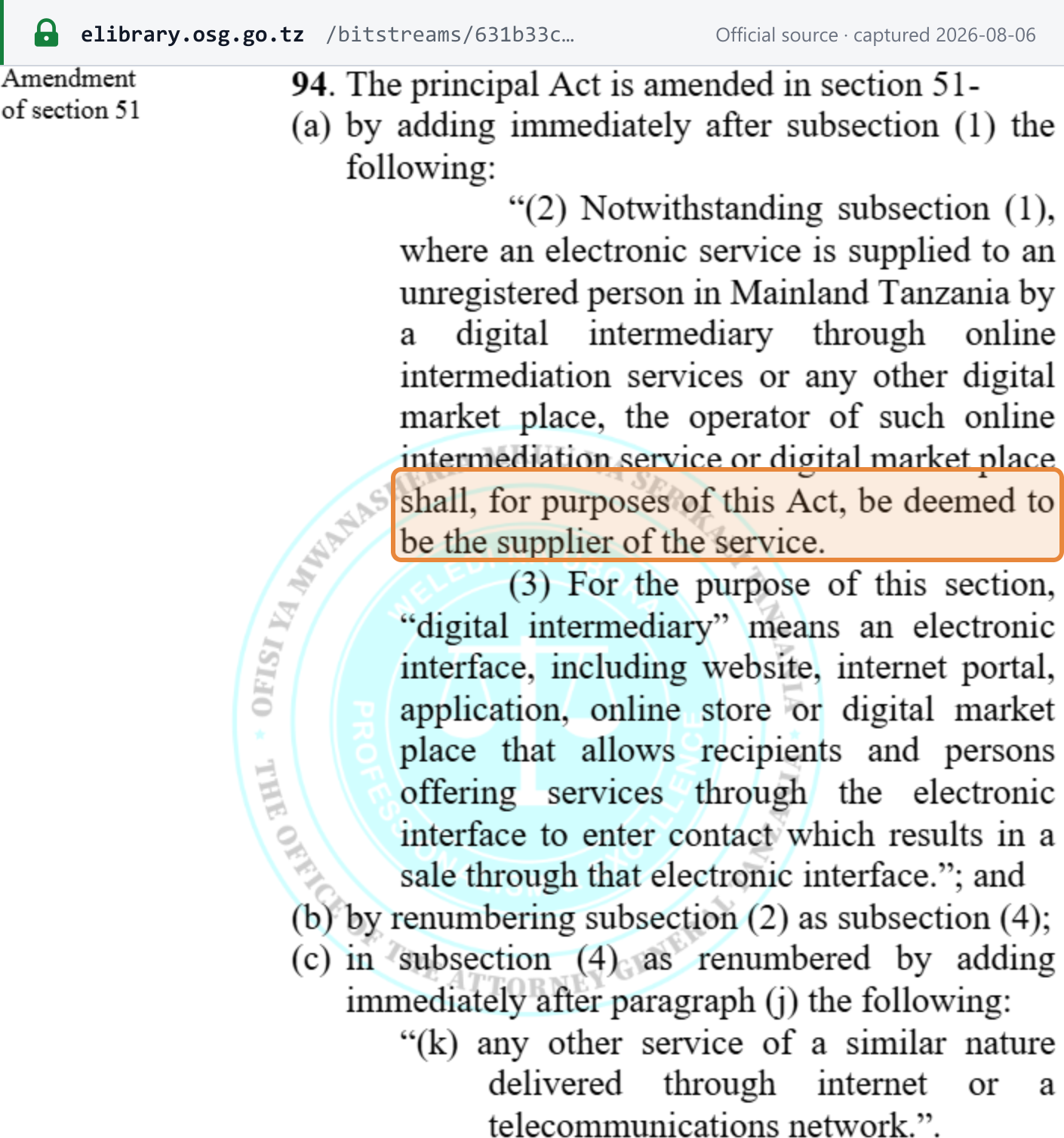 Source snapshot of the official page. Open full size ↗