Tanzania exempts imports of LPG smart meters and EV charging stations from VAT
This page records one dated change. For the rules in Tanzania as they stand today, see the Tanzania guide →
- Jurisdiction
- Tanzania
- Tax
- VAT
- Change type
- Update
- Status
- In force
- Impact
- Action required
- Announced
- 30 June 2026
- Effective
- 1 July 2026
- Authority
- Office of the Attorney General, United Republic of Tanzania (Government Printer, Dodoma)
- Systems
- Tax engine, Customs
- Verified
- Fetched from official source · high confidence
Licensed liquefied petroleum gas distributors and licensed electric vehicle charging service providers importing the two specified HS codes into Mainland Tanzania.
LPG distributors and licensed EV charging service providers importing qualifying equipment should apply the new VAT exemption from 1 July 2026.
Tax engineCustoms
Tanzania's Finance Act 2026 added new VAT exemptions to the Second Schedule (Part II) of the VAT Act CAP 148: imports of Liquefied Petroleum Gas (LPG) Smart Meters (HS Code 9028.10.00) by a licensed LPG distributor, and imports of electric vehicle charging stations (HS Code 8504.40.00) by a licensed electric vehicle charging service provider.
What changed in detail
Section 96 of the Finance Act, 2026 (Act No. 2 of 2026) amends the Schedule to the Value Added Tax Act (CAP. 148). In Part II — the import-exemption list — two new items are added immediately after item 32, with effect from 1 July 2026:
- Item 33 exempts an import of Liquefied Petroleum Gas Smart Meters of HS Code 9028.10.00 by a distributor of liquefied petroleum gas.
- Item 34 exempts an import of an electric vehicle charging station of HS Code 8504.40.00 by a licensed electric vehicle charging service provider.
Both exemptions are conditioned on the importer, not only on the goods. Item 33 requires the importer to be an LPG distributor; item 34 requires a licensed EV charging service provider. An identical unit imported by anyone else remains taxable at the standard rate.
The same section makes unrelated changes elsewhere in the Schedule, including a Part II addition of “paper for printing boarding pass” to item 23 and several Part I amendments covering animal feed, fishing nets, dairy packaging and locally manufactured garments.
What it means
These are narrow, sector-conditional reliefs, and the condition is where the risk sits. Customs classification alone will not get the exemption applied — the entry has to be able to demonstrate the importer’s status as an LPG distributor or a licensed charging service provider, so the licence reference belongs in the import documentation rather than in a file somewhere.
The direction is familiar: Tanzania is using the VAT import schedule as energy-transition policy, in the same pass that widened the marketplace VAT net. If you import either HS code through a group entity that is not itself the licensed operator, the exemption is likely to fail on the importer test even though the goods qualify.
Proof
"33. An import of Liquefied Petroleum Gas Smart Meters of HS Code 9028.10.00 by a distributor of liquefied petroleum gas. 34. An import of electric vehicle charging station of H.S Code 8504.40.00 by licenced electric vehicle charging service provider.".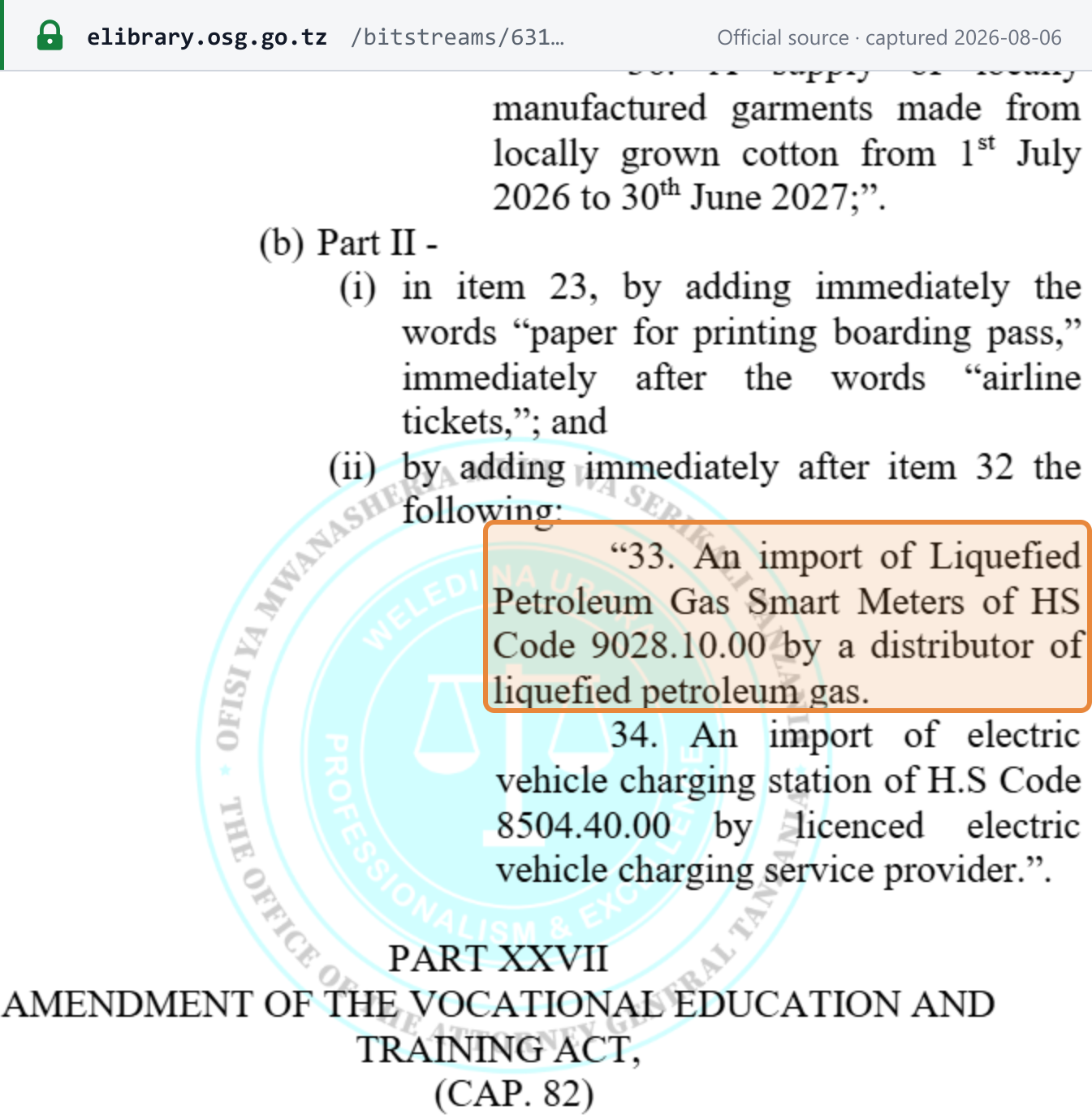 Source snapshot of the official page. Open full size ↗