UAE sets the costing method for valuing deemed supplies of services
This page records one dated change. For the rules in United Arab Emirates as they stand today, see the United Arab Emirates guide →
- Jurisdiction
- United Arab Emirates
- Tax
- VAT
- Change type
- Compliance
- Status
- In force
- Impact
- Action required
- Announced
- 20 July 2026
- Effective
- 20 July 2026
- Instrument
- AE-DIRECTIVE-5-2026
- Authority
- Federal Tax Authority (UAE)
- Systems
- Tax engine, Reporting, ERP
- Verified
- Fetched from official source · high confidence
Any UAE taxable person that makes a deemed supply of services and has to value it under Article 37 of the VAT Law.
Apply the Article 37 costing methodology — open market value less profit margin, scaled by the input-tax-bearing cost share — when valuing deemed supplies of services.
Tax engineReportingERP
FTA Directive on Tax Transactions No. 5 of 2026, issued 20 July 2026, sets the method for valuing deemed supplies of services under Article 37 of the VAT Law. The value equals the total costs on which input tax was incurred, both direct and indirect, determined by taking the open market value of comparable services, removing the profit margin based on the taxable person's or the sector's net profit margin, and applying the ratio of input-tax-bearing costs to total costs.
What changed in detail
Directive on Tax Transactions No. 5 of 2026, issued on 20 July 2026, sets the method for valuing deemed supplies of services under Article 37 of the VAT Law.
The value of the deemed supply equals the total costs on which input tax was incurred, both direct and indirect. That figure is arrived at in three steps: take the open market value of comparable services; remove the profit margin, based on the taxable person’s own net profit margin or the sector’s; then apply the ratio of input-tax-bearing costs to total costs.
What it means
This is the more demanding of the two July directives, because it asks for two numbers most tax engines do not produce natively: a defensible net profit margin and a cost ratio that separates input-tax-bearing costs from the rest. Payroll is the obvious line that carries no input tax, so the ratio is rarely close to one. Build the calculation once, document the comparables and the margin source, and keep it — the method is a costing exercise that an auditor can re-perform, which is exactly why the working papers matter more than the output.
Proof
Th e net profit margin shall be calculated based on the T axable P erson's financial statements for the preceding financial year.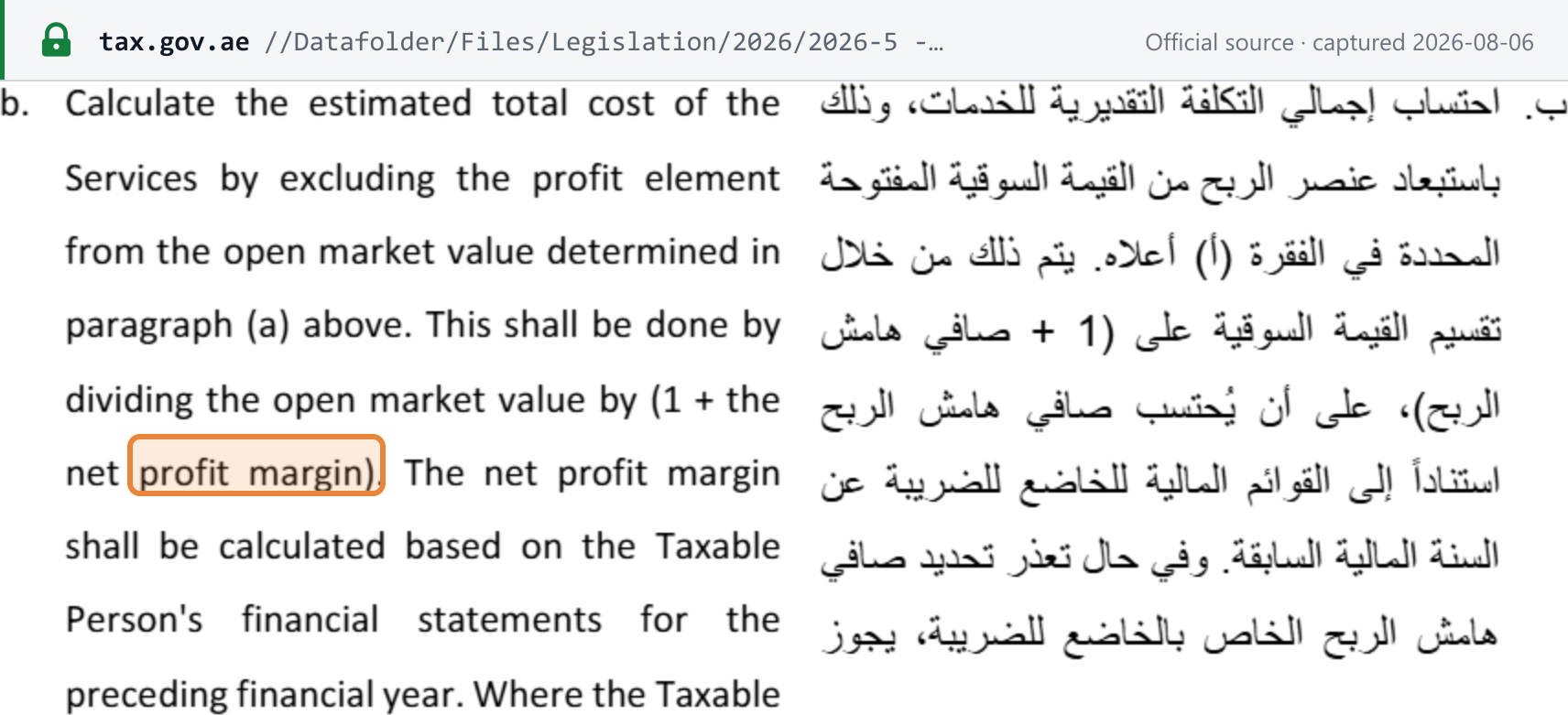 Source snapshot of the official page. Open full size ↗