UAE Cabinet rewrites the VAT Executive Regulation with Cabinet Decision No. 149 of 2026
This page records one dated change. For the rules in United Arab Emirates as they stand today, see the United Arab Emirates guide →
- Jurisdiction
- United Arab Emirates
- Tax
- VAT
- Change type
- Compliance
- Status
- In force
- Impact
- Action required
- Announced
- 1 September 2026
- Effective
- 1 October 2026
- Authority
- UAE Ministry of Finance
- Systems
- Tax engine, ERP, Invoicing
- Verified
- Fetched from official source · high confidence
UAE VAT-registered businesses using the Capital Assets Scheme apportionment mechanism, businesses receiving multi-component supplies, and those recovering input tax on high-value cash payments.
Update VAT input-tax recovery, apportionment and cash-payment controls, composite-supply treatment and tax credit note templates to reflect Cabinet Decision No. 149 of 2026 ahead of its 1 October 2026 effective date; note the separate 2027 Tax Year start date for the revised apportionment mechanism.
Tax engineERPInvoicing
The UAE Cabinet issued Cabinet Decision No. 149 of 2026 amending the Executive Regulation (Cabinet Decision No. 52 of 2017) of the VAT Federal Decree-Law No. 8 of 2017. It replaces provisions on the purchase-price definition for deemed supplies, zero-rating of medical goods, the place-of-supply presence test, employee-accommodation input-tax blocking, the Capital Assets Scheme input-tax apportionment mechanism (Article 55) and tax credit notes, and adds new provisions treating certain multi-component supplies as a single composite supply and restricting input-tax recovery on cash payments above a threshold to be set by the Minister of Finance. The Decision is signed 1 September 2026 and takes effect 1 October 2026, except the amended input-tax apportionment mechanism (Article 55, clauses 6, 7 and new clause 19), which applies from the first Tax Year commencing after 1 October 2027.
What changed in detail
Cabinet Decision No. 149 of 2026, signed 1 September 2026, amends Cabinet Decision No. 52 of 2017 (the Executive Regulation of Federal Decree-Law No. 8 of 2017 on VAT). It replaces the purchase-price definition for deemed supplies, the zero-rating rule for medical goods, the place-of-supply presence test, the employee-accommodation input-tax block, the Article 55 Capital Assets Scheme apportionment mechanism, and tax credit notes. It also adds a rule treating certain multi-component supplies as a single composite supply, and restricts input-tax recovery on cash payments above a threshold the Minister of Finance will set.
The Decision takes effect 1 October 2026, except the revised apportionment mechanism (Article 55, clauses 6, 7 and new clause 19), which applies from the first Tax Year commencing after 1 October 2027.
What it means
Two effective dates matter here, not one — most of the Decision lands in three weeks, but the apportionment rewrite gives Capital Assets Scheme users a full extra tax year to prepare. The composite-supply rule and the cash-payment cap are the parts most likely to catch ERP configuration off guard: neither has a numeric threshold yet (the cash limit is left to a future Ministerial decision), so systems teams are implementing a rule whose trigger point isn’t set yet. Tax credit note templates should be reviewed now rather than at go-live, since that provision is not among the ones deferred to 2027.
Proof
This Decision shall be published in the Official Gazette and shall be effective from 1 October 2026.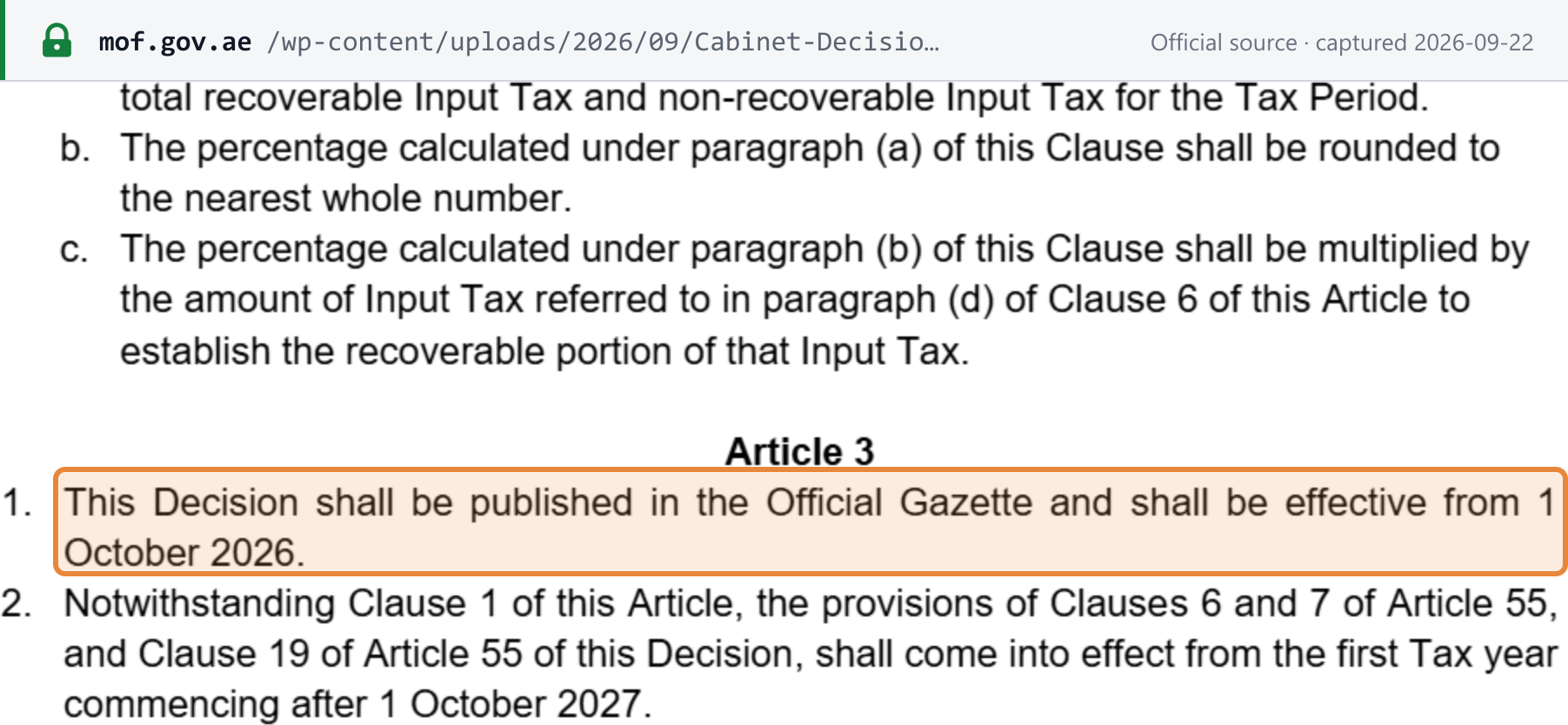 Source snapshot of the official page. Open full size ↗