UAE treats fees bundled into a life insurance contract as part of the exempt supply
This page records one dated change. For the rules in United Arab Emirates as they stand today, see the United Arab Emirates guide →
- Jurisdiction
- United Arab Emirates
- Tax
- VAT
- Change type
- Compliance
- Status
- In force
- Impact
- Action required
- Announced
- 14 July 2026
- Effective
- 14 July 2026
- Instrument
- AE-DIRECTIVE-4-2026
- Authority
- Federal Tax Authority (UAE)
- Systems
- Tax engine, Reporting
- Verified
- Fetched from official source · high confidence
UAE life insurers and life reinsurers, and anyone charging fees connected with a life insurance or life reinsurance contract.
Review life insurance and reinsurance fee and charge treatment against the Directive's bundling test and reclassify any fees that qualify as part of the exempt supply.
Tax engineReporting
FTA Directive on Tax Transactions No. 4 of 2026, issued 14 July 2026, provides that services connected with a life insurance or life reinsurance contract are treated as forming part of the VAT-exempt supply of life insurance, provided the services are necessary for making that supply, are directly connected with the provision or transfer of ownership of the contract, and the consideration for them forms an integral part of the total consideration payable under the contract, in accordance with Article 42 of the VAT Executive Regulation. Services charged independently remain separate taxable supplies.
What changed in detail
Directive on Tax Transactions No. 4 of 2026, issued on 14 July 2026, provides that services connected with a life insurance or life reinsurance contract are treated as forming part of the VAT-exempt supply of life insurance.
Three conditions apply, in accordance with Article 42 of the VAT Executive Regulation: the services must be necessary for making the supply of life insurance, must be directly connected with the provision or transfer of ownership of the contract, and the consideration for them must form an integral part of the total consideration payable under the contract.
Services charged independently of the contract remain separate taxable supplies.
What it means
The Directive turns on how a fee is presented rather than on what it is: bundle it into the premium and it follows the exempt supply, invoice it separately and it is taxable — the same economic service, two different answers. That makes the billing template, not the service description, the control point. Review fee and charge schedules against the bundling test and reclassify anything that qualifies, because the reclassification runs in both directions and a separately invoiced fee cannot be retro-fitted into the contract consideration.
Proof
Where a Taxable Person provides or transfers the ownership a life insurance /reinsurance contract, S ervices connected with that contract shall be treated as forming part of the Exempt Supply of life insurance for Value Added Tax (“VAT”) purposes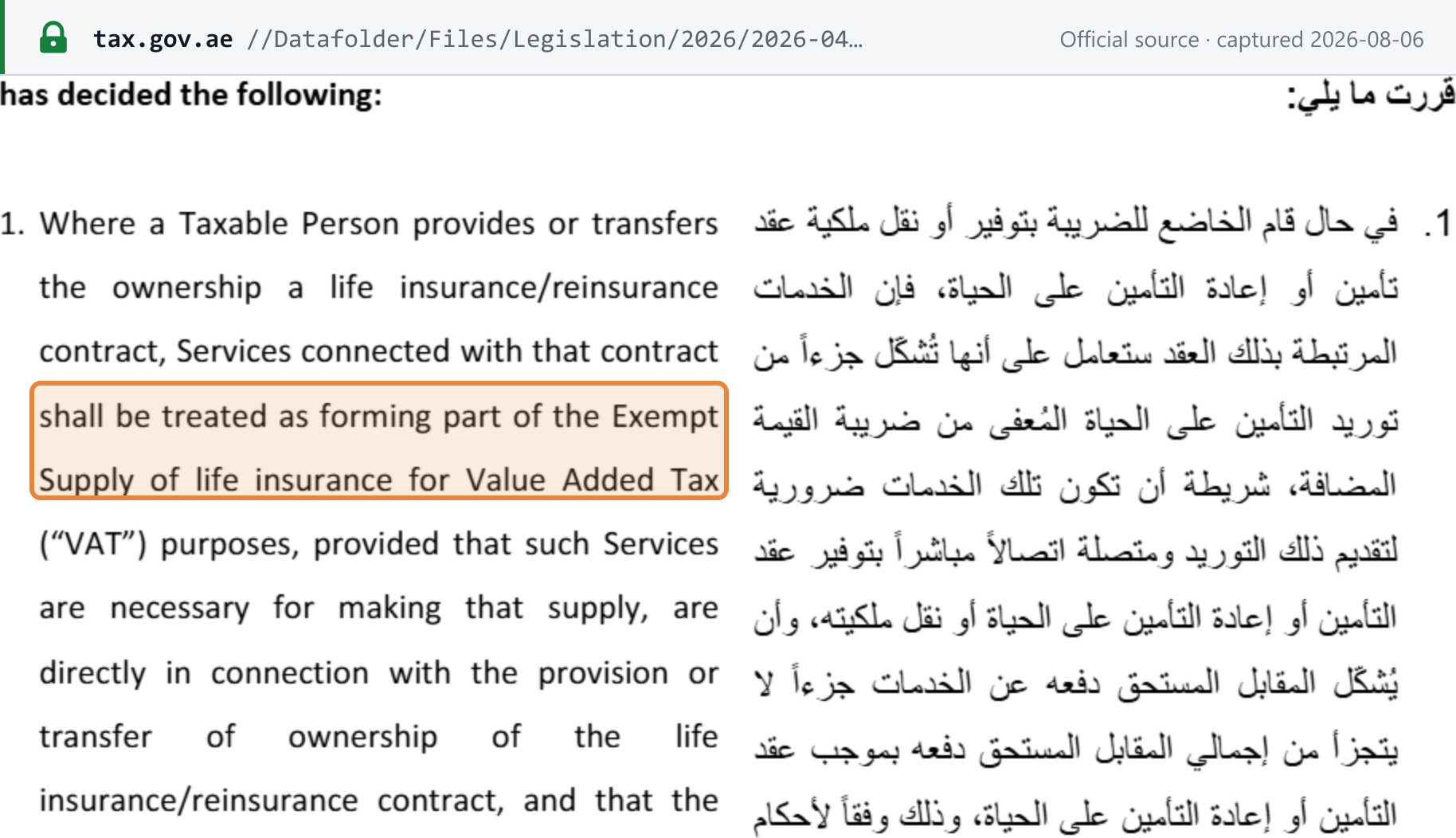 Source snapshot of the official page. Open full size ↗