HMRC holds its education VAT position but invites protective claims after the St Patrick's College ruling
This page records one dated change. For the rules in United Kingdom as they stand today, see the United Kingdom guide →
- Jurisdiction
- United Kingdom
- Tax
- VAT
- Change type
- Update
- Status
- Enacted
- Impact
- Plan ahead
- Announced
- 2 September 2026
- Authority
- HM Revenue & Customs
- Systems
- Tax engine
- Verified
- Fetched from official source · high confidence
Alternative providers of higher or further education in the UK that are not eligible bodies for the Group 6 exemption, and their VAT advisers.
Alternative providers of higher/further education and their VAT advisers should review the VAT liability of their education supplies against HMRC's updated position in RCB 9 (2026).
Tax engine
HMRC published Revenue and Customs Brief 9 (2026) on 2 September 2026, updating its position on the VAT treatment of supplies of education and closely related services by alternative providers of higher and further education, following the Court of Appeal's decision in St Patrick's International College and Others Ltd v The Commissioners for HMRC ([2026] EWCA Civ 852).
What changed in detail
HMRC published Revenue and Customs Brief 9 (2026) on 2 September 2026, setting out the implications of the Court of Appeal’s decision in St Patrick’s International College and Others Ltd v The Commissioners for HMRC ([2026] EWCA Civ 852).
The Court of Appeal overruled the First-tier and Upper Tribunals and found for St Patrick’s International College, holding that it was bound by the earlier Court of Appeal judgment in Leisure, Independence, Friendship and Enablement Services Ltd (LIFE) ([2020] EWCA Civ 452). In LIFE the court held that the typical consumer’s perspective is relevant when assessing fiscal neutrality, and that the principle can apply even where the legislation imposes additional qualifying conditions for an exemption. The effect is that some supplies made by organisations that are not eligible bodies were exempt rather than standard-rated.
HMRC’s stated policy is unchanged: the education exemption in Group 6 of Schedule 9 to the Value Added Tax Act 1994 applies to supplies by eligible bodies, supplies by providers that are not eligible bodies are standard-rated, and the typical consumer’s perspective does not alter that. HMRC has been granted permission to appeal to the Supreme Court.
Pending that appeal, alternative providers who believe they are in the same position as St Patrick’s may submit a claim for a refund of VAT. HMRC will review claims case by case, taking account of unjust enrichment, partial exemption and whether over-declared VAT was correctly accounted for across the supply chain, and says it will protect its position to secure revenue.
What it means
Read this as an invitation to protect a position, not as a change of treatment. HMRC’s policy still says these supplies are standard-rated; it is simply telling providers how to stand in the queue while the Supreme Court decides.
The trap is treating the claim as a gross refund. HMRC is explicit that a claim is net — associated input tax previously recovered has to come back out, and partial exemption has to be re-run over the affected periods. For a provider with meaningful recoverable input tax, the net figure can be small enough that the exercise is not worth it, and modelling that before filing is cheaper than discovering it afterwards.
Normal statutory time limits still apply, so the four-year cap continues to erode the oldest periods while the appeal runs. That is the real deadline here, not anything HMRC has published.
Proof
This brief provides an update on HMRC's position on the VAT treatment of supplies of education and closely related services provided by alternative providers. It sets out the implications of the Court of Appeal's decision in St Patrick's International College and Others Ltd v The Commissioners for HMRC ([2026] EWCA Civ 852).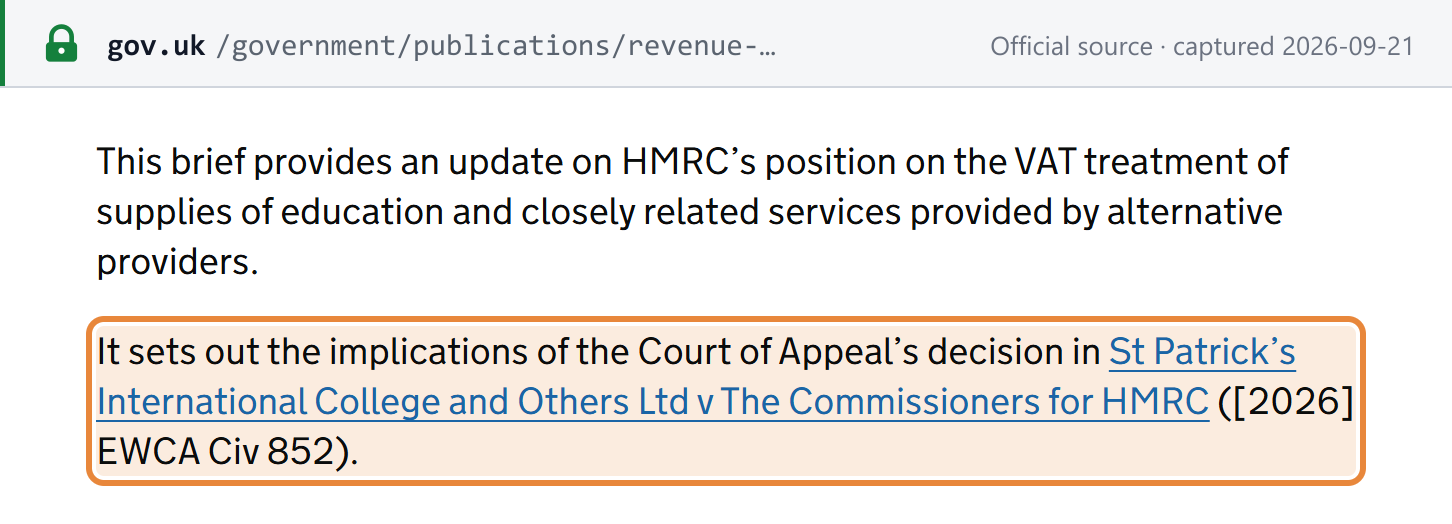 Source snapshot of the official page. Open full size ↗
Archived from the official distribution · HMRC Revenue and Customs Brief 9 (2026), published 2 September 2026 · www.gov.uk