California CDTFA confirms sales and use tax applies to digital products, including prewritten SaaS, from 1 January 2027
This page records one dated change. For the rules in United States as they stand today, see the United States guide →
- Jurisdiction
- United States (California)
- Tax
- Sales and use tax
- Change type
- Digital services
- Status
- Enacted
- Impact
- Action required
- Effective
- 1 January 2027
- Authority
- California Department of Tax and Fee Administration (CDTFA)
- Systems
- Tax engine, Invoicing, ERP, E-commerce, Reporting
- Verified
- Fetched from official source · high confidence
Sellers of prewritten software and prewritten software-as-a-service into California, including out-of-state sellers engaged in business in California, and California businesses buying such products.
Map prewritten software/SaaS products to California taxability and configure place-of-sale sourcing before 1 January 2027.
Tax engineInvoicingERPE-commerceReporting
CDTFA Special Notice L-1036 (September 2026), 'Sales and Use Tax Applies to Digital Products Beginning January 1, 2027', states that from 1 January 2027 the definition of tangible personal property expands to include digital products (prewritten software transferred on tangible media, transferred electronically or accessed remotely, including prewritten SaaS). It lists exclusions (digital assets, digital audio works, audiovisual works, digital books, digital infrastructure, digital video games, digital visual works) and exemptions (digital products representing a service other than SaaS, custom computer software, products transferred with reproduction and distribution rights, products purchased solely for use outside California), and a USD 5 million annual aggregate gross-receipts threshold above which tax liability may shift from retailer to purchaser (use tax direct payment permit). Place of sale for local/district reporting is generally the customer's address. Out-of-state sellers engaged in business in California must register.
What changed in detail
CDTFA Special Notice L-1036 (September 2026), ‘Sales and Use Tax Applies to Digital Products Beginning January 1, 2027’, states that from 1 January 2027 the definition of tangible personal property expands to include digital products. These are prewritten software transferred on tangible media, transferred electronically or accessed remotely, including prewritten SaaS.
The notice lists exclusions: digital assets, digital audio works, audiovisual works, digital books, digital infrastructure, digital video games and digital visual works. It also lists exemptions: digital products representing a service other than SaaS, custom computer software, products transferred with reproduction and distribution rights, and products purchased solely for use outside California.
A USD 5 million annual aggregate gross-receipts threshold applies, above which tax liability may shift from the retailer to the purchaser, who would then use a use tax direct payment permit. For local and district reporting, the place of sale is generally the customer’s address. Out-of-state sellers engaged in business in California must register.
What it means
SaaS and software sellers should map each product to a California taxability outcome and set up place-of-sale sourcing at the customer’s address before 1 January 2027. The notice is guidance on a law already enacted; draft regulations that would add detail are still proposals and are covered separately.
Proof
Beginning January 1, 2027, the definition of tangible personal property in the Sales and Use Tax Law will be expanded to include digital products and any copyright or patent interests associated with those digital products.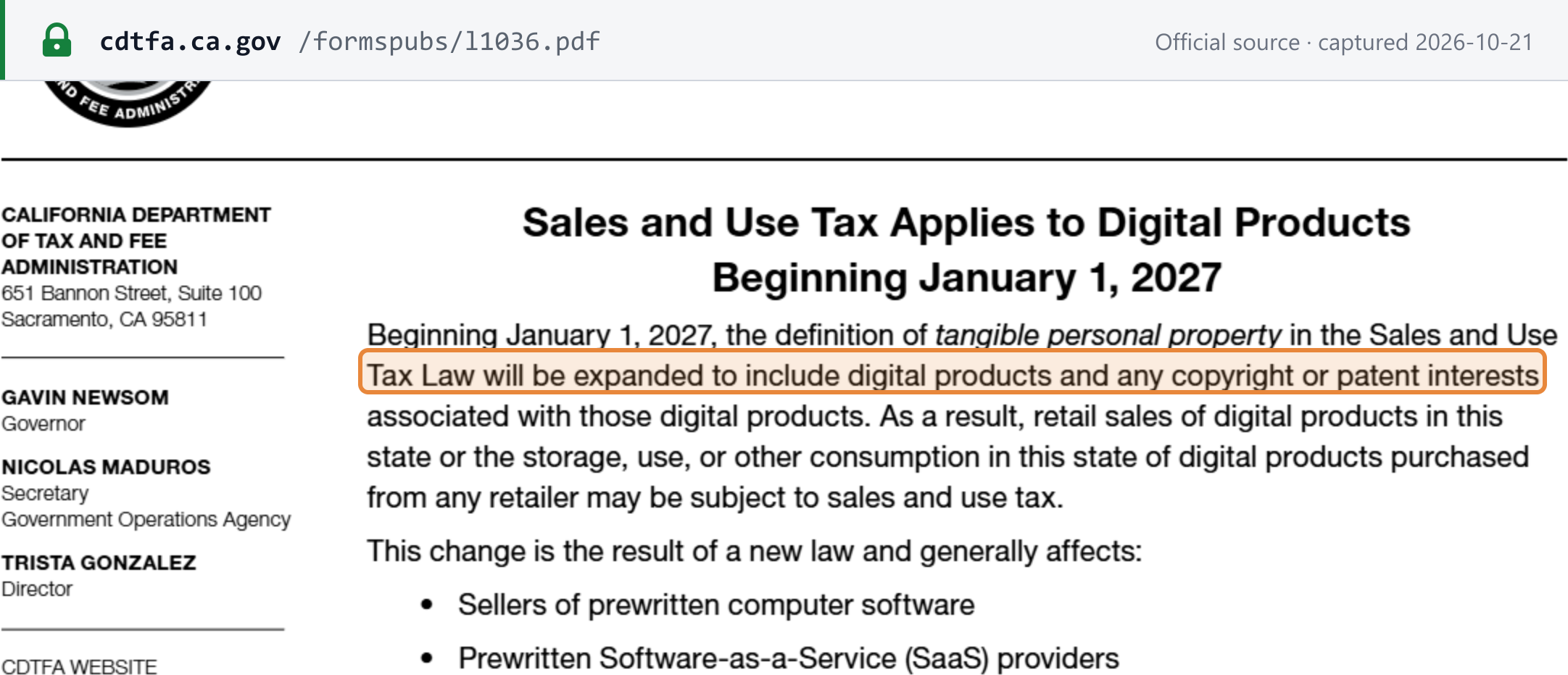 Source snapshot of the official page. Open full size ↗