United States Sales & Use Tax guidelines
| FACTSHEET | |
|---|---|
| Country code | US |
| Tax name | State & local Sales and Use Tax — there is no federal VAT/GST. |
| Tax Authority | State Departments of Revenue (sales tax is state-administered); Internal Revenue Service (IRS) for the federal EIN. |
Overview
The United States has no federal VAT or GST. Indirect tax takes the form of sales and use tax, levied and administered at the state and local level. As of June 2021, 45 states and the District of Columbia impose a statewide sales tax and all of them have adopted economic-nexus collection requirements for remote sellers. [1]
Five states — New Hampshire, Oregon, Montana, Alaska and Delaware (the "NOMAD" states) — levy no statewide sales tax. Alaska is a special case: the state itself levies no sales tax, but about 110 of its 162 municipal governments levy local sales taxes ranging from 1% to 7%. [2]
Sales tax is a single-stage tax charged on retail sales to the end consumer; there is no input-credit mechanism as in a VAT. Business purchases for resale are relieved via resale certificates rather than input tax credits.
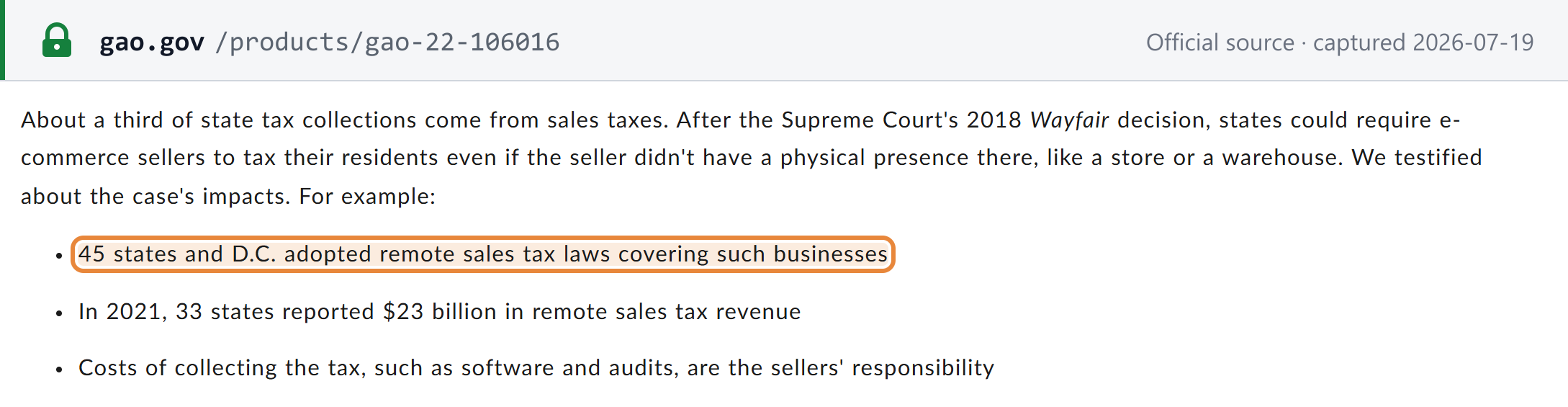 Source snapshot captured 19 July 2026 — original (U.S. Government Accountability Office)
Tax IDs & registration
- EIN (Employer Identification Number) — the nine-digit federal tax identifier (format XX-XXXXXXX) issued free of charge by the IRS. It is generally needed to hire employees, operate a partnership or corporation, and pay federal sales and excise taxes. The IRS warns: "You never have to pay a fee for an EIN." [1]
- State sales tax permit — the EIN is not a sales tax registration. A business must register for a sales tax permit (seller's permit / sales tax license) with the Department of Revenue of each state where it has physical or economic nexus. There is no single nationwide registration, although the Streamlined Sales Tax Registration System (SSTRS) covers the 24 Streamlined member states in one application. [2]
- Resale certificates — registered purchasers buying for resale give their supplier a resale/exemption certificate so tax is not charged on the wholesale transaction; requirements and forms are state-specific. [3]
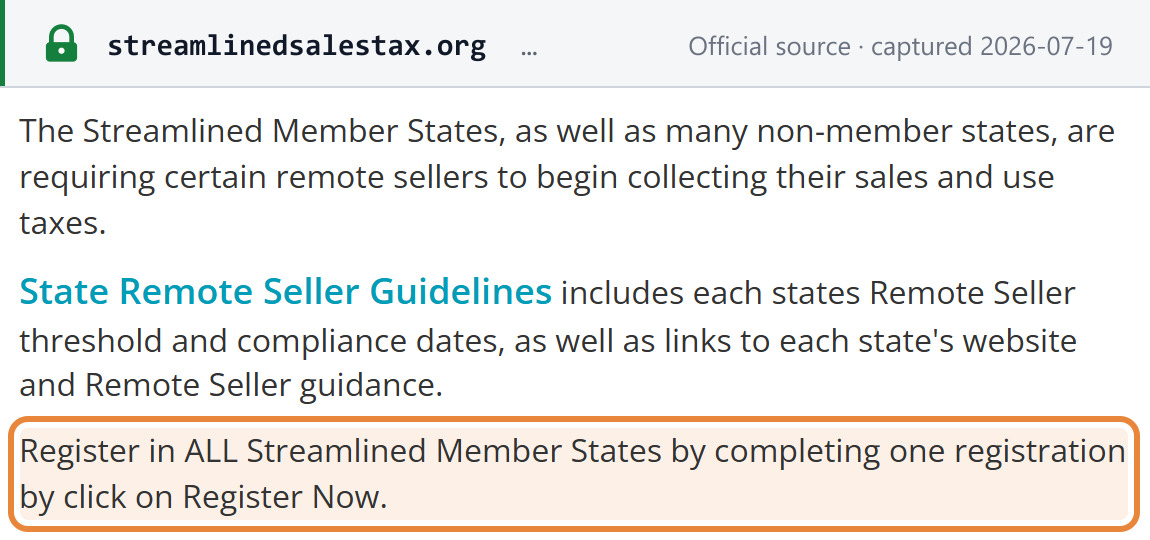 Source snapshot captured 19 July 2026 — original (Streamlined Sales Tax Governing Board)
Economic nexus
In South Dakota v. Wayfair, Inc. (decided June 21, 2018), the U.S. Supreme Court held that states can require sellers to collect and remit sales or use tax on sales delivered into the state regardless of physical presence. [1] [2]
Most states adopted thresholds modelled on South Dakota's law — typically USD 100,000 in annual sales and/or 200 transactions — but the amount, the sales measure (gross vs. retail vs. taxable sales) and the measurement period vary by state, and several states have dropped the transaction count. South Dakota itself removed the 200-transaction test effective July 1, 2023, leaving only the USD 100,000 gross-sales threshold. [3] Kentucky followed suit: House Bill 757 (2026 RS, Acts Ch. 161) amends KRS 139.340 to remove the 200-transaction alternative trigger, leaving a USD 100,000 sales-volume-only economic nexus test for remote retailers and marketplace providers, effective August 1, 2026. [4] Check each state's current threshold in the Streamlined Sales Tax remote seller state guidance. [5]
 Source snapshot captured 19 July 2026 — original (South Dakota Department of Revenue)
Marketplace facilitator rules
States have enacted marketplace facilitator laws requiring a marketplace — a business that owns, operates or controls a physical or electronic marketplace, facilitates third-party sales and collects payment from the purchaser — to collect and remit sales tax on facilitated sales once it exceeds the state's threshold. [1]
Marketplace sellers may still need their own registration for direct (non-marketplace) sales, and in some states facilitated sales count toward the seller's own nexus threshold — see the Streamlined marketplace seller guidance. [2]
Digital products, software and streaming
There is no national rule on digital goods: each state decides whether streaming content, downloads and remotely accessed software fall inside its sales tax base, and the base is widening. Two 2026 enactments change the answer for large markets:
- Utah — from 1 July 2026. S.B. 162 (Online Sales Tax Amendments, 2026 General Session) adds to the Utah sales and use tax base "amounts paid or charged for access to digital audio-visual works, digital audio works, digital books, or gaming services, including the streaming of or subscription for access", regardless of the delivery method and whether the access is single-use or by subscription. It also taxes prewritten computer software delivered electronically or by load and leave, and — new — seller-hosted prewritten computer software, defined as software "accessed through the internet or a seller-hosted server, regardless of whether the access is permanent" or "any downloading occurs" (i.e. SaaS). Transactions already taxed under Utah's Multi-Channel Video or Audio Service Tax Act are excluded. [1]
- California — operative 1 January 2027. S.B. 122 (Chapter 23 of 2026, approved 29 June 2026) brings "digital products" into the sales and use tax base, defining the term as prewritten computer software transferred on tangible storage media, transferred electronically, or accessed remotely. New Revenue and Taxation Code § 6016.2 defines "accessed remotely" as access for consideration, by digital code, password or other means, to prewritten software residing on the vendor's server or a third party's server; sourcing follows the purchaser's known address. [2]
- Colorado — from 1 January 2027. House Bill 26-1223 (signed 4 June 2026; Session Laws of Colorado 2026, Chapter 379) amends C.R.S. 39-26-102(15)(c) to remove the requirement that computer software be prepackaged for repeated sale, licensed under a tear-open nonnegotiable agreement, and delivered in a tangible medium before it counts as taxable tangible personal property — bringing electronically delivered software, including SaaS and mobile apps, into the sales/use tax base. A new C.R.S. 39-26-713(3) exemption carves back out software licensed under a negotiated agreement (individually bargained and signed in writing by both parties before or contemporaneous with use — click-through, browse-wrap and other automated acceptances do not qualify) or developed for a particular user. Applies to the sale, storage, use and consumption of tangible personal property on or after 1 January 2027 (HB26-1223 § 9). [3]
 Source snapshot captured 2026-07-28 — original
Because these measures widen the taxable base rather than the rate, they can also change a remote seller's nexus position in states that measure their economic-nexus threshold on taxable sales — re-test Utah from 1 July 2026 and California ahead of 1 January 2027.
Maryland's digital advertising tax, struck down
Maryland's Digital Advertising Gross Revenues Tax (Md. Code Ann., Tax-Gen. §§ 7.5-101 to 7.5-301) is not a sales tax, but it is the one US levy aimed squarely at digital supply. On 14 August 2026 the Maryland Tax Court held it unlawful and unconstitutional in three Memoranda and Orders issued the same day — Apple Inc. (23-DA-OO-0456), Google LLC (23-DA-OO-0649) and Peacock TV LLC (23-DA-OO-0654) — reversing the Comptroller's refund denials and ordering refunds with interest. There are three holdings, not one: the tax violates the federal Internet Tax Freedom Act § 1105(2)(A)(i) because digital advertising is indistinguishable from the non-digital advertising Maryland does not tax; it fails the Complete Auto tests under the Dormant Commerce Clause through its graduated global-revenue tiers; and it violates the Due Process Clause. Peacock adds a fourth, First Amendment holding on the broadcast- and news-media exemption. [6]
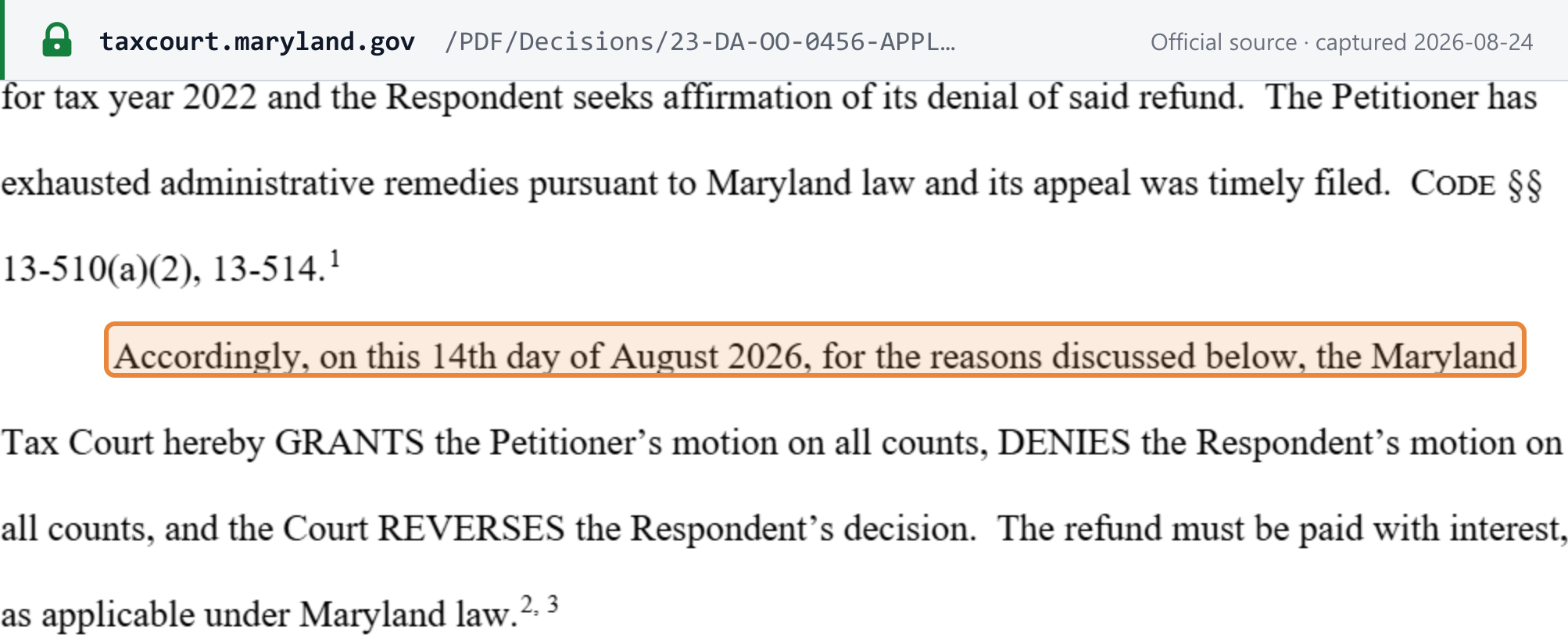 Source snapshot captured 2026-08-24 — original
The three orders are not identical, and the difference matters to anyone reading them as a template. Apple and Google were granted summary judgment on all counts; Peacock was denied on the foreign Commerce Clause count, which the Comptroller won. [7]
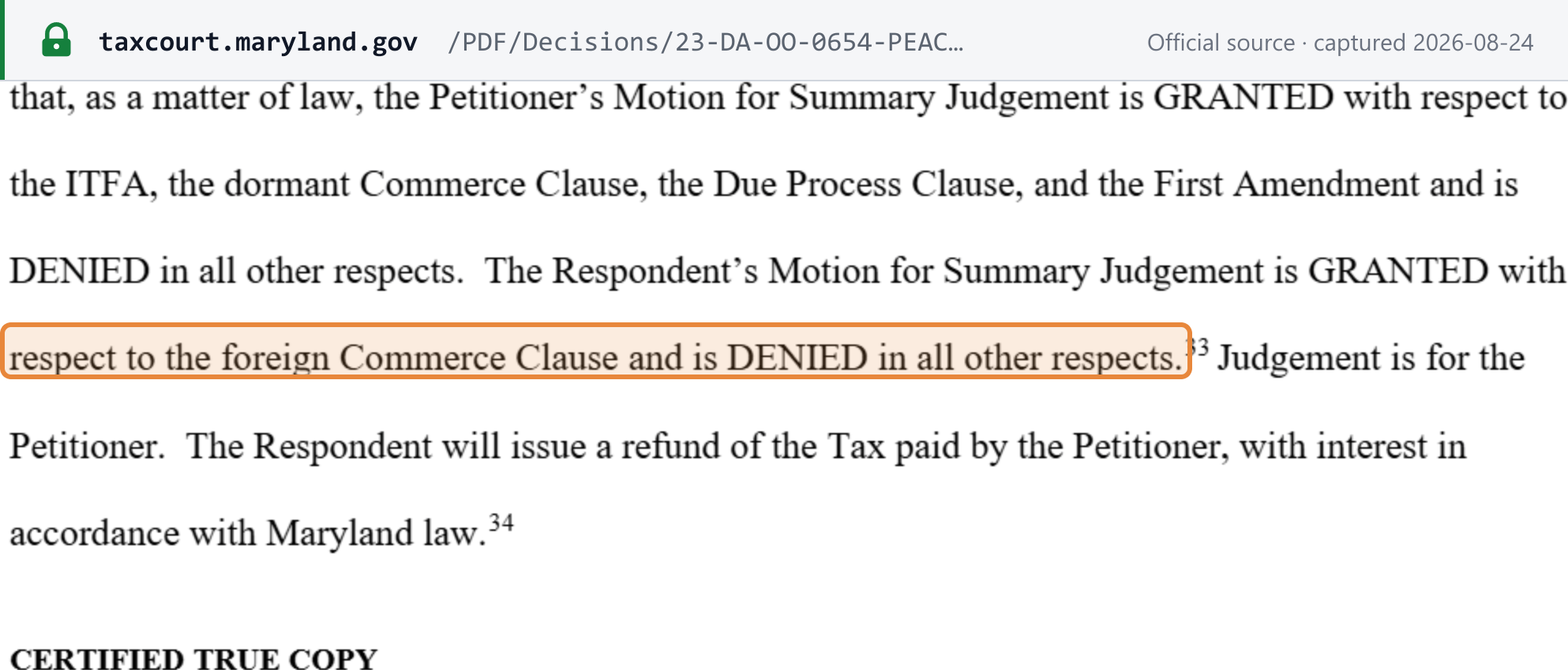 Source snapshot captured 2026-08-24 — original
The Maryland Tax Court is an adjudicatory administrative agency and its decisions are appealable to the Circuit Court within 30 days, so nothing here is final — but the grounds attack features any copycat statute would share.
Rate structure
There is no national rate. Each state sets its own state rate, and local jurisdictions (cities, counties, transit and special districts) typically add local rates on top. Illustrative examples (state base rates; local additions vary by location):
| State | State rate | Local additions | Official source |
|---|---|---|---|
| California | 7.25% statewide base | District taxes of 0.10%–2.00% apply in many areas (districts can overlap) — a further round of voter-approved district changes takes effect 1 Oct 2026, see below | CDTFA |
| Colorado | 2.9% | State-administered local taxes plus self-collected home-rule city taxes | Colorado DOR |
| District of Columbia | 6.0% — the increase to 7.0% is now delayed to 1 Oct 2027 (was 1 Oct 2026), see below | None — single district-wide rate (§ 47-2202 sets separate higher rates for certain categories) | DC Law Library |
| Texas | 6.25% | Local jurisdictions may add up to 2%, for a maximum combined rate of 8.25% — several city/county/district rates change 1 Oct 2026, see below | Texas Comptroller |
| Washington | 6.5% | City, county and transit-district rates apply on top — Mattawa's combined rate falls to 8.3% from 1 Oct 2026, see below | WA DOR |
| Alabama | 4% | Local city/county rates apply on top, plus category-specific local rates (e.g. lodgings, automotive) — several change 1 Oct 2026, see below | Alabama DOR |
| Arkansas | 6.5% | County and city rates apply on top — several county rates change 1 Oct 2026, see below | Arkansas DFA |
| Illinois | 6.25% on general merchandise | Home-rule, mass-transit (NITA, formerly RTA) and other local taxes raise the combined rate — NITA rose 0.25% in six counties from 1 Aug 2026, see below | Illinois DOR |
| Louisiana | 5% (from 1 Jan 2025; scheduled to fall to 4.75% on 1 Jan 2030) | Parish and local taxes apply in addition | Louisiana DOR |
| New York | 4% | Local rates plus 0.375% in the Metropolitan Commuter Transportation District | NY DTF |
The District of Columbia is the one jurisdiction in the table with no local layer. D.C. Code § 47-2202 originally provided that the general rate "shall be 6.0% before October 1, 2026, and 7.0% beginning on October 1, 2026, and continuing thereafter" — the increase enacted by the Fiscal Year 2026 Budget Support Act of 2025 (D.C. Law 26-55, effective 6 December 2025). That increase has since been delayed by one year: the Sales Tax Increase Delay Emergency Amendment Act of 2026 (Title VII, Subtitle A of D.C. Act 26-416, the Fiscal Year 2027 Budget Support Emergency Act of 2026, effective 13 August 2026) amends §§ 47-2002(a) and 47-2202(a) so the general rate is 6.0% before October 1, 2027, and 7.0% beginning on October 1, 2027. The rate therefore stays at 6.0% on and after 1 October 2026, and the 7.0% step that this page previously reported for that date does not take effect. As an emergency act it lasts up to 90 days; the permanent Fiscal Year 2027 Budget Support Act was still in congressional review when this was last checked, so confirm the rate has not reverted before relying on it past the emergency act's expiry. [1]
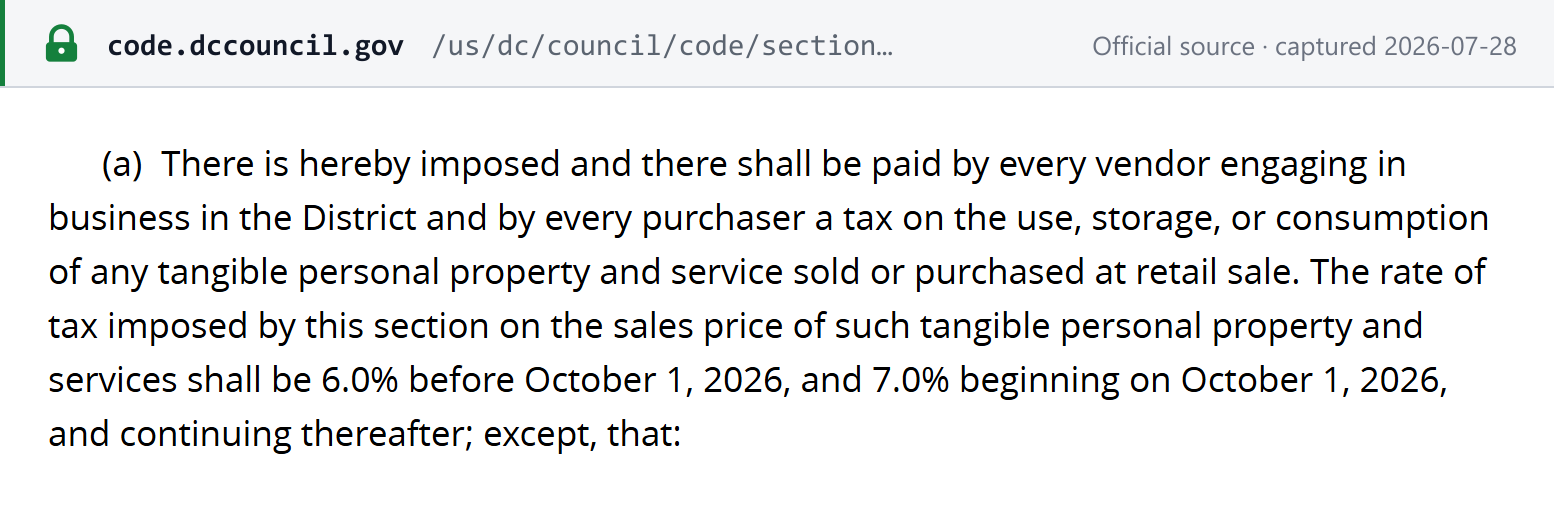 Source snapshot captured 2026-07-28 — original — superseded: D.C. Act 26-416 (effective 13 August 2026) delayed the 7.0% step to 1 October 2027; see the updated text above.
Texas, Washington, Alabama and Arkansas local rates also change on 1 October 2026 — see Recent changes below for the specifics; each state's quarterly notice carries dozens to hundreds of individual jurisdiction rates, so only the highlights are reproduced here and the Comptroller/DOR/DFA feed is the rate of record.
Illinois's regional transit tax also rose on 1 August 2026. The Northern Illinois Transit Authority (NITA) — renamed from the Regional Transportation Authority (RTA) — raised its occupation and use tax by 0.25% in Cook, DuPage, Kane, Lake, McHenry and Will counties, effective 1 August 2026. For titled or registered property (Form RUT-25), the new NITA rate is 1.25% in Cook County and 1.00% in the other five counties. For general merchandise (Forms ST-1/ST-556), Cook County's combined NITA rate is 1.25%, or 1.50% on qualifying groceries and drugs; the other five counties apply a flat 1.00%. [2]
A further round of local rate changes takes effect on 1 October 2026 in California, Georgia and Ohio. In Ohio, the Department of Taxation's rate-change bulletin raises the combined sales and use tax rate for Warren County (county code 83) from 6.75% to 7.25%, effective 1 October 2026. [5] In California, CDTFA Special Notice L-1037 publishes voter-approved district changes: the countywide County of Los Angeles rate rises from 9.750% to 10.250%, and — the detail that breaks integrations rather than merely raising a rate — its tax code changes from B47 to D29, so any rate table or tax engine keyed on the old code silently stops matching. The City of Perris goes from 7.750% to 8.750%, and the City of Red Bluff from 7.500% to 8.500% under a new code E05, with consequential changes for cities inside Los Angeles County. CDTFA states the downloadable rate spreadsheet became available on 1 September 2026. [3]
In Georgia, the Department of Revenue publishes new combined county rates from the same date for eleven jurisdictions: Charlton 8, Dougherty 9, Heard 8, Houston 8, Jenkins 9, Monroe 9, Richmond 9, Tattnall 9, Towns 7, Wilcox 9, and Fulton (S. Downtown) 3.9. The bulletin carries no publication date, so only its effective date is stated here. [4]
Further state and local changes (July 2026 to January 2027).
- Pennsylvania (Philadelphia and Allegheny County): Act 21 of 2026 (enacted 12 July 2026, retroactive to tax years after 31 December 2025) moves the Philadelphia 2% and Allegheny County 1% local sales tax from point-of-sale to point-of-destination sourcing. Vendors already collecting the 6% state tax must collect the local tax on sales delivered into those counties. The Department of Revenue will not begin enforcing before 1 October 2026. [20]
- North Dakota (1 October 2026): Minot's city sales, use and gross receipts tax rises from 2% to 2.5% (combined general rate 8%: 5% state, 2.5% city and 0.5% county); Kindred and Walhalla remove their USD 50 per-sale maximum tax, rates unchanged. [21] (North Dakota Office of State Tax Commissioner — Notice to Minot permit holders)
- Oklahoma (1 October 2026): Salina sales and use tax rises from 4% to 5%, Laverne falls from 3.25% to 3% and Wellston from 4% to 3.5%; a new Selah 4% sales and use tax and a new Bristow 10% lodging tax begin; the state rate stays 4.5%. [22]
- Minnesota (1 October 2026): the 0.5% Albert Lea and 0.5% Blackduck local sales and use taxes end on 30 September 2026, so the general 6.875% rate plus any other local taxes applies in those cities. There is no state-level rate change. [23] [24]
- North Carolina (datacenter electricity): Session Law 2026-41 repeals the sales and use tax exemptions for electricity used at certified datacenters effective 7 July 2026, applying to billing periods starting on or after 6 August 2026; Session Law 2026-42 requires purchasers of such electricity to report tax paid quarterly, with the first report due 30 October 2026. [25]
- Tennessee (Davidson County, 1 November 2026): under Department of Revenue Notice 26-19, the local sales tax rate on food and food ingredients in Davidson County, including all cities within it, is reduced to 1.75%; other goods and services stay at 2.25% local, and the 4% state food rate is unchanged. It is reported on a new return line from the November 2026 return (due 20 December). [26]
- Illinois (Bourbonnais, 1 November 2026): Bourbonnais will impose a 1% local Automobile Renting Occupation and Use Tax, for a combined 6.00% (State 5.00% plus 1.00% local) on qualifying motor vehicle rentals. [27]
- Tennessee (money transmission, 1 January 2027): Public Chapter 1035 (2026) imposes sales tax of USD 10 per transaction plus 2% of the amount over USD 500 on money transmission from Tennessee to locations outside the United States or its territories, for entities licensed under the Tennessee Money Transmission Modernization Act. Under an agreed order of the Davidson County Chancery Court, the Department will not enforce the law until a final judicial determination, followed by a 45-day grace period if upheld (Notice 26-12). [28]
- West Virginia (1 January 2027): Danville, Farmington, Gilbert, Kenova, Keyser and Wellsburg each impose a 1% municipal sales and use tax, taking the combined rate there to 7%. [29]
- Washington (peer-to-peer car sharing, 1 January 2027): section 9 of Engrossed Substitute Senate Bill 6113 (Chapter 250, Laws of 2026, partial veto) amends RCW 82.08.020 to levy an additional tax on peer-to-peer car sharing transactions equal to the selling price multiplied by the retail car rental tax rate in RCW 82.08.020(2)(a), which is 9.9% from 1 January 2027. It applies only where the vehicle owner obtained the shared vehicle for resale using a reseller permit or an approved exemption certificate under RCW 82.04.470; revenue goes to the multimodal transportation account. [30] [31]
Rates change frequently (many states adjust local rates each 1 January and 1 July) — always confirm against the state Department of Revenue's rate lookup for the delivery address.
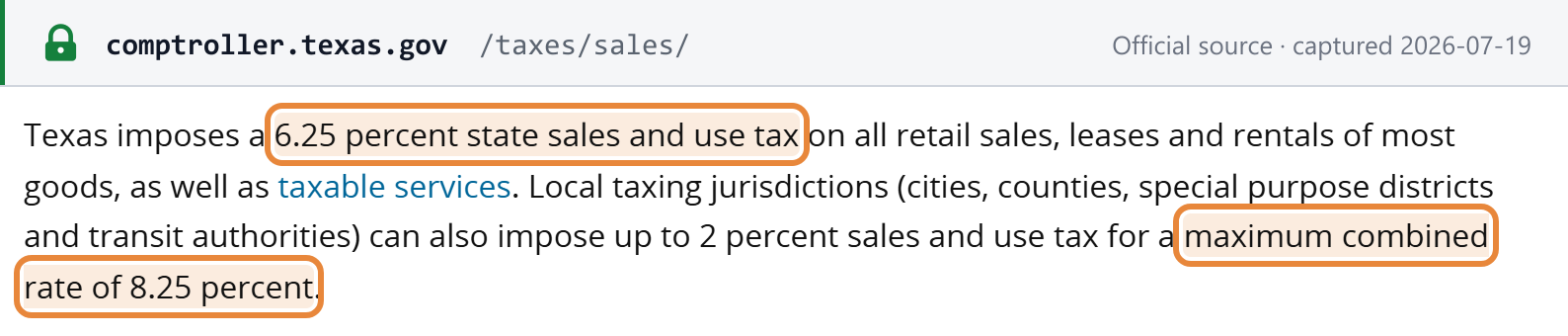 Source snapshot captured 19 July 2026 — original (Texas Comptroller of Public Accounts)
Sales tax holidays
Some states run temporary, statutory exemption windows — "sales tax holidays" — usually timed to back-to-school shopping. Formats and price caps are set state by state and can change year to year within the same state.
Ohio's 2026 sales tax holiday runs from 12:00 a.m. Friday, 7 August to 11:59 p.m. Sunday, 9 August 2026, exempting clothing priced at USD 75 or less per item and school supplies and school instructional materials priced at USD 20 or less per item. This is a reversion to Ohio's traditional narrow, three-day format — the 2024 and 2025 holidays ran for roughly two weeks and covered most tangible personal property priced at USD 500 or less; that broader USD 500 design does not apply in 2026. [1]
Illinois's 2026 back-to-school State sales tax holiday runs 7 August through 16 August 2026, under Public Act 104-0468. The State's portion of sales tax is reduced by 5 percentage points, from 6.25% to 1.25%, on qualifying clothing and footwear priced under USD 125 per item and on qualifying school supplies used by students in the course of study — school supplies are not subject to the USD 125 threshold. Local and other add-on taxes are unaffected: a retailer applies whatever combined rate is currently in effect at its location, minus 5.00 percentage points (State portion only). This is a separate measure from the Illinois NITA rate change and the Illinois Remote Retailer Tax Amnesty covered under Rate structure and Recent changes below. [2]
Always confirm the current year's dates, price caps and qualifying categories directly with the state Department of Revenue before configuring POS or e-commerce exemptions — holiday scope is not stable from year to year.
Invoice requirements
There is no federal invoice mandate in the United States, and no nationwide list of particulars a sales invoice must carry. This is not an oversight — it follows from the structure described in Overview: there is no federal VAT or GST, so there is no federal body with authority to prescribe invoice content. What exists instead are state-level rules, and they regulate a much narrower question than a VAT act does.
If you are arriving from a VAT jurisdiction, the mental model does not transfer. In a VAT country the invoice is the instrument that transfers a deduction, so the state prescribes its contents in detail. In the US, sales tax is a single-stage tax on the final consumer — there is no input-tax credit to protect — so the invoice carries far less legal weight. The documents that do carry weight are exemption and resale certificates.
What state rules actually require
The recurring requirements across states concern how the tax is presented, not what else the invoice contains:
- Separately stating the tax. Where a seller lists a separate amount of sales tax reimbursement on receipts or invoices, the customer is presumed to have agreed to pay it. [5]
- Tax-included pricing must be disclosed. A seller that folds sales tax reimbursement into the shelf price rather than itemising it must inform the buyer that tax is included. [5]
- Use tax collected must be separately stated, and the retailer must give the purchaser a receipt showing the amount of tax collected. [5]
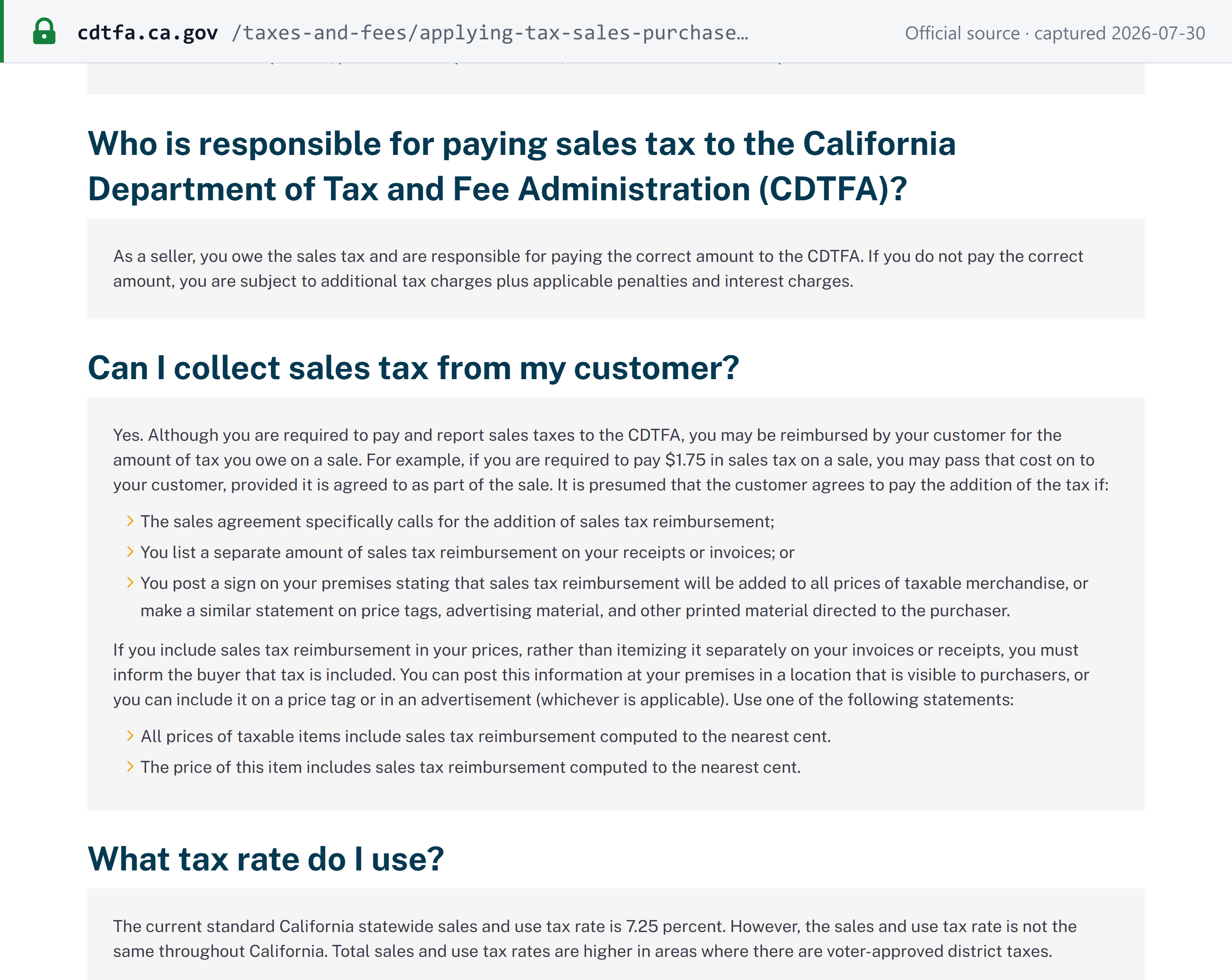 Source snapshot captured 2026-07-30 — original
The California rules above are cited as a worked example of the pattern, not as a national standard. Each state sets its own; a seller with nexus in multiple states must check each one. See Economic nexus for where those obligations arise.
The document that matters instead: exemption and resale certificates
Because there is no input-tax credit mechanism, a US seller does not prove a B2B sale through the invoice — it proves it by holding a valid resale or exemption certificate from the buyer, collected before or at the time of sale and retained for audit. A missing or invalid certificate, not a defective invoice, is what turns an untaxed sale into an assessment against the seller.
Practical consequence for cross-border sellers
An invoice template built for EU or GCC VAT will generally satisfy US requirements, because those templates carry strictly more information than any state demands. The failure mode runs the other way: a US-designed invoice usually lacks the supplier tax number, sequential numbering and per-rate tax breakdown that VAT jurisdictions require. Build to the strictest jurisdiction you sell into, then add the US "separately stated tax" line.
E-invoicing status
There is no federal or state B2B e-invoicing mandate in the United States. Adoption is voluntary and market-driven: the Business Payments Coalition (BPC), with Federal Reserve support, convened an E-invoice Exchange Market Pilot in September 2021 with 73 industry organizations, and in 2023 pilot participants launched the Digital Business Networks Alliance (DBNAlliance) as the legal entity overseeing the resulting four-corner e-invoice exchange framework. [1] [2]
Recent changes
- 2026-10-01 — Pennsylvania: Act 21 of 2026 (enacted 12 July 2026, retroactive to tax years after 31 December 2025) moves the Philadelphia 2% and Allegheny County 1% local sales tax from point-of-sale to point-of-destination sourcing; vendors already collecting the 6% state tax must collect the local tax on sales delivered into those counties, and the Department of Revenue will not begin enforcing before 1 October 2026. (Pennsylvania Department of Revenue) — see event
- 2026-10-01 — North Dakota: Minot's city sales, use and gross receipts tax rises from 2% to 2.5% (combined general rate 8%: 5% state, 2.5% city and 0.5% county); Kindred and Walhalla remove their USD 50 per-sale maximum tax, rates unchanged. (North Dakota Office of State Tax Commissioner; Notice to Minot permit holders) — see event
- 2026-10-01 — Oklahoma: Salina sales and use tax rises from 4% to 5%, Laverne falls from 3.25% to 3% and Wellston from 4% to 3.5%; a new Selah 4% sales and use tax and a new Bristow 10% lodging tax begin; the state rate stays 4.5%. (Oklahoma Tax Commission) — see event
- 2026-10-01 — Minnesota: the 0.5% Albert Lea and 0.5% Blackduck local sales and use taxes ended on 30 September 2026; from 1 October 2026 the general 6.875% rate plus any other local taxes applies in those cities. (Minnesota Department of Revenue) — see event
- 2026-10-01 — Texas: the Comptroller's quarterly local rate notice adds or raises city sales and use taxes in Beckville, Ellinger, Frost and Northlake, abolishes local taxes in Bellmead, Naples, Orchard, Roscoe and the Northlake development corporation, adds a new Ellis County Emergency Services District No. 1 tax, and merges Shoreacres into La Porte (Harris County), with Shoreacres abolishing its own sales tax. (Texas Comptroller) — see event and the issue
- 2026-10-01 — Washington: the City of Mattawa (Grant County) Transportation Benefit District tax falls 0.1 percentage point, lowering the combined rate in Mattawa (location code 1308) from 8.4% to 8.3%. (Washington DOR) — see event and the issue
- 2026-10-01 — Alabama: Irondale (Ordinance No. 2026-23) raises its sales tax on the net difference paid for automotive vehicles, truck trailers, semi-trailers and house trailers from 2% to 2.25%; Huntsville and Madison raise their lodgings tax rates from 9% to 10%, and Gadsden (Ordinance No. O-22-26) from 5% to 10%. (Alabama DOR) — see event and the issue
- 2026-10-01 — Arkansas: countywide rate changes apply in Hempstead County (up to 2.750%), Logan County (down to 1.500%) and Stone County (down to 1.000%), an increase in Alpena (Boone County) to 2.250%, and further city rate changes from annexations. (Arkansas DFA) — see event and the issue
- 2026-10-01 — Ohio: the Department of Taxation's rate-change bulletin raises the combined sales and use tax rate for Warren County (county code 83) from 6.75% to 7.25%. (Ohio Department of Taxation) — see the issue
- 2026-10-01 — California: voter-approved district sales and use tax changes take effect. The countywide County of Los Angeles rate rises from 9.750% to 10.250% and its tax code changes from B47 to D29; the City of Perris goes from 7.750% to 8.750% and the City of Red Bluff from 7.500% to 8.500% under a new code E05, with consequential rates for cities within Los Angeles County. CDTFA states the rate spreadsheet became available on 1 September 2026. (CDTFA Special Notice L-1037)
- 2026-10-01 — Georgia: new combined county rates apply in eleven jurisdictions — Charlton 8, Dougherty 9, Heard 8, Houston 8, Jenkins 9, Monroe 9, Richmond 9, Tattnall 9, Towns 7, Wilcox 9, and Fulton (S. Downtown) 3.9. The bulletin carries no publication date, so only the effective date is stated. (Georgia Department of Revenue)
- 2026-08-14 — The Maryland Tax Court held Maryland's Digital Advertising Gross Revenues Tax (Md. Code Ann., Tax-Gen. §§ 7.5-101 to 7.5-301) unlawful and unconstitutional in three separate Memoranda and Orders issued the same day in three separate dockets — Apple Inc. (23-DA-OO-0456), Google LLC (23-DA-OO-0649) and Peacock TV LLC (23-DA-OO-0654) — reversing the Comptroller's refund denials and ordering refunds with interest. Apple and Google were granted summary judgment on all counts; Peacock on all but the foreign Commerce Clause count, which the Comptroller won. There are three holdings, not one: the tax violates the federal Internet Tax Freedom Act § 1105(2)(A)(i) because digital advertising is indistinguishable from the non-digital advertising Maryland does not tax; it fails the Complete Auto tests of fair apportionment, non-discrimination and fair relation under the Dormant Commerce Clause through its graduated global-revenue tiers; and it violates the Due Process Clause. In Peacock the court added a fourth, First Amendment holding — the broadcast- and news-media-entity exemption is content-based and the words "news" and "primarily" are unconstitutionally vague. The Maryland Tax Court is an adjudicatory administrative agency and the decisions are appealable to the Circuit Court within 30 days, so nothing is final — but these grounds attack features any copycat statute would share. (Maryland Tax Court) — see the event record and the issue
- 2026-08-13 — District of Columbia: the Sales Tax Increase Delay Emergency Amendment Act of 2026 (Title VII, Subtitle A of D.C. Act 26-416, the Fiscal Year 2027 Budget Support Emergency Act of 2026) amends D.C. Code §§ 47-2002(a) and 47-2202(a) so the general sales and use tax rate is 6.0% before 1 October 2027 and 7.0% from 1 October 2027 — delaying by one year the increase to 7.0% previously scheduled for 1 October 2026 (DC Law Library) — see event and the issue
- 2026-08-07 — Illinois's back-to-school State sales tax holiday runs 7 August through 16 August 2026 (Public Act 104-0468), reducing the State's portion of sales tax from 6.25% to 1.25% on qualifying clothing and footwear priced under USD 125 per item and on qualifying school supplies (no price cap on school supplies). (Illinois DOR Informational Bulletin FY 2026-30) — see issue
- 2026-08-07 — Ohio's 2026 sales tax holiday runs 12:00 a.m. Friday 7 August to 11:59 p.m. Sunday 9 August, exempting clothing at USD 75 or less and school supplies/instructional materials at USD 20 or less per item — a reversion to the narrow three-day format after the broader, roughly USD 500 general-merchandise holidays of 2024 and 2025. (Ohio Department of Taxation) — see issue
- 2026-08-01 — Illinois: the Northern Illinois Transit Authority (NITA, renamed from the Regional Transportation Authority) occupation and use tax rises 0.25% in Cook, DuPage, Kane, Lake, McHenry and Will counties — Cook County's combined NITA rate is now 1.25% general merchandise (1.50% on qualifying groceries and drugs) and 1.25% on titled/registered property, with the other five counties flat at 1.00%. (Illinois DOR Bulletin FY 2026-34) — see issue
- 2026-08-01 — Kentucky simplifies economic nexus for remote retailers and marketplace providers to a USD 100,000 sales-volume-only test, removing the 200-transaction alternative trigger (House Bill 757, which became law by veto override on 14 April 2026 — House 66-18, Senate 31-5 — as Acts Chapter 161, amending KRS 139.340). (Kentucky Legislature) — see issue
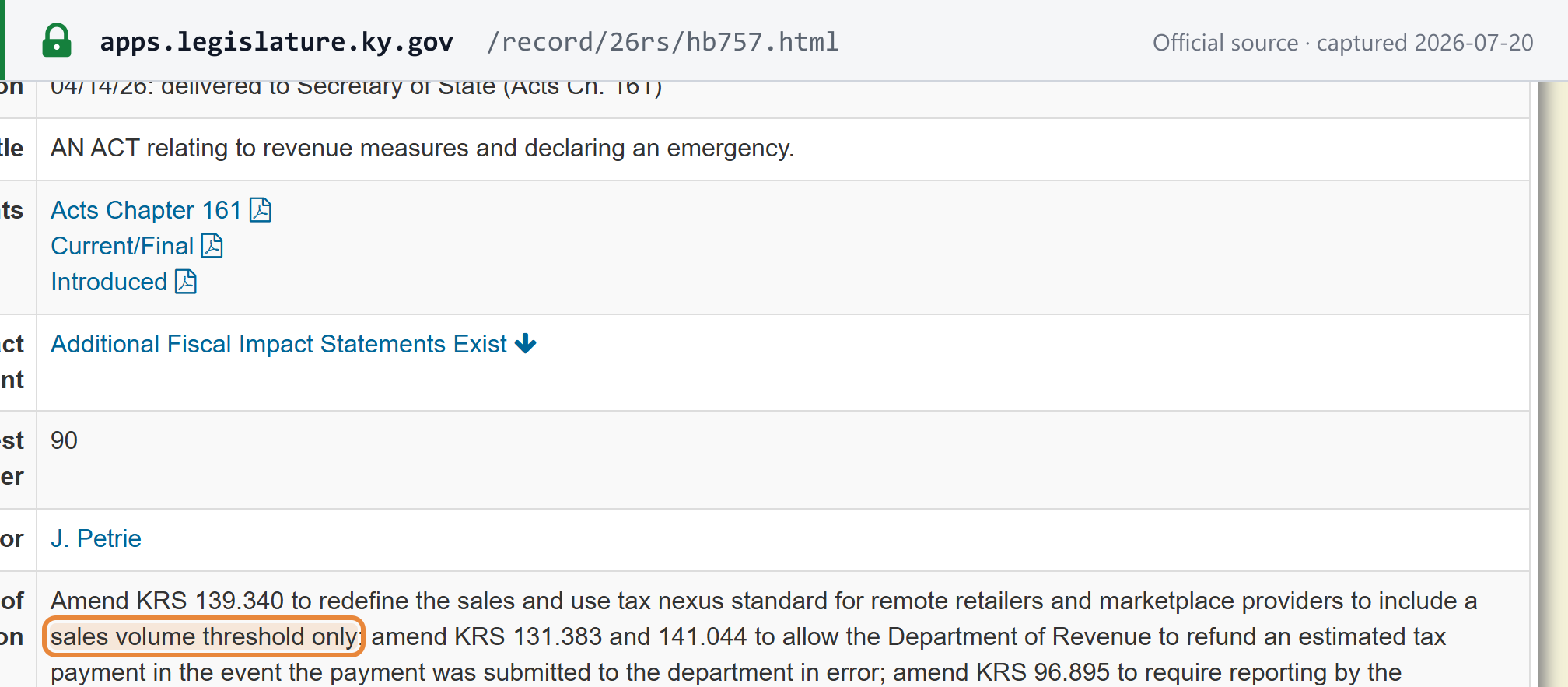 Source snapshot captured 2026-07-20 — original
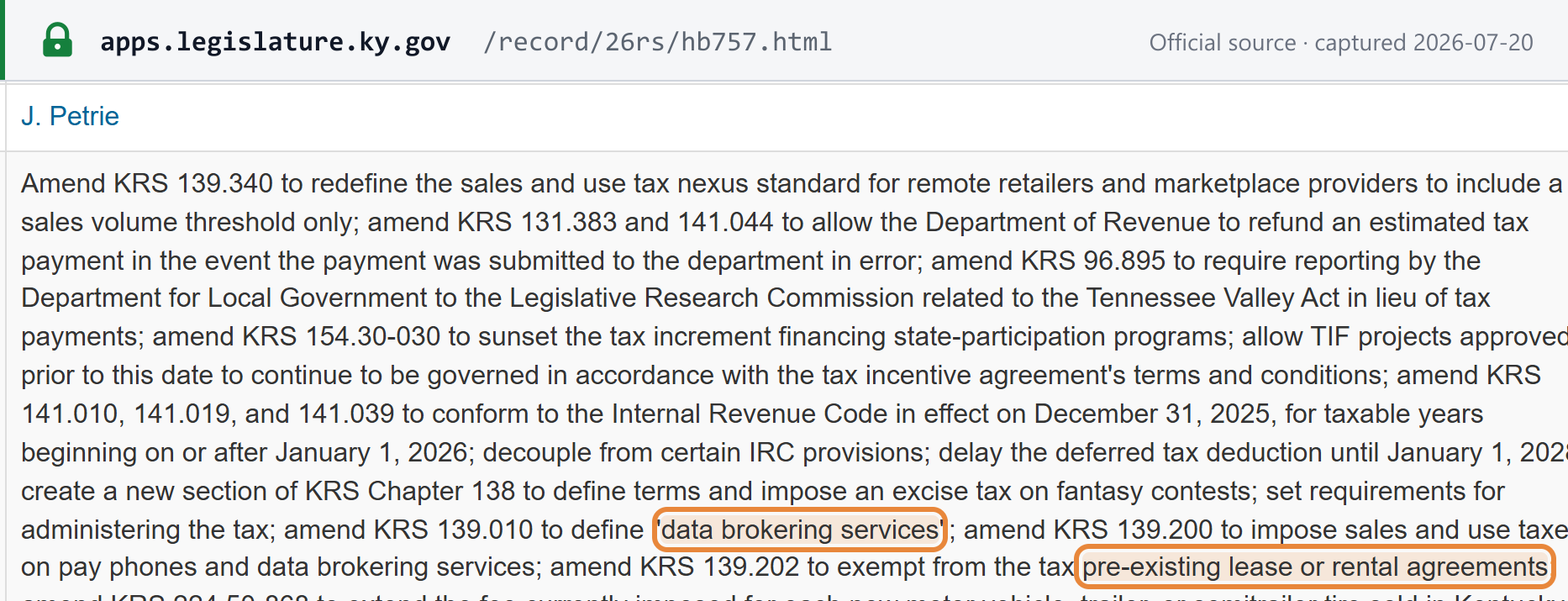
- 2026-08-01 — Kentucky defines "data brokering services" and subjects them to its 6% sales and use tax, exempting state/local government agencies and pre-existing lease/rental agreements (House Bill 757, enacted over the Governor's veto on 14 April 2026 as Acts Chapter 161, amending KRS 139.010, 139.200, 139.202 and 139.470). (Kentucky Legislature) — see issue
 Source snapshot captured 2026-07-20 — original
- 2026-08-01 — Illinois opens a Remote Retailer Tax Amnesty: remote retailers can apply 1 August–31 October 2026 to settle Retailers' Occupation Tax for 1 Jan 2021–30 Jun 2026 with penalties and interest waived, using simplified flat rates of 9% (general merchandise) and 1.75% (qualifying food and drugs). (Illinois DOR) — see issue
- 2026-07-07 — North Carolina: Session Law 2026-41 repealed the sales and use tax exemptions for electricity used at certified datacenters, applying to billing periods starting on or after 6 August 2026; Session Law 2026-42 requires purchasers to report tax paid quarterly, first report due 30 October 2026. (North Carolina Department of Revenue) — see event
- 2026-07-01 — Utah extends sales and use tax to access to streaming digital content (digital audio-visual works, digital audio works, digital books and gaming services) and to prewritten computer software in all delivery forms, including seller-hosted software accessed over the internet (SaaS), under S.B. 162. (Utah State Legislature) — see issue
Ahead — scheduled changes that have not yet taken effect:
- 2026-11-01 (scheduled) — Tennessee: the local sales tax rate on food and food ingredients in Davidson County, including all cities within it, is reduced to 1.75% (other goods and services stay at 2.25% local; the 4% state food rate is unchanged), reported on a new return line from the November 2026 return (due 20 December). (Tennessee Department of Revenue) — see event
- 2026-11-01 (scheduled) — Illinois: Bourbonnais will impose a 1% local Automobile Renting Occupation and Use Tax, for a combined 6.00% (State 5.00% plus 1.00% local) on qualifying motor vehicle rentals. (Illinois Department of Revenue) — see event
- 2027-01-01 (scheduled; enforcement stayed) — Tennessee: Public Chapter 1035 (2026) imposes sales tax (USD 10 per transaction plus 2% of the amount over USD 500) on money transmission from Tennessee to locations outside the United States or its territories; under an agreed order of the Davidson County Chancery Court the Department will not enforce the law until a final judicial determination, followed by a 45-day grace period if upheld. (Tennessee Department of Revenue) — see event
- 2027-01-01 (scheduled) — West Virginia: Danville, Farmington, Gilbert, Kenova, Keyser and Wellsburg each impose a 1% municipal sales and use tax, taking the combined rate there to 7%. (West Virginia State Tax Department) — see event
- 2027-01-01 (scheduled) — Washington: an additional tax applies to peer-to-peer car sharing transactions equal to the selling price multiplied by the retail car rental tax rate in RCW 82.08.020(2)(a), 9.9% from 1 January 2027, where the vehicle owner obtained the shared vehicle for resale using a reseller permit or an approved exemption certificate (Engrossed Substitute Senate Bill 6113, section 9). (Washington State Legislature) — see event
- 2027-01-01 (scheduled) — Colorado: House Bill 26-1223 (signed 4 June 2026, Session Laws of Colorado 2026 Chapter 379) removes the prepackaged/tear-open-license/tangible-medium requirement from taxable "computer software" (C.R.S. 39-26-102(15)(c)), extending sales and use tax to SaaS, downloaded software and mobile apps delivered electronically, subject to a new negotiated-license or particular-user exemption (C.R.S. 39-26-713(3)). (Colorado General Assembly) — see the issue
- 2027-01-01 (scheduled) — California brings "digital products" — including prewritten computer software transferred electronically or accessed remotely — into the sales and use tax base, with a new Rev. & Tax. Code § 6016.2 definition of "accessed remotely" (S.B. 122, Chapter 23 of 2026, approved 29 June 2026). (California Legislative Counsel) — see issue
Reference links
- Colorado General Assembly — House Bill 26-1223, Final Act (Chapter 379, Session Laws of Colorado 2026)
- Ohio Department of Taxation — Sales and Use Tax Rate Change Bulletin, Warren County, effective October 1, 2026
- IRS — Get an Employer Identification Number (EIN)
- Streamlined Sales Tax — Remote seller FAQs and state guidance
- Streamlined Sales Tax — Marketplace facilitator state guidance
- U.S. GAO — Remote Sales Tax: Initial Observations on Effects of States' Expanded Authority (GAO-22-106016)
- Federal Reserve FedPayments Improvement — Electronic invoices
- DC Law Library — D.C. Code § 47-2202 (sales tax rates)
- DC Law Library — D.C. Act 26-416, Fiscal Year 2027 Budget Support Emergency Act of 2026 (Sales Tax Increase Delay)
- Texas Comptroller — Local Sales and Use Tax Rate Changes Effective October 1, 2026
- Washington DOR — Local sales tax change: City of Mattawa Transportation Benefit District
- Alabama DOR — Local Tax Rate Change Notices
- Arkansas DFA — Recent Changes for Local Taxes
- Utah State Legislature — S.B. 162 Online Sales Tax Amendments (enrolled)
- California Legislative Counsel — S.B. 122 Taxation: sales and use taxes: digital products
- Illinois DOR — Bulletin FY 2026-34: NITA Occupation and Use Tax Rate Change
- Ohio Department of Taxation — 2026 Sales Tax Holiday
- Illinois Department of Revenue — Informational Bulletin FY 2026-30: Back-to-School State Sales Tax Holiday
- Maryland Tax Court — Apple Inc. v. Comptroller, 23-DA-OO-0456 (14 August 2026)
- Maryland Tax Court — Peacock TV LLC v. Comptroller, 23-DA-OO-0654 (14 August 2026)
Frequently Asked Questions
Does the United States have a VAT or GST?
No. There is no federal VAT/GST. Indirect tax is the state and local sales and use tax: 45 states and the District of Columbia levy a statewide sales tax. [1] The five NOMAD states (New Hampshire, Oregon, Montana, Alaska, Delaware) levy no statewide sales tax, though about 110 Alaska municipalities levy local sales taxes of 1%–7%. [2]
Is an EIN the same as a US sales tax number?
No. The EIN is a nine-digit federal identifier issued free by the IRS for federal tax purposes (employees, partnerships, corporations, excise taxes). [1] Sales tax registration is separate and state-level: you need a sales tax permit from each state Department of Revenue where you have nexus.
What is economic nexus and when must a remote seller register?
Since South Dakota v. Wayfair (21 June 2018), states can require remote sellers to collect sales tax without physical presence. [1] Typical thresholds are USD 100,000 in sales and/or 200 transactions, but the measure and period vary by state — South Dakota removed its 200-transaction test effective 1 July 2023, leaving only the USD 100,000 gross-sales threshold, and Kentucky removed its 200-transaction alternative trigger effective 1 August 2026 (House Bill 757), also leaving a USD 100,000 sales-only threshold. [2] [3] Check each state in the Streamlined remote seller state guidance. [4]
Do marketplaces collect US sales tax for their sellers?
Generally yes. State marketplace facilitator laws require the marketplace operator to collect and remit tax on facilitated third-party sales once it exceeds the state threshold. Sellers may still need their own registration for direct sales, and facilitated sales can count toward the seller's own threshold in some states. [1]
Do US states tax SaaS, streaming and other digital products?
It varies by state, and the base is widening. Utah taxes access to digital audio-visual works, digital audio works, digital books and gaming services — including streaming and subscriptions, regardless of delivery method — and prewritten computer software in every delivery form, including seller-hosted software accessed over the internet (SaaS), from 1 July 2026 under S.B. 162; transactions already taxed under the Multi-Channel Video or Audio Service Tax Act are excluded. [1] California follows on 1 January 2027: S.B. 122 (Chapter 23 of 2026) adds "digital products" — prewritten software transferred on tangible media, transferred electronically or accessed remotely — to the sales and use tax base, with new Rev. & Tax. Code § 6016.2 defining remote access. [2] Colorado follows on the same date: House Bill 26-1223 removes the prepackaged/tangible-medium requirement from taxable "computer software" (C.R.S. 39-26-102(15)(c)), bringing SaaS, downloaded software and mobile apps into the base, subject to a new negotiated-license/particular-user exemption (C.R.S. 39-26-713(3)). [3] There is no national rule: map each product code state by state.
What is the sales tax rate in Washington, D.C.?
The District of Columbia is a single taxing jurisdiction with no local add-on. D.C. Code § 47-2202 sets the general sales and use tax rate at 6.0% before 1 October 2027 and 7.0% beginning on 1 October 2027. The increase had originally been enacted for 1 October 2026 by the Fiscal Year 2026 Budget Support Act of 2025 (D.C. Law 26-55, effective 6 December 2025), but the Sales Tax Increase Delay Emergency Amendment Act of 2026 (D.C. Act 26-416, effective 13 August 2026) pushed it back a year, so the rate stays at 6.0% on and after 1 October 2026. Separate, higher rates apply to certain categories listed in the same section. [1]
When is Illinois's back-to-school sales tax holiday in 2026, and what does it cover?
Illinois's back-to-school State sales tax holiday runs 7 August through 16 August 2026, under Public Act 104-0468. The State's portion of sales tax is reduced by 5 percentage points, from 6.25% to 1.25%, on qualifying clothing and footwear under USD 125 per item and on qualifying school supplies used by students in the course of study; school supplies are not subject to the USD 125 threshold. Local and other add-on taxes are not reduced. This is separate from the NITA rate change and the Remote Retailer Tax Amnesty covered elsewhere on this page. [1]
Is e-invoicing mandatory in the United States?
No. There is no e-invoicing mandate at federal or state level for B2B transactions. The Business Payments Coalition's Federal Reserve-supported E-invoice Exchange Market Pilot (2021, 73 organizations) led to the 2023 launch of the DBNAlliance, which oversees a voluntary four-corner e-invoice exchange framework. [1] [2]
To check a US Employer Identification Number (EIN), use our United States EIN validator.