Maryland's digital advertising tax is struck down on two independent grounds
This page records one dated change. For the rules in United States as they stand today, see the United States guide →
- Jurisdiction
- United States (Maryland)
- Tax
- Digital Advertising Gross Revenues Tax
- Change type
- Digital services
- Status
- In force
- Impact
- Watch
- Announced
- 14 August 2026
- Effective
- 14 August 2026
- Authority
- Maryland Tax Court
- Systems
- Tax engine, Reporting
- Verified
- Fetched from official source · high confidence
Businesses that have paid Maryland's Digital Advertising Gross Revenues Tax, and — indirectly — anyone exposed to the copycat digital advertising taxes proposed in other US states.
No action yet - the Maryland Tax Court has held the digital advertising tax unlawful and ordered refunds with interest, but the decisions are appealable to the Circuit Court and the 30-day window runs to 13 September 2026. Preserve refund claims.
Tax engineReporting
On 14 August 2026 the Maryland Tax Court issued three separate Memoranda and Orders on the same day, in three separate dockets - Apple Inc. v. Comptroller of Maryland (23-DA-OO-0456), Google LLC v. Comptroller (23-DA-OO-0649) and Peacock TV LLC v. Comptroller (23-DA-OO-0654) - holding Maryland's Digital Advertising Gross Revenues Tax (Md. Code Ann., Tax-Gen. ss 7.5-101 to 7.5-301) unlawful and reversing the Comptroller's refund denials, with refunds payable with interest. The court held the tax violates the federal Internet Tax Freedom Act s 1105(2)(A)(i) because digital advertising services are indistinguishable from non-digital advertising services Maryland does not tax; that it fails the Complete Auto tests of fair apportionment, non-discrimination and fair relation under the dormant Commerce Clause through its graduated global-revenue rate tiers; and that it violates the Due Process Clause. In Peacock the court additionally held the broadcast-entity and news-media-entity exemption content-based under the First Amendment and the words 'news' and 'primarily' unconstitutionally vague, while granting the Comptroller summary judgment on the foreign Commerce Clause count. The decisions are of an adjudicatory administrative agency and are appealable to the Circuit Court within 30 days.
What changed in detail
On 14 August 2026 the Maryland Tax Court issued three separate Memoranda and Orders on the same day, in three separate dockets - Apple Inc. v. Comptroller of Maryland (23-DA-OO-0456), Google LLC v. Comptroller (23-DA-OO-0649) and Peacock TV LLC v. Comptroller (23-DA-OO-0654) - holding Maryland’s Digital Advertising Gross Revenues Tax (Md. Code Ann., Tax-Gen. ss 7.5-101 to 7.5-301) unlawful and reversing the Comptroller’s refund denials, with refunds payable with interest. The court held the tax violates the federal Internet Tax Freedom Act s 1105(2)(A)(i) because digital advertising services are indistinguishable from non-digital advertising services Maryland does not tax; that it fails the Complete Auto tests of fair apportionment, non-discrimination and fair relation under the dormant Commerce Clause through its graduated global-revenue rate tiers; and that it violates the Due Process Clause. In Peacock the court additionally held the broadcast-entity and news-media-entity exemption content-based under the First Amendment and the words ‘news’ and ‘primarily’ unconstitutionally vague, while granting the Comptroller summary judgment on the foreign Commerce Clause count. The decisions are of an adjudicatory administrative agency and are appealable to the Circuit Court within 30 days.
What it means
Both grounds attack features any copy would share. The Internet Tax Freedom Act holding turns on digital advertising being similar to untaxed non-digital advertising; the Commerce Clause holding turns on the graduated global-revenue apportionment tiers. Neither is a Maryland drafting quirk. The decision is at Tax Court level and the Comptroller may appeal to the Circuit Court, so nothing is final — but refund claims should be preserved now rather than after an appellate ruling.
Proof
Accordingly, on this 14th day of August 2026, for the reasons discussed below, the Maryland Tax Court hereby GRANTS the Petitioner's motion on all counts, DENIES the Respondent's motion on all counts, and the Court REVERSES the Respondent's decision. The refund must be paid with interest, as applicable under Maryland law.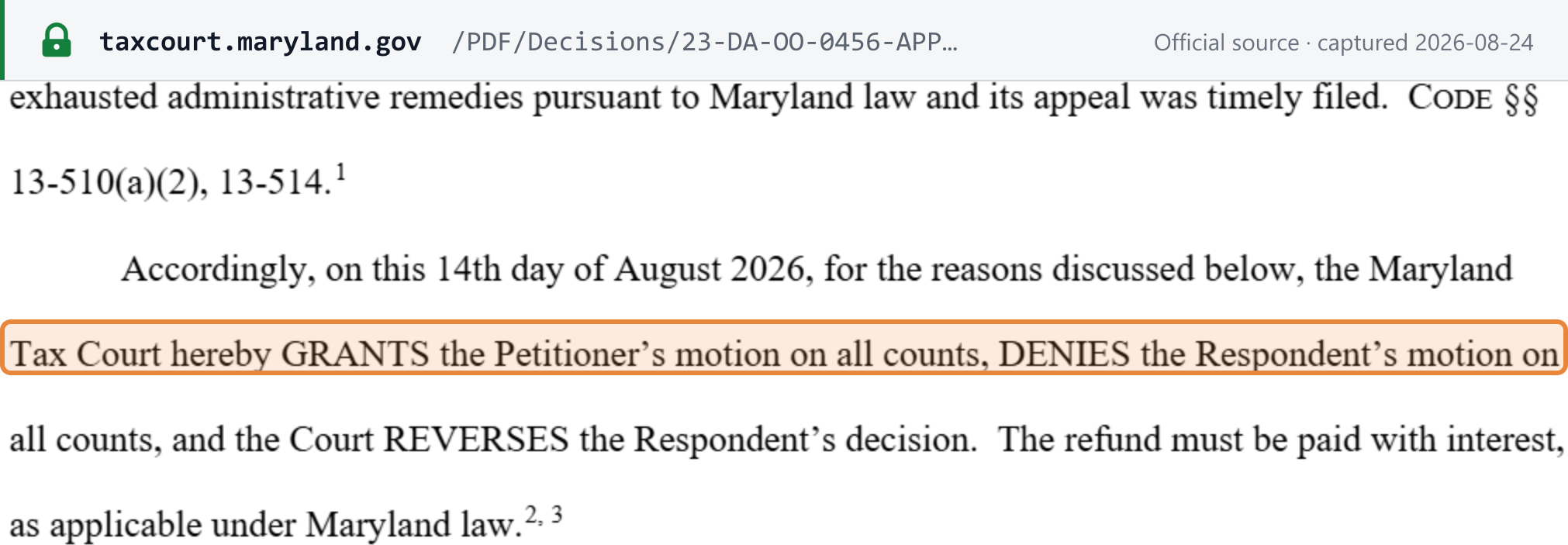 Source snapshot of the official page. Open full size ↗