How to verify GST Reg No in Singapore?
GST Reg number check on myTax Portal
GST Reg number search option is available for free on the Inland Revenue Authority Singapore myTax website. You can access the GST search here. You can search on the IRAS website by the Business Name, UEN, GST Reg No, or NRIC.
Example: 201812927R
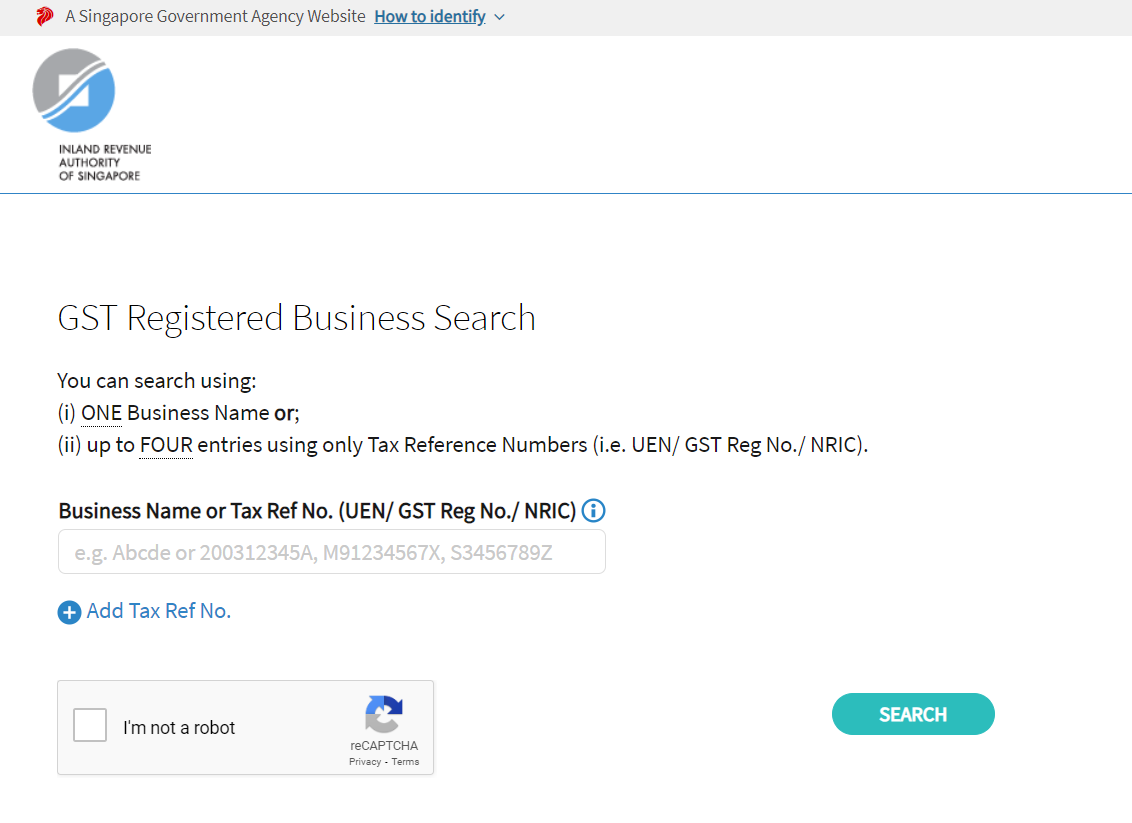 |
| GST search on iras website |
A successful verification of the GST on the myTax portal GST lookup tool will return the following details
- GST Reg No.
- UEN/NRIC
- Name
- Status
- Registered From
- Registered To
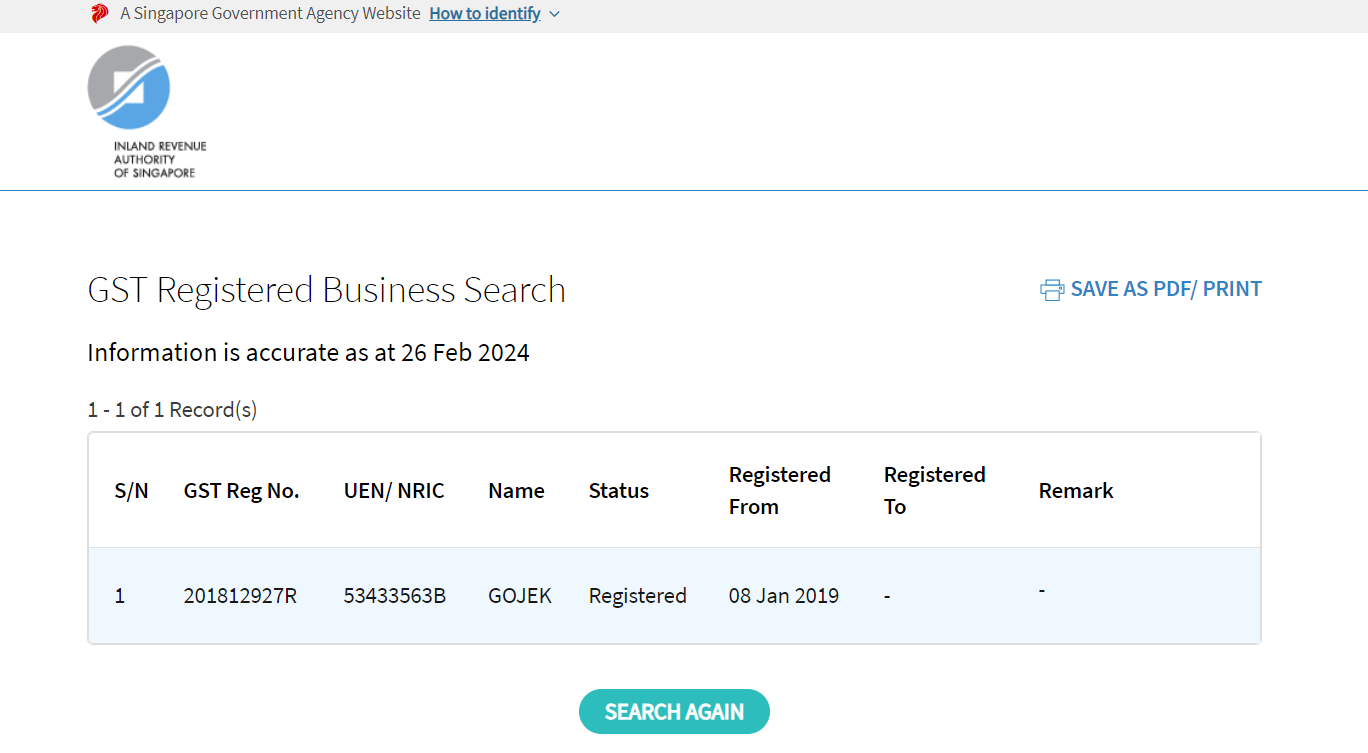 |
| Successful GST Verification |
For more details on Singapore tax identifiers, see our Singapore Tax ID Guide.
Frequently Asked Questions
What is the difference between a Singapore GST Registration Number and a UEN, and which should appear on a tax invoice?
The UEN (Unique Entity Number) is Singapore's general business identifier assigned to all registered entities by ACRA. The GST Registration Number is issued by IRAS specifically to GST-registered businesses. For most Singapore companies, the GST Reg No is the same as the UEN, but they are formally different — GST registration is a separate process from business incorporation. A Singapore tax invoice must display the GST Registration Number (not just the UEN). If a supplier only shows their UEN without a GST Reg No, verify on the IRAS portal whether they are actually GST-registered before claiming input tax credits. [1]
My supplier's GST status shows "Deregistered" — can I still claim input tax on their old invoices?
Yes, for invoices dated within the "Registered From" to "Registered To" range. You can only claim input tax credit on invoices issued while the supplier was actively registered. Invoices dated after the "Registered To" date should not include GST — if the supplier charged GST after deregistration, do not claim the credit. IRAS recommends checking supplier registration status at the time of purchase and retaining verification records. [1]
Singapore raised GST from 8% to 9% on 1 January 2024 — how do I handle transition-period invoices?
The GST rate increased from 7% to 8% on 1 January 2023, and from 8% to 9% on 1 January 2024. The correct rate depends on the time of supply: if payment or invoice was issued before the rate change (whichever is earlier), the old rate applies. If you receive a 2024 invoice still charging 8%, request a corrected invoice — incorrect rates affect your input tax claim accuracy. IRAS published detailed transitional rules for both rate changes. [1]
Does a foreign company selling digital services to Singapore customers need to register for Singapore GST?
Yes, since 1 January 2020. Overseas businesses supplying digital services B2C to Singapore with global turnover exceeding S$1 million and Singapore sales exceeding S$100,000 must register under the Overseas Vendor Registration (OVR) regime. Since 1 January 2023, the OVR regime was extended to non-digital B2C services and B2B imported services (under reverse charge). OVR-registered foreign businesses appear on the IRAS GST listing with a distinctive GST Reg No format. [1]
What is the Singapore GST Registration Number format, and can I validate it offline?
Singapore GST Reg Nos follow the UEN format: locally incorporated companies use 9 characters (year + 5-digit sequence + check letter, e.g. 201812927R); foreign OVR-registered entities use a different format (e.g. M90000001A). There is no publicly documented checksum algorithm for the check character. Offline format validation is limited to character count and pattern matching. The IRAS myTax portal is the authoritative source for confirming active GST registration. [1]
How Lookuptax can help you in GST Reg No validation?
Lookuptax GST Reg No validation revolutionizes GST Reg No number validation with its robust platform, empowering businesses to seamlessly verify GST Reg No numbers across over 100 countries. Our cutting-edge technology ensures accurate and efficient validation, reducing errors and enhancing compliance.