Greece Tax ID Guide — AFM and FPA (VAT) Numbers Explained
AFM — Arithmos Forologikou Mitroou (ΑΦΜ)
The Greek taxpayer identification number is called the AFM (Αριθμός Φορολογικού Μητρώου, romanised Arithmos Forologikou Mitroou), which translates as Tax Registry Number. Under Article 11 of the Greek Tax Procedures Code (Law 4174/2013), the Independent Authority for Public Revenue — known by its Greek acronym AADE (Ανεξάρτητη Αρχή Δημοσίων Εσόδων) — assigns a unique AFM to every taxpayer. AADE also issues an AFM to non-taxpayers whenever other legal provisions require one, including for financial transactions with government bodies, Greek banks, or payment institutions.
The AFM is required for virtually every formal transaction in Greece: opening a bank account, signing a lease, purchasing or registering a vehicle, hiring employees, issuing invoices, and submitting tax returns. Businesses operating in Greece must display the AFM on all commercial documents.
Format: 9 digits. Example: 999999999
The ninth digit is a check digit computed using a weighted mod-11 algorithm. Each of the first eight digits is multiplied by 2 raised to the power of its positional weight (positions 8 down to 1), the products are summed, the sum is taken modulo 11, and the result modulo 10 must equal the ninth digit. Because of this checksum, any transposed digit or single substitution will produce a detectable validation failure — ERP systems and accounting platforms that implement the algorithm will reject structurally invalid AFM values before they ever reach an AADE portal.
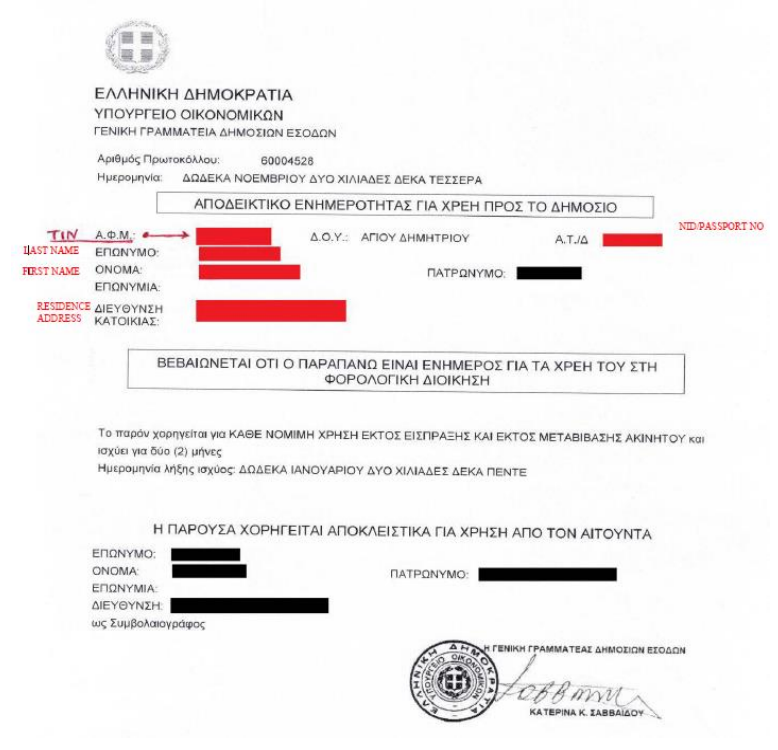 |
| TIN on Tax Completeness Status |
Where and how the AFM appears
An individual's AFM appears on the Tax Completeness Status certificate (Αποδεικτικό Ενημερότητας) issued by AADE, on the E1 income tax return, and on the myAADE taxpayer portal at myaade.gov.gr. Businesses can look up their own AFM status and their tax clearance certificate through myAADE. Third parties can verify the validity of another party's AFM through the AADE public verification service.
Getting an AFM as a non-resident
Non-residents without a Greek address apply at the DOY Katoikon Exoterikou (Tax Office for Foreign Residents), Mesogeion 207, 115 25 Athens. In-person applicants typically receive the AFM the same day. Since 2024, remote applications by videoconference are available through the AADE myAADE Live service for eligible cases. All foreign public documents — including powers of attorney — must carry an apostille (Hague Convention) or Greek consular certification, plus a certified Greek translation.
FPA — Foros Prostithemenis Aksias (VAT Number)
The Greek VAT number is known as the FPA (Φόρος Προστιθέμενης Αξίας, Foros Prostithemenis Aksias), sometimes also transliterated as Arithmós Forologikou Mētrṓou in the context of VAT registration. It is the same underlying tax registry number as the AFM, but prefixed for EU VAT purposes.
Format: Country code EL + 9 digits. Example: EL999999999
The prefix is EL — derived from Ellada (Ελλάδα), the Greek name for Greece — not GR, which is Greece's ISO 3166-1 alpha-2 country code used for IBANs, passports, and postal codes. This distinction is one of the most common sources of validation failure in ERP integrations and is covered in detail in the FAQ below.
Greece's standard VAT rate is 24%, with a reduced rate of 13% on certain food, hotels, and utilities, and super-reduced rates of 6% (for example books and medicines) and 4%. A 30% reduction — to 17%, 9%, 4% and 3% — applies on Lesvos, Kos, Samos and Chios (under decision A.1150/2021) and, since 1 January 2026, also on the North Aegean, Samothraki and Dodecanese islands with up to 20,000 inhabitants; Crete, Rhodes and the Cyclades are not covered (AADE circular E.2113/2025). [E.2113] For rates, registration and filing rules, see the Greece VAT guide.
myDATA and e-invoicing
Greece operates the myDATA (My Digital Accounting and Tax Application) platform, which requires businesses to transmit accounting documents — including invoices, credit notes, and expense records — to AADE in near-real time. Mandatory B2B e-invoicing through AADE-certified providers or AADE's free timologio application applies to businesses whose gross revenue in their 2023 income-tax return exceeded EUR 1 million from 2 March 2026, and to all remaining businesses from 1 October 2026 (Joint Decisions A.1128/2025 and A.1044/2026). [A.1128] [A.1044] Non-compliance penalties are significant — see the FAQ for exact figures.
For EU-based sellers of digital services to Greek consumers, the EU VAT One Stop Shop (OSS) allows registration in one EU member state to cover all cross-border B2C digital sales, avoiding the need to register directly in Greece. The EU-wide OSS threshold is EUR 10,000 in total cross-border B2C digital sales; below that threshold, home-country VAT rules can apply.
Non-EU digital services suppliers have no threshold — the first B2C sale to a Greek consumer triggers a Greek VAT obligation, which can be met through the Non-Union OSS scheme.
Frequently Asked Questions
Why do ERP systems fail VIES validation for Greek VAT numbers when using the GR country code?
Greece uses the ISO 639-1 language code EL (from Ellada/Hellas) as its VAT prefix in VIES instead of the ISO 3166-1 country code GR used for all other purposes — IBANs, passports, and postal codes all use GR. Submitting a Greek VAT number prefixed with GR to VIES returns an INVALID_INPUT fault rather than a validation result. This silent failure has affected multiple ERP platforms, including a well-documented bug in Magento 2 fixed in release 2.3.1 (PR #20548), and it recurs in any system that auto-derives the VAT prefix from the ISO country code. SAP systems encounter a related conflict: Greek IBAN codes start with GR, while VIES VAT registration uses EL, causing BF00 025 errors in bank data. Any automated EU VAT validation workflow must explicitly map Greece (ISO: GR) to the VAT prefix EL before querying VIES. [1] [2]
Does a non-EU company need a fiscal representative to register for Greek VAT, and what liability does that representative take on?
Non-EU businesses carrying out taxable activities in Greece must appoint a Greek-resident fiscal representative before making any VATable transaction — there is no opt-out or grace period. The requirement is in art. 41(3)(δ) of the VAT Code (Law 5144/2024), and art. 40(1)(γ) makes the fiscal representative the person liable for the VAT on the foreign company's transactions. The appointment is made by filing a copy of the power of attorney, certified by a Greek consular authority or carrying an apostille under the Hague Convention, with the AADE office competent for the representative's own income tax. EU-established companies may appoint a representative but are not obliged to. Non-EU digital services sellers can instead use the Non-Union OSS scheme to register in any EU member state. [1] [2]
What are the penalties for not issuing e-invoices or not transmitting invoices to myDATA?
Under art. 57(6) of the Tax Procedure Code (Law 5104/2024), not issuing an invoice for a VATable transaction carries a fine equal to 50% of the VAT that the invoice would have shown, with a minimum per tax audit of EUR 250 for single-entry and EUR 500 for double-entry bookkeepers. For non-VATable transactions the fine is EUR 500 per audit (single-entry accounting) or EUR 1,000 (double-entry) under art. 57(5). AADE circular E.2004/2026 treats an in-scope invoice that is not issued through a certified provider or AADE's timologio application — for example one issued by hand or from an ERP — as not issued, so these fines apply. Failing to transmit invoice data to myDATA is a separate infringement under art. 58: 10% of the net value of each untransmitted document, capped at EUR 250 a day. A repeat infringement within five years of notification of the earlier penalty act doubles the original fine, and each further repeat quadruples it (arts. 67 and 3(ιβ)). For the first phase of large businesses, the transitional window in which other issuing methods could be used in parallel ended on 3 May 2026 (Joint Decision A.1044/2026). [1] [2] [3]
Which Greek tax office handles AFM registration for non-residents, and what documents are required?
Non-residents without a Greek address must register at the DOY Katoikon Exoterikou (Tax Office for Foreign Residents) at Mesogeion 207, 115 25 Athens. Applicants attending in person can receive the AFM the same day; those using a notarised power of attorney typically wait one to two weeks. Every foreign public document submitted — including the power of attorney itself — must carry an apostille under the Hague Convention (or Greek consular certification for non-party states) and a certified Greek translation. EU citizens residing in Greece may alternatively apply at any local DOY. Since 2024, remote applications via videoconference through the AADE myAADE Live service are also available for eligible cases. [1]
Can a digital nomad on the Greek Digital Nomad Visa keep their foreign tax residency, and when does an AFM become mandatory?
Holders of the Greek Digital Nomad Visa (Law 4825/2021) who remain in Greece fewer than 183 days in a calendar year keep their foreign tax residency and owe no Greek tax on foreign-sourced income. Once stays exceed 183 days, Greek tax residency is triggered and an AFM becomes mandatory — it is also required to open a Greek bank account, sign a lease, or qualify for the Article 5C incentive. Article 5C of the Income Tax Code (Law 4172/2013) offers qualifying new residents a 50% income tax reduction for up to seven years, provided they were not Greek tax residents in five of the six preceding years and take up employment or self-employment in Greece. The application deadline is 31 July of the relevant tax year, submitted to the Tax Office for Foreign Residents. [1] [2]
Related Resources
- Greece VAT guide — rates, registration, invoicing, e-invoicing and filing
- Greece VAT number validator
- How to verify an EU VAT number in VIES
- Greece tax changes on Lookuptax
- EU VAT One Stop Shop (OSS) — complete guide
- VAT registration thresholds worldwide
- Global e-invoicing status tracker
- Worldwide directory of VAT and tax ID names
How Lookuptax can help you?
Lookuptax VAT validation revolutionizes VAT number validation with its robust platform, empowering businesses to seamlessly verify VAT numbers across over 100 countries. Our cutting-edge technology ensures accurate and efficient validation, reducing errors and enhancing compliance.