Italy Tax ID guide — Codice Fiscale & Partita IVA
Codice Fiscale
The Tax Identification Number (TIN) in Italy is called Codice Fiscale. It is a crucial identifier for individuals and entities in all dealings with the Italian Public Administration and is mandatory in specified transactions under Presidential Decree no. 605/1973.
Individuals who do not yet hold a Codice Fiscale must request one at any Agenzia delle Entrate office by submitting form AA4/8 with personal data and a valid domicile. Minors' requests are submitted by parents; infants typically receive their code from the municipality of birth. Non-EU citizens must present a valid passport and, where applicable, a visa or residence permit. Entities that are not VAT-registered must also request their code directly from an Agenzia delle Entrate office.
A valid Codice Fiscale is stored in the Registro Anagrafico Tributario (Italian Tax Register) managed by the Agenzia delle Entrate. Only codes issued by that agency are accepted — no other body is authorised to create TIN-related software or print official tax cards.
Format
The Codice Fiscale consists of 16 alphanumeric characters following the pattern LLLLLL99L99L999L:
| Position | Characters | Encodes |
|---|---|---|
| 1–3 | Letters | First consonants of surname |
| 4–6 | Letters | First consonants of given name |
| 7–8 | Digits | Year of birth (last two digits) |
| 9 | Letter | Month of birth (A–T, excluding certain letters) |
| 10–11 | Digits | Day of birth; women add 40 to distinguish sex |
| 12–15 | Letter + 3 digits | Italian municipality or foreign state of birth (Belfiore code) |
| 16 | Letter | Check character (Luhn-style mod-26 algorithm) |
Example: RSSMRA85T10A562S — a male named Mario Rossi, born 10 December 1985 in Milan.
Official Database — Codice Fiscale Search
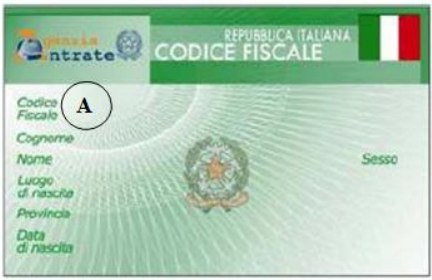 | 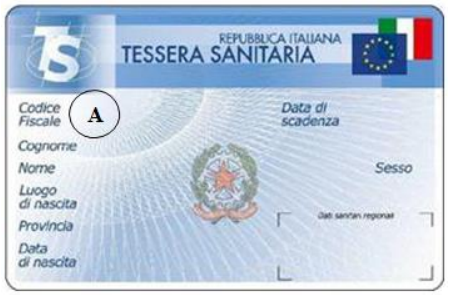 |
| Codice fiscale on TIN card | Codice fiscale on Health card |
Partita IVA (VAT)
The VAT number in Italy is called Partita IVA. Under Presidential Decree no. 633/1972, any individual or entity commencing a business activity or establishing a permanent presence in Italy must file a declaration with the local Agenzia delle Entrate office — or a provincial VAT office — within 30 days of starting operations. The declaration includes personal or legal details, the nature and purpose of the activity, and locations where it is conducted.
Non-residents wishing to fulfil Italian VAT obligations directly may do so under Article 35-ter of DPR 633/1972, which governs direct identification for EU/EEA entities. Non-EU companies cannot use direct identification and must instead appoint an Italian fiscal representative.
Format
The Partita IVA consists of 11 digits, validated by a mod-11 check on the last digit. When used in EU cross-border transactions it carries the IT country prefix (e.g., IT12345678901):
| Position | Digits | Encodes |
|---|---|---|
| 1–7 | Seven digits | Serial number in the registry of the competent Province |
| 8–10 | Three digits | Identification code of the Province where the Revenue Office is located |
| 11 | One digit | Check digit (mod-11 algorithm) |
Official Database — Partita IVA Search
E-Invoicing via SDI
Since 1 January 2019, all B2B and B2C invoices between VAT-registered parties in Italy must be transmitted electronically through the Sistema di Interscambio (SDI), the government hub operated by the Agenzia delle Entrate. Paper invoices between domestic VAT-registered entities are no longer legally valid.
SDI invoices use the FatturaPA XML format. Each invoice must include the sender's Partita IVA in the IdFiscaleIVA field and must route to the recipient via a seven-character CodiceDestinatario or a certified email address (PEC). SDI performs automated formal and semantic validation before delivery. Rejected invoices are treated as never sent and must be reissued with a corrected SDI transmission number. See the SDI e-invoicing guide for complete technical requirements.
How Lookuptax can help you in VAT validation?
Lookuptax VAT validation revolutionizes VAT number validation with its robust platform, empowering businesses to seamlessly verify VAT numbers across over 100 countries. Our cutting-edge technology ensures accurate and efficient validation, reducing errors and enhancing compliance.
Frequently Asked Questions
Can a foreigner get a Codice Fiscale from an Italian consulate abroad?
As of July 2024, Italian consulates apply significantly stricter rules. Non-Italian nationals planning financial or administrative activity in Italy must submit their Codice Fiscale request through a delegated representative directly at any Agenzia delle Entrate office in Italy using form AA4/8. Consular issuance is reserved only for cases where the applicant genuinely cannot delegate someone in Italy and the code is required for an Italian government online procedure. Non-EU citizens must present a valid passport and, where applicable, a visa or residence permit. [1] [2]
What happens if my revenue exceeds €85,000 under the forfettario flat-rate regime?
The forfettario regime requires prior-year gross receipts to remain at or below €85,000 (raised from €65,000 by the 2023 Budget Law). Exceeding €85,000 but staying below €100,000 during the tax year keeps you in the regime for that year, but exclusion applies automatically from the following year and standard VAT rules take over. Exceeding €100,000 in a single year triggers immediate exit in that same tax year — VAT must be charged on all transactions from that point. A separate cap bars access if you received more than €35,000 in employment or pension income in the prior year (raised from €30,000 for 2026). [3] [4]
Why do SDI e-invoices get rejected, and what do error codes 00305 and 00312 mean?
Italy's Sistema di Interscambio performs automated formal checks before delivering a fattura elettronica. Error 00305 means the recipient's Partita IVA in the IdFiscaleIVA field is invalid or absent from the Tax Register — the most frequent cause is entering a 16-character Codice Fiscale in a field that requires an 11-digit VAT number. Error 00312 means the seven-character CodiceDestinatario is correct in format but has been deactivated. Both errors cause full invoice rejection, treating it as never sent; you must reissue a corrected version. XML schema violations and duplicate invoice numbers cause similar rejections. [5] [6]
Do non-EU companies making taxable supplies in Italy need a fiscal representative, and what is the joint liability risk?
Under Article 17(3) of Presidential Decree 633/1972, non-EU companies without a permanent establishment in Italy that make VAT-taxable supplies there must appoint an Italian-resident fiscal representative — direct identification via form ANR/3 is available only to EU/EEA businesses. The fiscal representative and the foreign company are jointly and severally liable for all Italian VAT, penalties, and interest. From April 2025, non-EU businesses seeking VIES registration must also lodge a financial guarantee of at least €50,000 (valid 36 months), in the form of cash, a bank guarantee, or an insurance surety bond. Failure to appoint a representative before making Italian supplies is a compliance violation subject to penalty. [7] [8]
When must a freelancer apply ritenuta d'acconto on invoices, and who is exempt?
Ritenuta d'acconto is a 20% advance income-tax withholding that business clients (sostituti d'imposta) must deduct from payments to self-employed professionals holding a Partita IVA under the ordinary tax regime, per Article 25 of Presidential Decree 600/1973. The client retains 20% and remits it to the tax authority; the freelancer recovers the withheld amount as a tax credit in their annual return. Two situations create no withholding obligation: if the freelancer operates under the forfettario regime (the invoice must cite "Operazione effettuata ai sensi dell'art. 1, commi 54–89, della L. 190/2014"); or if the client is a private individual without a Partita IVA, as private persons are not sostituti d'imposta. [9] [10]
Related Resources
- EU VAT number verification via VIES — verify an Italian Partita IVA against the EU VIES database; explains why a number active in Italy may not appear in VIES
- SDI e-invoicing guide for Italy — complete technical reference for the Sistema di Interscambio XML format, routing codes, and submission workflow
- France TIN number guide — comparable EU dual-identifier structure (NIF personal code + TVA intracommunautaire)
- Germany Tax ID guide — Steuer-IdNr personal TIN and Steuernummer comparison; useful for cross-border EU B2B transactions