Mauritius TIN number guide
Tax Account Number (TAN)
Individuals in Mauritius receive a Tax Account Number (TAN) from the Mauritius Revenue Authority (MRA) as part of their registration process in the MRA databases. This unique identifier is assigned to all individuals with a tax obligation in Mauritius
TAN Format
Individuals in Mauritius are assigned a Tax Account Number (TAN) comprising 8 numerals (format: 99999999), where the first digit is consistently 1, 5, 7, or 8. On the other hand, entities receive a TAN also composed of 8 numerals (format: 99999999), with the first digit exclusively being 2 or 3.
Business Registration Number (BRN)
Upon creation, Mauritian entities and individuals engaging in business activities are assigned a Business Registration Number (BRN) by the Central Business Registration Department, a governmental authority. The BRN serves various purposes, including taxation. Once entities and individuals obtain their BRN, the Mauritius Revenue Authority (MRA) allocates a Tax Account Number (TAN) to facilitate their tax-related processes.Entities and individuals carrying on a business are automatically issued an TAN once they obtain their BRN
Example : C15127871
List of VAT registered entities in mauritius can be found here
National Identification Number
National Identification Number consits of 14 digits
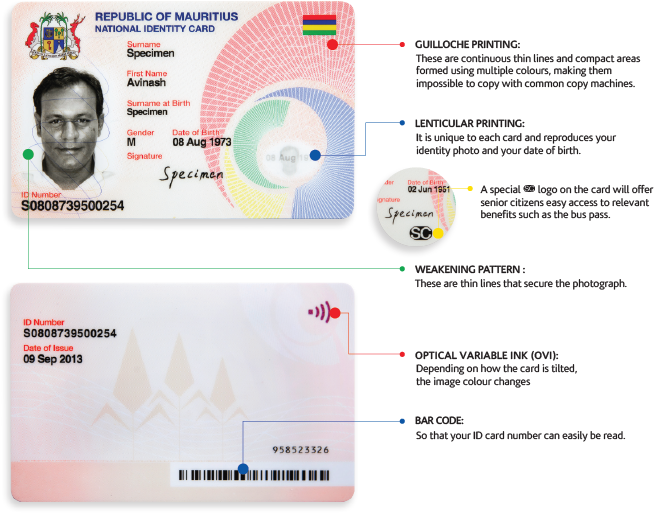 |
| National Identity Card |
How Lookuptax can help you in VAT validation?
Lookuptax VAT validation revolutionizes VAT number validation with its robust platform, empowering businesses to seamlessly verify VAT numbers across over 100 countries. Our cutting-edge technology ensures accurate and efficient validation, reducing errors and enhancing compliance.
Frequently Asked Questions
Can a foreign resident obtain a TAN without a Mauritian residency permit, and what is the sequence blocker?
Non-residents who have not yet obtained a Mauritian residency permit cannot independently apply for a TAN — the MRA issues TAN only to individuals who have formalised their tax presence in Mauritius, typically after obtaining a permit or registering a business. This creates a sequencing dependency: you need a BRN or residency permit first, then the MRA auto-assigns or grants a TAN. The online TAN request portal at MRA eServices accepts applications only once your identity is verifiable in the MRA database. Expats frequently report being turned away at the e-filing stage because their National Identity Number is not yet linked to a TAN in the system. [1] [2]
Do foreign digital service providers need to register for Mauritius VAT with no turnover threshold?
Yes — from 1 January 2026, all foreign suppliers of digital and electronic services to recipients in Mauritius must register for VAT with the MRA regardless of revenue, with no minimum turnover threshold for the registration obligation itself. The standard VAT rate is 15%. Once registered, if taxable supplies in Mauritius exceed or are likely to exceed MUR 3 million, the foreign supplier must additionally appoint a tax representative with a permanent establishment in Mauritius. VAT returns must be submitted monthly or quarterly within 20 days of the period end, and payment is accepted in foreign currency. B2B supplies to registered Mauritius businesses are zero-rated, but registration remains compulsory even for B2B-only sellers. [3] [4]
What withholding tax applies when a Mauritius company pays interest or royalties to a non-resident?
Interest paid by a Mauritius resident to a non-resident is subject to withholding tax at 15%, which constitutes the final tax — the non-resident has no further Mauritius tax return obligation on that income. Royalties are similarly subject to 15% withholding as a final tax, with one important exemption: royalties paid by a company to a non-resident out of the company's foreign-source income are fully exempt. Dividends paid to non-residents carry no withholding tax at all. There is no minimum threshold below which deduction can be skipped — even a single payment triggers the obligation. The payer must hold a valid TAN to remit the withholding to MRA and must file a return of tax deducted at source. [5] [6]
Does a Global Business Company still benefit from the 80% partial exemption after the India treaty changes, and what substance is required?
The 80% Partial Exemption Regime (PER) replaced the old deemed foreign tax credit in 2019 and remains in force: a GBC holding a valid FSC Global Business Licence can exempt 80% of qualifying foreign-source income — including foreign dividends, interest, and profit from overseas permanent establishments — leaving an effective Mauritius corporate tax rate of 3% on that income. To qualify, the GBC must carry out its core income-generating activities (CIGA) in Mauritius, employ a reasonable number of qualified persons (directly or through a management company), maintain its principal bank account in Mauritius, and hold at least two board meetings per year with Mauritius-resident directors present. The 2017 India-Mauritius DTAA protocol separately removed capital gains protection for Indian shares acquired on or after 1 April 2017; pre-2017 acquisitions were grandfathered but the 2026 Tiger Global Supreme Court ruling confirmed GAAR can override that protection where substance is absent. [7] [8]
What are the penalties for missing the Mauritius income tax e-filing deadline, and when is the deadline?
Individual taxpayers must submit their annual income tax return by 30 September (paper) or 15 October (e-filing via MRA's e-services portal). Missing the 15 October online deadline triggers a penalty of MUR 2,000 per month of default, capped at MUR 20,000. Late payment of any tax balance due attracts an additional 5% late-payment penalty on the outstanding amount, plus 0.5% monthly interest for as long as the balance remains unpaid. Companies file on a different cycle — corporate returns are due within six months of the accounting year end — and face separate penalties under the Income Tax Act. Employees whose income is fully covered by PAYE need not file unless they have additional income sources. [9] [10]