How to verify New Zealand Business Number(NZBN)?
NZBN verification on companies register website
The NZ Companies Register provides free NZBN verification. The register covers all registered companies, overseas companies operating in New Zealand, and — via the NZBN Register at nzbn.govt.nz — sole traders, partnerships, trusts, and charitable organisations.
- Access the Tool: Go to the NZ Companies Register.
- Enter Your Search: Search by company name, NZBN (e.g.,
9429048131575), or company number (e.g.,7959559). Use Advanced Search to search by director or shareholder name, or to filter by entity type (e.g., Overseas ASIC company for Australian firms operating in New Zealand). - Review Results: The register returns the company's status, incorporation date, entity type, directors, shareholders, and available documents including the Certificate of Incorporation and Annual Returns.
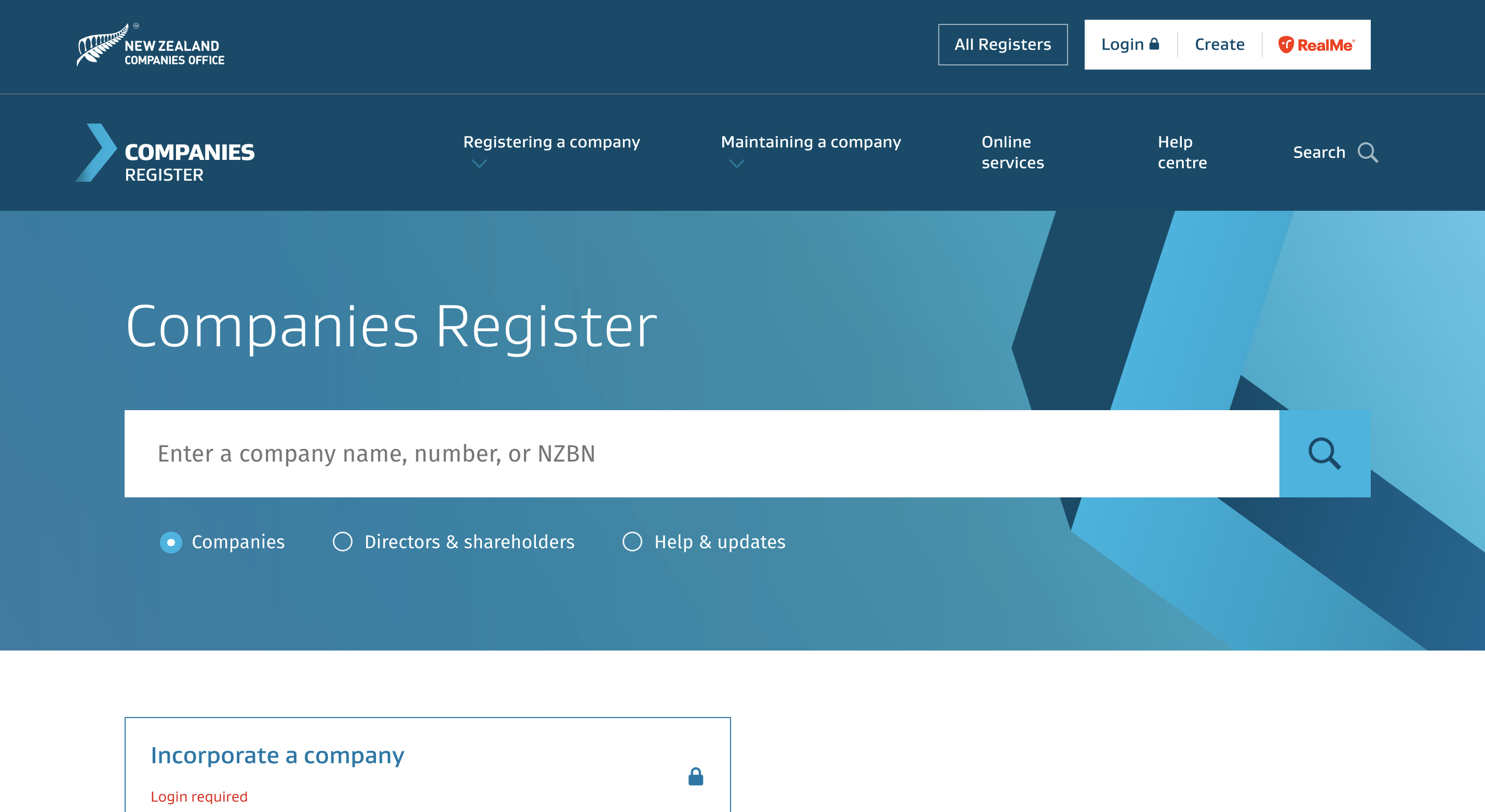 |
| NZBN lookup |
- Example NZBN: 9429048131575
- Example Company number: 7959559
The search returns the following details
- Company number:
- NZBN:
- Incorporation Date:
- Company Status:
- Entity type:
- Constitution filed:
- AR filing month:
- Ultimate holding company
- Company addresses:
- Registered Office
- Address for service
- View all addresses
- Directors
- Company record link
- Trading Name
- Phone Number
- Email Address
- Website
- Industry Classification
- Details of shareholding
- Documents such as Annual Returns
- It also provides option to download Certificate of Incorporation and the Company Extract
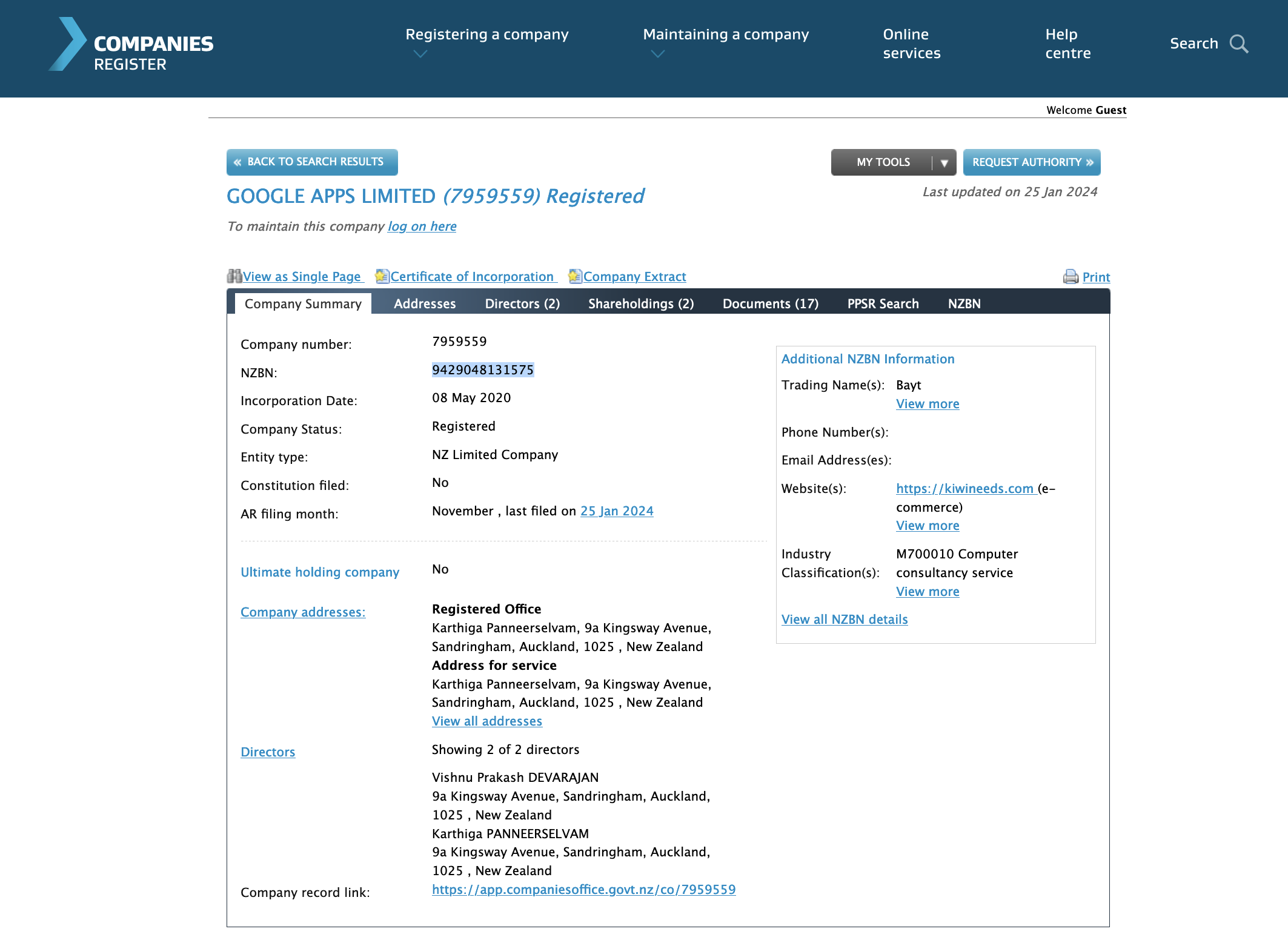 |
| NZBN verification status |
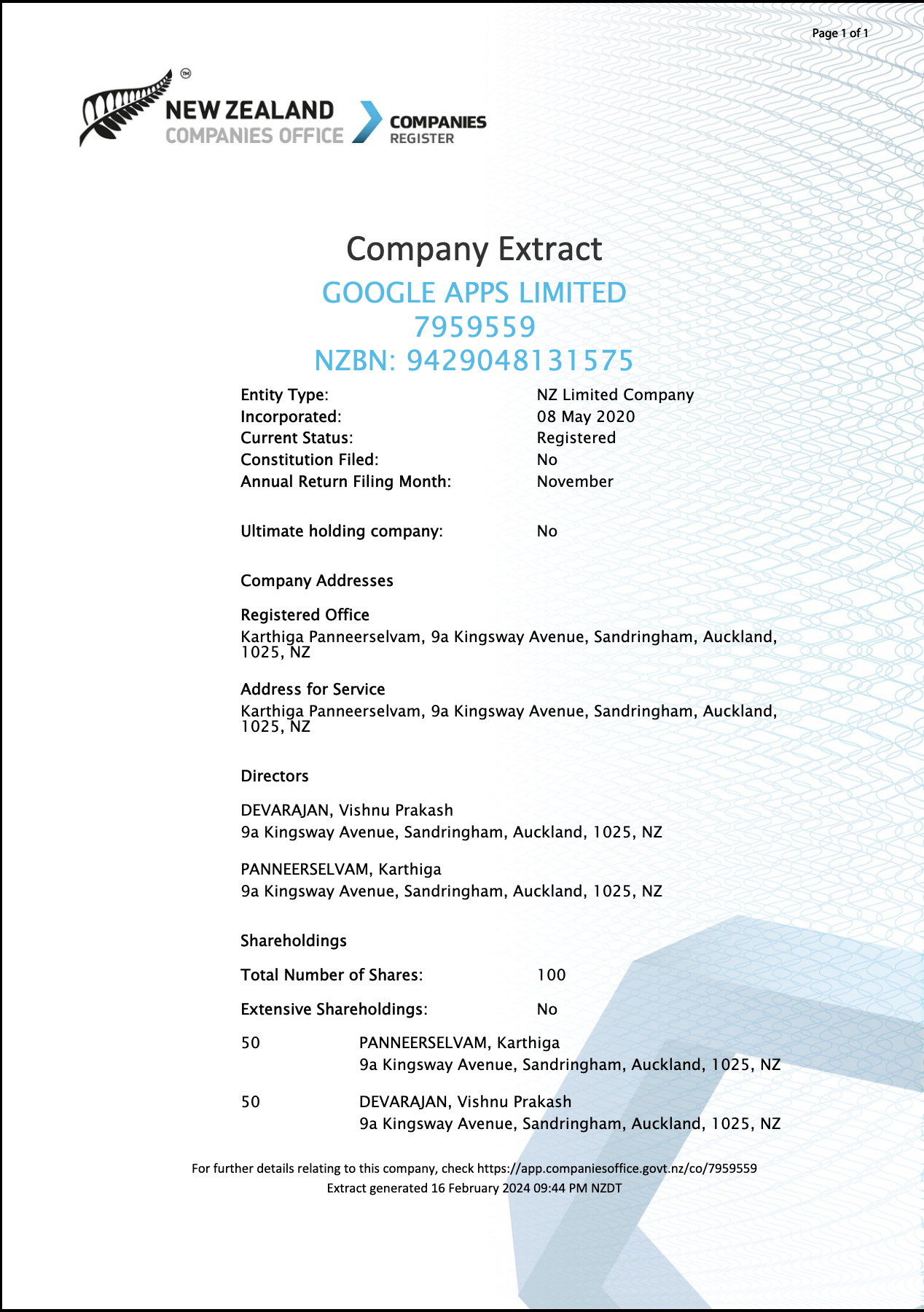 |
| NZBN details export |
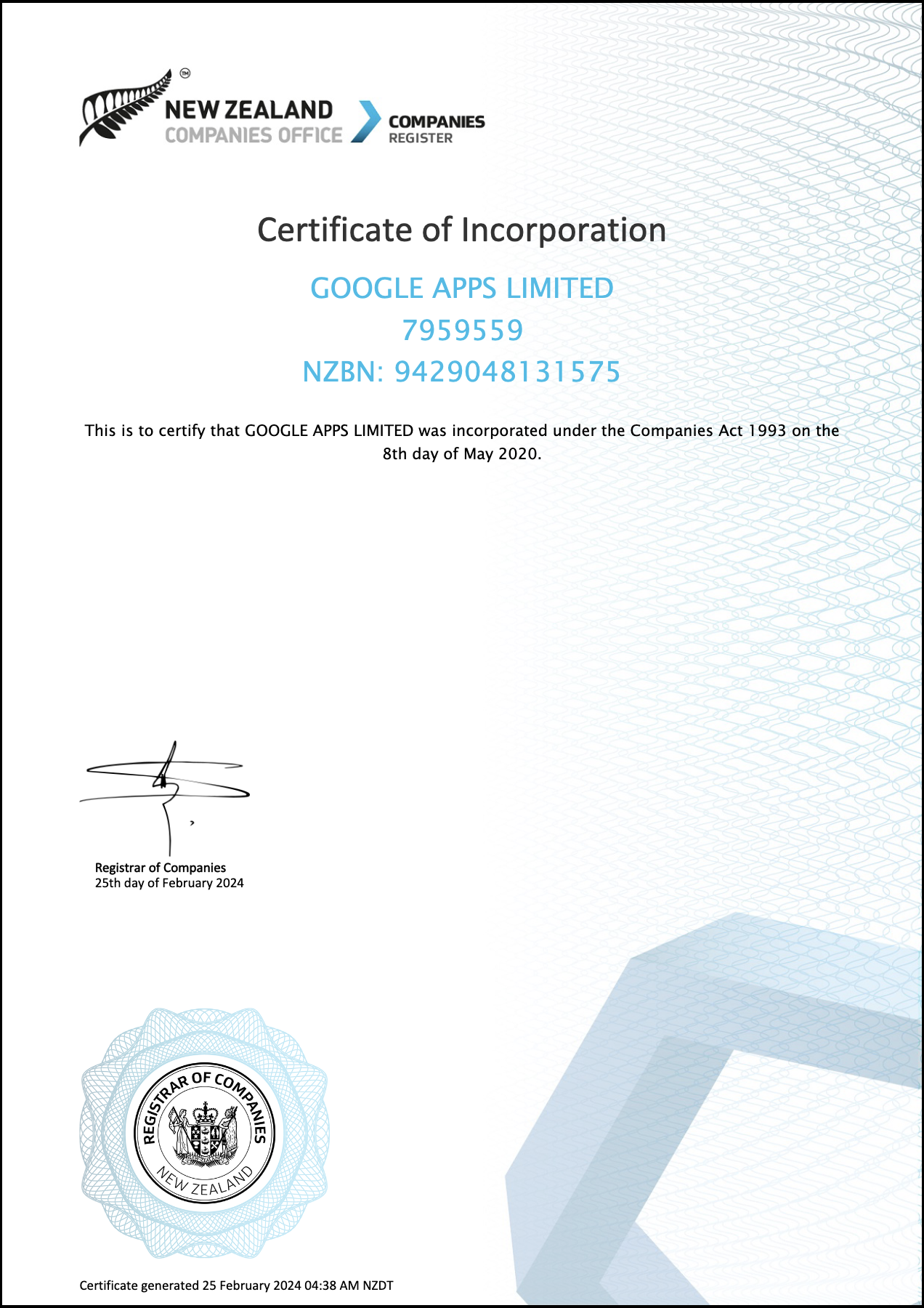 |
| Incorporation certificate |
For more details on New Zealand tax IDs, see our New Zealand Tax ID Guide.
Frequently Asked Questions
What is the difference between an NZBN, a company number, and an IRD number — and which should I ask a supplier for?
These are three distinct identifiers that serve different purposes. The company number is assigned at incorporation and applies only to limited liability companies — sole traders and partnerships do not have one. The NZBN is a 13-digit universal identifier available to any business entity (companies, sole traders, partnerships, trusts, and charities) and links to publicly visible trading details. [1] The IRD number is issued by Inland Revenue for tax purposes (income tax, GST, PAYE) and is not publicly searchable. [2] For supplier onboarding, request the NZBN — it lets you verify the entity exists, is active, and resolves to the correct trading name. Do not use the NZBN lookup as a substitute for GST verification (see below).
A sole trader gave me their NZBN but it returns "not found" on the Companies Register — is their number fake?
Not necessarily. Sole traders are not automatically assigned an NZBN — they must apply voluntarily through nzbn.govt.nz. [1] Critically, a sole trader's NZBN does not appear in the Companies Register at companies-register.companiesoffice.govt.nz because they are not incorporated entities. Search the NZBN Register directly at nzbn.govt.nz/mynzbn/search/ to find sole traders, partnerships, and trusts. Additionally, because NZBN registration is optional for sole traders, a legitimate sole trader may simply not have one at all — in that case, ask for their IRD number and a GST registration confirmation from myIR if they are GST-registered.
The Companies Register shows a supplier's status as "Removed" — is this different from "In Liquidation," and can I still pay their outstanding invoices?
Yes, these are legally distinct statuses. Removed (struck off) means the Registrar has deregistered the company under the Companies Act 1993 because it failed to file annual returns or breached compliance obligations. A removed company ceases to exist as a legal entity and cannot trade or issue new invoices, though it can be restored within 10 years. [1] In Liquidation means the company still legally exists but is under the control of an appointed liquidator — if you owe money, pay the liquidator directly; if you are owed money, file a creditor's claim with the Insolvency and Trustee Service at insolvency.govt.nz. [2] In Receivership means a secured creditor's receiver controls assets; existing contracts are not automatically terminated but may be voidable under their terms.
A supplier's NZBN lookup shows they are "Registered" — does that confirm they are GST-registered and I can claim GST on their invoices?
No — this is one of the most common verification mistakes. The Companies Register confirms corporate registration status only; it says nothing about GST registration with Inland Revenue. GST registration is a separate IRD process required once taxable turnover exceeds NZD 60,000 in a 12-month period. [1] There is no publicly searchable GST register — IRD treats GST registration status as private taxpayer information. Although companies can voluntarily add their GST number to their NZBN Primary Business Data, this is optional and many have not done so. [2] To verify GST status, ask the supplier for a tax invoice correctly showing their IRD number with 15% GST charged.
We are building an integration against the NZBN API — do we need authentication even for public lookups?
Yes. The NZBN API at api.business.govt.nz requires an active subscription for all callers, even read-only searches of publicly visible data. Two authentication models are available: a subscription key (static API key in the request header, sufficient for most read-only integrations) and OAuth2 bearer token (required when writing data or when the key could be exposed to end users). Register at the MBIE API Developer Portal, subscribe to the NZBN API product, and generate separate keys for sandbox and production environments — these are not interchangeable. [1]
How do I look up an Australian company operating in New Zealand — will its NZBN appear in the standard Companies Register search?
Australian companies carrying on business in New Zealand are registered on the Overseas Register, a separate section of the NZ Companies Register. They receive an NZ company number and an NZBN distinct from their Australian ABN or ACN. They will not appear in a standard search — use Advanced Search and select "Overseas ASIC company" from the Entity Type filter. Non-Australian overseas companies appear under "Overseas non-ASIC company." An overseas company must register within 10 working days of commencing business in New Zealand; if it has not registered, it has no NZ NZBN to look up. [1]
Does a charitable trust or incorporated society have an NZBN, and where do I verify their status?
Yes, but they are not on the Companies Register. Incorporated societies are listed at is-register.companiesoffice.govt.nz and charitable trust boards at ct-register.companiesoffice.govt.nz. [1] Both types of entity are automatically allocated an NZBN if registered with the Companies Office, so you can find them by NZBN at nzbn.govt.nz/mynzbn/search/ or via the unified search at app.businessregisters.govt.nz. [2] Note: the Incorporated Societies Act 2022 required societies to re-register by 5 April 2026 — societies that missed the deadline are now shown as "Dissolved/Removed" even if previously active.
Our overseas SaaS company sells software subscriptions to New Zealand customers — do we need to register with the Companies Office and get an NZBN?
No. A foreign digital services supplier does not need to register a local company, maintain a physical presence, or obtain an NZBN. The obligation that applies is GST registration with Inland Revenue once NZ-resident consumer (B2C) sales exceed NZD 60,000 in any 12-month period, at which point you must charge GST at 15% and file quarterly returns via the IRD's simplified non-resident registration process. You receive an IRD number and GST registration, not an NZBN. If your sales are exclusively to NZ GST-registered businesses for business use, you are exempt from this obligation regardless of revenue. [1]
How Lookuptax can help you in NZBN And VAT validation?
Lookuptax VAT validation revolutionizes VAT number validation with its robust platform, empowering businesses to seamlessly verify VAT numbers across over 100 countries. Our cutting-edge technology ensures accurate and efficient validation, reducing errors and enhancing compliance.